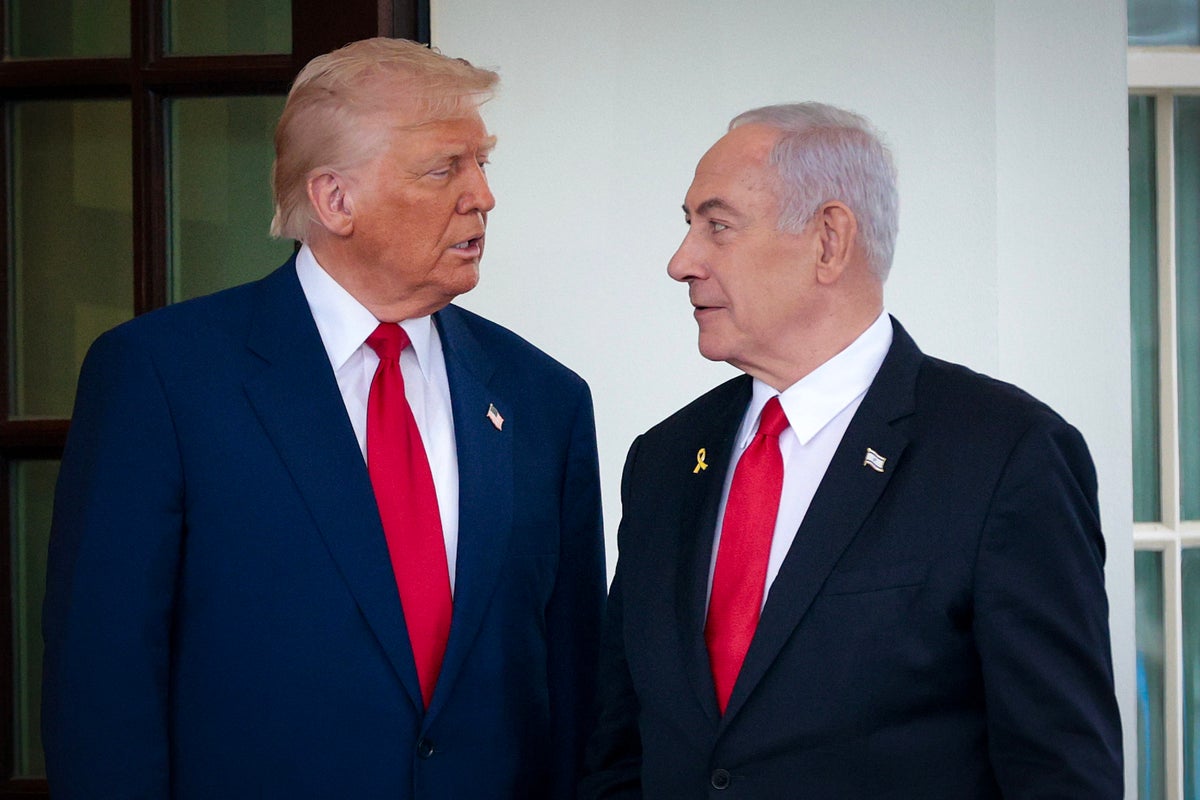
The perceived alignment between Donald Trump and Benjamin Netanyahu operates on a surface-level shared ideology that masks a fundamental friction in energy security and escalation management. While both leaders prioritize the neutralization of Iranian regional influence, their tactical definitions of "maximum pressure" have diverged into two competing doctrines: Stabilized Deprivation vs. Kinetic Disruption. This divergence became quantifiable following the strategic debate over targeting Iranian offshore gas infrastructure, specifically the South Pars field and associated maritime platforms.
The core of this friction rests on the global energy supply chain. A Netanyahu-led strike on Iranian gas fields aims to achieve internal systemic collapse by stripping the Iranian regime of domestic power generation and export revenue. Conversely, the Trump doctrine—premised on "America First" insulation—treats energy price volatility as a primary political risk. The logic of the gas field attack suggests that Israel is willing to internalize global market shocks to achieve a regional security reset, while a Trump administration views such shocks as a direct threat to the domestic U.S. consumer base.
The Architecture of Strategic Friction
To understand why these two allies are out of sync, one must map the Triple Constraint of Middle Eastern Escalation:
- Revenue Asymmetry: Iran’s economy is heavily weighted toward oil and gas exports. Striking these assets isn't just a military move; it is a forced sovereign default.
- Global Price Elasticity: Every barrel or cubic meter removed from the global market via kinetic action incurs a "conflict premium" that affects Western inflation rates.
- The Threshold of Proportionality: Israel views gas infrastructure as a legitimate military-economic target (a "Center of Gravity" in Clausewitzian terms). The U.S. strategic establishment, even under Trump, views it as a "Global Commons" violation that could trigger a retaliatory closure of the Strait of Hormuz.
The tension is most visible in the Cost-Benefit Ratio of the Gas Field Attack. For Netanyahu, the benefit is the immediate degradation of the IRGC’s funding mechanism. For Trump, the cost is a $20-per-barrel surge in Brent Crude that would erase the economic gains of his domestic deregulation policies.
The Infrastructure Vulnerability Matrix
The Iranian energy sector is not a monolith. It consists of high-density nodes that are difficult to defend but catastrophic to lose. The specific disagreement over the gas field attack highlights a gap in how both leaderships value these nodes.
- South Pars/North Dome: The world's largest gas field. It represents a single point of failure for Iranian domestic heating and industrial output.
- Assaluyeh Hub: The processing center for the majority of Iran’s natural gas. Destroying this would require years, not months, to repair.
- Kharg Island: The primary terminal for oil exports.
Israel’s strategy focuses on Kinetic Degradation. By destroying the physical means of production, they remove the regime’s ability to "buy" domestic stability. The Trump strategy, however, has historically favored Financial Interdiction. By using SWIFT bans and secondary sanctions, the U.S. attempts to achieve the same result without the physical destruction that leads to environmental disasters or immediate price spikes.
The "split" noted in recent diplomatic backchannels suggests that Israel no longer believes sanctions provide a sufficient "Time-to-Collapse" metric. If Netanyahu moves forward with a gas field strike, he is effectively betting that he can force a Trump administration to deal with the aftermath rather than prevent the event. This is a shift from "Coordinated Pressure" to "Fait Accompli Diplomacy."
Quantifying the Economic Fallout Function
A strike on Iranian gas fields triggers a predictable chain reaction that explains the U.S. hesitation. The function of this disruption can be viewed as:
$$E_r = (S_d \times P_v) + R_m$$
Where:
- $E_r$ = Escalation Risk
- $S_d$ = Supply Disruption (volume of gas/oil removed)
- $P_v$ = Price Volatility (market reaction)
- $R_m$ = Retaliatory Margin (Iran’s likelihood of striking Saudi or Emirati assets)
If Israel strikes, $S_d$ increases instantly. If Iran responds by targeting the Abqaiq plant in Saudi Arabia or tankers in the Gulf, $R_m$ skyrockets. For a Trump-led U.S., the goal is to keep $E_r$ low enough to protect the domestic economy while keeping the "Maximum Pressure" narrative high. For Netanyahu, $E_r$ is a secondary concern compared to the existential threat of a nuclear-capable or well-funded Iranian proxy network.
The Proxy Conflict Divergence
The misalignment extends to how both leaders view the "Ring of Fire"—Iran’s network of regional proxies like Hezbollah and the Houthis.
The Israeli Doctrine: Total Neutralization
Israel operates on a decimation strategy. The goal is to degrade the physical arsenal and leadership of these groups to a point where they cannot project power for a decade. This requires high-intensity, sustained military operations that often disregard short-term diplomatic friction.
The Trump Doctrine: Transactional Deterrence
Trump’s approach to proxies is rooted in "Deal-Making" via leverage. He prefers to hold the "patron" (Tehran) accountable for the "client’s" (Hezbollah/Houthis) actions. If a proxy attacks, the U.S. response is usually a targeted strike on high-value individuals or economic assets rather than a full-scale ground war or infrastructure demolition.
When Israel targets gas fields, it disrupts this transactional balance. It moves the conflict from a "negotiable" state of economic pain to an "irreversible" state of total war.
Structural Limitations of the Alliance
The assumption that Trump and Netanyahu are "in sync" ignores the institutional constraints on both sides.
- The U.S. Military-Industrial Baseline: The Pentagon remains wary of any action that necessitates a long-term U.S. naval presence to secure energy lanes. Trump, despite his rhetoric, has shown a consistent desire to reduce, not increase, Middle Eastern troop footprints.
- The Israeli Political Lifecycle: Netanyahu’s survival depends on a "Victory Narrative." A successful strike on Iranian energy infrastructure provides a tangible, visual win to a domestic audience, regardless of the long-term diplomatic cost in Washington.
- The Energy Transition Paradox: Even as a proponent of fossil fuels, a Trump administration must manage the transition of global markets. A sudden collapse of Iranian supply forces the U.S. to lean harder on OPEC+, giving more leverage to Russia and Saudi Arabia—entities that Trump wishes to influence, not be beholden to.
Mechanism of the "Split": Strategic Autonomy vs. Subsidized Security
The fundamental tension is the transition from Subsidized Security to Strategic Autonomy. For decades, Israel’s security was subsidized by U.S. diplomatic cover and military aid, requiring a high degree of operational synchronization. However, the gas field attack debate signals that Israel is pursuing Strategic Autonomy—the willingness to act against the expressed preferences of its primary benefactor when the perceived existential risk outweighs the alliance's benefits.
This creates a Deterrence Gap. If Iran perceives that the U.S. and Israel are not aligned on the "Red Lines" for infrastructure attacks, they may feel emboldened to escalate just below the threshold of U.S. intervention, specifically targeting Israeli maritime interests or offshore rigs like Karish.
The Realignment of the "Maximum Pressure" Framework
If the U.S. and Israel are to synchronize, they must reconcile their views on the Duration of Conflict.
- Trump’s View: Conflict is a tool to reach a better negotiating position.
- Netanyahu’s View: Conflict is a tool to eliminate the competitor’s capacity to negotiate.
This is not a minor disagreement; it is a fundamental shift in the definition of victory. The gas field attack is the "litmus test" for this relationship. If it occurs without U.S. backing, it marks the end of the era of coordinated Western strategy in the Middle East and the beginning of a fragmented, multi-polar regional security environment.
The path forward requires a move away from symbolic "Maximum Pressure" toward a Targeted Infrastructure Quarantine. Instead of kinetic destruction, a synchronized approach would focus on the total maritime interdiction of Iranian energy exports—essentially a blockade by another name. This achieves the revenue depletion Israel seeks while avoiding the immediate price shock and environmental devastation of a gas field explosion.
However, the current trajectory suggests that Netanyahu is prepared to trade his relationship with the White House for a decisive blow against Tehran’s economic heart. The strategic play for the U.S. is no longer trying to "sync" with Israel, but rather preparing the global energy markets for the inevitable shock of an unsynchronized Israeli strike.
Would you like me to map the specific retaliatory vectors Iran might deploy against Gulf State energy infrastructure in the event of an Israeli strike on South Pars?