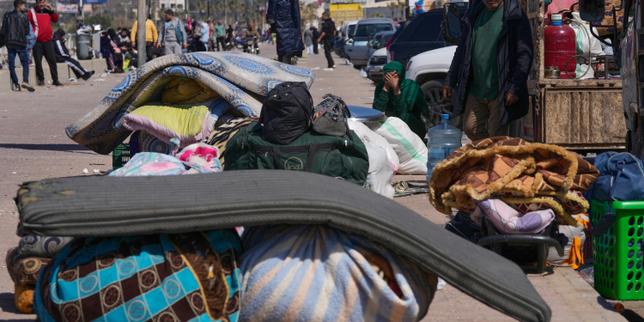
The displacement of 31,000 civilians in Lebanon following targeted strikes serves as a quantifiable metric of regional instability, yet the raw number obscures the underlying structural shifts in military posture and humanitarian logistics. To understand the current friction, one must analyze the situation through three distinct lenses: the Kinetic Barrier Effect, the Urban Density Stress Test, and the Escalation Dominance Framework.
The Kinetic Barrier Effect
Displacement is rarely a random byproduct of conflict; it is a direct function of the "Kinetic Barrier," a conceptual zone where the risk of remaining exceeds the physical and economic cost of flight. In the current context of Southern Lebanon, the United Nations' report of 31,000 displaced persons indicates that the Kinetic Barrier has shifted significantly northward.
- Risk Threshold Calculation: Civilians calculate the probability of "collateral intersection"—the likelihood of being present during a strike on a nearby military asset. As strike precision increases, paradoxical behavior emerges: some populations stay longer due to perceived "surgical" safety, while others flee earlier as the frequency of strikes suggests an impending ground shift.
- Infrastructure Chokepoints: The movement of 31,000 people creates immediate pressure on the Litani River crossings and the primary north-south arterial roads. This creates a secondary risk: the weaponization of congestion. When civilian evacuation routes overlap with military supply lines, the resulting "friction" serves as a strategic deterrent for both sides, complicating target acquisition for the aggressor and maneuverability for the defender.
The Urban Density Stress Test
The transition of 31,000 individuals from rural southern districts to urban hubs like Tyre, Saida, and Beirut is not a simple geographic relocation. It is an injection of massive demand into a failing economic ecosystem. Lebanon’s current state of "Permacrisis"—characterized by currency devaluation and fractured public services—means the absorption capacity of these "Safe Zones" is near zero.
The Breakdown of Absorption Capacity
- Utility Grid Volatility: The Lebanese power grid, already operating on a deficit, cannot sustain the concentrated load of internally displaced persons (IDPs) in collective shelters. This leads to a localized "darkness contagion," where the arrival of IDPs inadvertently degrades the living standards of the host population, heightening social friction.
- The Liquidity Gap: Most displaced individuals are fleeing agrarian or small-business economies in the south. Upon arrival in urban centers, their capital is non-transferable. This creates a sudden, massive reliance on the United Nations High Commissioner for Refugees (UNHCR) and the World Food Programme (WFP), converting a military event into a long-term fiscal liability for international donors.
Escalation Dominance and the Buffer Zone Hypothesis
The displacement of 31,000 people aligns with the military doctrine of "De Facto Buffer Creation." By creating a vacuum of civilian life, a combatant can simplify the rules of engagement (ROE). When a zone is emptied of non-combatants, any remaining signature is categorized as a legitimate military target.
This creates a Feedback Loop of Depopulation:
- Strikes induce initial flight.
- The area is declared a "military zone" due to the absence of civilians.
- The heightened ROE allows for more aggressive strikes.
- The remaining "holdouts" (often the elderly or the impoverished) are forced out by the total collapse of civil life.
The 31,000 figure is likely a trailing indicator. Displacement numbers reported by official bodies often lag behind the actual movement by 48 to 72 hours due to the time required for registration at municipal centers. Therefore, the actual operational reality likely involves a population movement 15–20% higher than the UN-verified data.
Structural Constraints of Humanitarian Response
The international response is currently bottlenecked by the "Access-Neutrality Dilemma." Organizations must coordinate with the Lebanese government while navigating the de facto control of southern territories by non-state actors.
- Supply Chain Fragility: Lebanon’s primary port and airport remain vulnerable to blockades or kinetic interference. If the displacement grows to the 100,000-person threshold, the current stockpile of emergency medical kits and grain will be exhausted within 14 days.
- The Winterization Variable: As the seasonal climate shifts, the "Cost of Shelter" scales exponentially. Tents and unheated public buildings, which might suffice in summer, require significant energy inputs in colder months. This shifts the humanitarian requirement from "Calories and Water" to "Fuel and Insulation"—a much more expensive and logistically difficult supply chain.
The Strategic Pivot
The current displacement represents a "Pressure Release Valve" for the tactical situation, but it builds catastrophic pressure on the Lebanese state's remaining foundations. The strategic play for regional actors is no longer just about the border coordinates; it is about the management of the human "Flow Rate."
If the rate of displacement exceeds the rate of humanitarian throughput, the resulting internal instability in Lebanon becomes a weapon of its own. The focus must shift from "Point-in-Time Statistics" (the 31,000 figure) to "Flow Dynamics." Monitoring the velocity of movement toward Beirut will provide a more accurate lead indicator of an impending full-scale regional realignment than any official communique.
International observers should monitor the "Return Rate" as the primary metric of success. Until the displaced population begins a net-positive movement back to the south, the "Buffer Zone" remains an active military reality, regardless of whether a formal declaration of war has been made. The objective for NGOs and state actors is to decouple the civilian movement from the military objective, a task that, currently, no framework is successfully achieving.