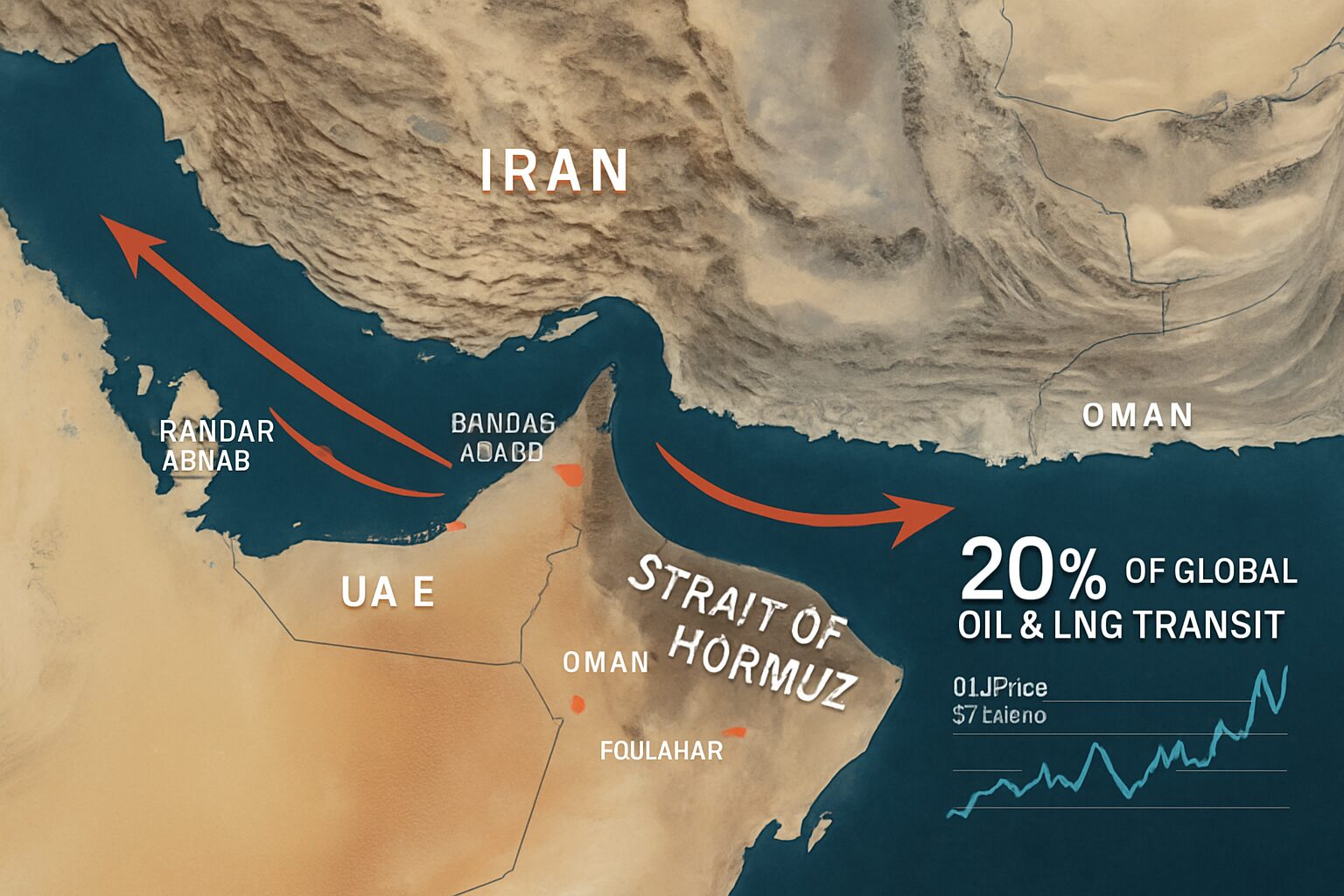
The Strait of Hormuz functions less as a conventional waterway and more as a global economic pressure valve, where the physics of maritime logistics meet the volatility of asymmetric warfare. When Iranian leadership issues warnings regarding the closure or restriction of the Strait, they are not merely making rhetorical threats; they are signaling a recalibration of their Escalation Dominance framework. This strategy relies on the disproportionate impact that a localized disruption has on the global energy supply chain, creating a "security tax" on every barrel of oil transiting the region.
Understanding the current friction between Tehran and the Trump administration requires moving past the headlines of "ultimatums" and into the mechanics of Anti-Access/Area Denial (A2/AD) capabilities. The threat to close the Strait is an exercise in sovereign signaling designed to offset conventional military inferiority through the credible threat of global economic contagion.
The Triple Constraint of Hormuz Logistics
The operational reality of the Strait is defined by three immutable factors that dictate the success or failure of any blockade attempt.
- Geographic Narrowness vs. Depth: The Strait consists of two 2-mile wide shipping lanes (inbound and outbound) separated by a 2-mile buffer zone. While the total width is roughly 21 miles at its narrowest, the navigable channels for Deep Draft Tankers (VLCCs) are restricted. This concentration of traffic creates a high-density target environment where even a single disabled vessel can create a systemic bottleneck.
- The Hydrocarbon Volumetric Risk: Approximately 20% of the world’s liquid petroleum and nearly 25% of global liquefied natural gas (LNG) pass through this corridor. Because global energy markets operate on "just-in-time" delivery models with limited spare capacity, a disruption of even 5% of this flow results in an exponential, rather than linear, price spike.
- The Asymmetric Cost Function: It is significantly cheaper to disrupt the Strait than it is to secure it. Iran utilizes a "Mosquito Fleet" strategy—high-speed, small craft armed with anti-ship missiles and sea mines. The cost of a $50,000 naval mine or a $150,000 drone compared to the $200 million cost of a single destroyer creates a negative ROI for any Western-led maritime protection force over a long-term engagement.
Mapping the Escalation Ladder
Iran's recent rhetoric regarding "opening the Strait to all except..." indicates a shift toward Discriminatory Interdiction. This is a more sophisticated tactical posture than a total blockade. In this scenario, Iran attempts to exercise "Customs and Border" style sovereignty over international waters, targeting vessels based on flag state or destination—specifically those linked to the United States or Israel.
The logical flaw in this strategy is the Indistinguishable Target Problem. Modern shipping is a web of flags of convenience, international crews, and global insurance syndicates. A ship might be Israeli-owned, Singapore-registered, Japanese-operated, and carrying oil for a Chinese refinery. Attempting to filter traffic by political affiliation risks alienating neutral powers, particularly China, which is the primary buyer of Iranian crude and a critical economic lifeline for Tehran.
The Trump Ultimatum and the "Maximum Pressure" 2.0 Feedback Loop
The re-entry of Donald Trump’s "ultimatum" style diplomacy introduces a variable of Strategic Unpredictability. If the U.S. executive branch signals that any disruption of the Strait will be met with a kinetic response against Iranian mainland energy infrastructure (such as the Kharg Island terminal), the deterrence math changes.
- The Sunk Cost of Sanctions: If Iran’s oil exports are already reduced to near-zero by aggressive sanction enforcement, the "opportunity cost" of closing the Strait vanishes. A cornered actor has more incentive to trigger a global crisis because they have less to lose domestically.
- The Buffer Paradox: To counter Iranian leverage, the U.S. and its allies rely on the East-West Pipeline (Saudi Arabia) and the Abu Dhabi Crude Oil Pipeline (UAE). However, these bypasses can only handle roughly 6.5 million barrels per day—less than 40% of the Strait's typical volume. The existence of these pipelines provides a psychological buffer but fails to solve the physical supply deficit of a full-scale closure.
Tactical Mechanics of a Blockade Scenario
An actualized Iranian attempt to restrict the Strait would likely follow a tiered operational sequence designed to maximize confusion while minimizing immediate direct confrontation with the U.S. Fifth Fleet.
Phase 1: The "Legalistic" Friction
Using environmental regulations or "maritime safety" as a pretext, the Islamic Revolutionary Guard Corps (IRGC) Navy begins boarding and inspecting vessels. This increases the Marine Insurance Premium (War Risk Surcharge) to a point where commercial shipping becomes economically unviable even without a single shot being fired.
Phase 2: Asymmetric Saturation
The deployment of bottom-dwelling "smart mines" that are difficult to detect with traditional sonar. Unlike floating mines, these can be programmed to ignore certain acoustic signatures and target others. The psychological impact of a single merchant vessel striking a mine is enough to halt 90% of traffic as ship owners refuse to enter the "High Risk Area."
Phase 3: The Missile-Sensor Loop
Utilization of coastal-based Silkworm or Noor anti-ship missiles integrated with shore-based radar. This forces U.S. Carrier Strike Groups to operate further out in the Gulf of Oman, stretching their defensive umbrellas and making the protection of slow-moving tankers statistically impossible.
The Economic Impact Formula
The global reaction to a Hormuz disruption is governed by the Price Elasticity of Oil. In the short term, the demand for oil is highly inelastic; consumers cannot immediately switch energy sources.
$$P_{new} = P_{old} \times \left( \frac{S_{old}}{S_{new}} \right)^\epsilon$$
Where $S$ represents supply and $\epsilon$ represents the coefficient of elasticity. Historically, a 10% decrease in global supply can lead to a 50% to 100% increase in price within days. This price shock acts as a regressive tax on global GDP, potentially triggering recessions in energy-dependent economies like the EU and India. This is the "Nuclear Option" of economic warfare that Iran holds.
Counter-Deterrence and the Limits of Maritime Power
The United States’ ability to keep the Strait open is restricted by the Geometry of the Persian Gulf. The Gulf is a "confined water" environment. Large surface combatants, such as aircraft carriers, are vulnerable to swarm attacks and land-based missile batteries because they lack the "sea room" to maneuver or disappear into the open ocean.
The U.S. response strategy, therefore, shifts from "Protection" to "Retaliation." If the U.S. cannot physically prevent every mine from being laid, it must ensure the cost of laying that mine is the destruction of the port it came from. This creates a Stalemate of Mutually Assured Economic Destruction. Iran destroys the global oil market; the U.S. destroys Iran’s capacity to ever rejoin it.
Strategic Recommendation for Market Participants
Market actors must look past the "closure" headlines and monitor the Brent-Dubai Spread and the VLCC Freight Rates. These are the true indicators of perceived risk. When the cost of insuring a hull exceeds the profit of the cargo, the Strait is effectively closed regardless of its physical status.
The immediate tactical play for energy-dependent entities is the aggressive buildup of Strategic Petroleum Reserves (SPR) and the securing of non-Gulf supply lines (West African or Brent crudes). Political rhetoric from Tehran will continue to cycle between "open for friends" and "closed for enemies," but the logistical reality remains: the Strait is a binary system. It is either safe for all, or functionally closed for everyone due to the collapse of the commercial insurance market.
The most probable outcome is not a total blockade, but a state of Permanent Gray-Zone Friction. Iran will likely use targeted harrassment to maintain a "risk premium" on global oil, using this as a bargaining chip to force the U.S. back to the negotiating table regarding sanctions. Until a viable, high-volume bypass infrastructure is completed—a project requiring decades and hundreds of billions in capital—the global economy remains tethered to the sovereign whims of the IRGC at the 21-mile wide neck of the Persian Gulf.
Establish a "Hormuz Risk Hedging" protocol that triggers at a 15% increase in regional maritime insurance rates, as this has historically preceded kinetic escalations by 14 to 21 days.