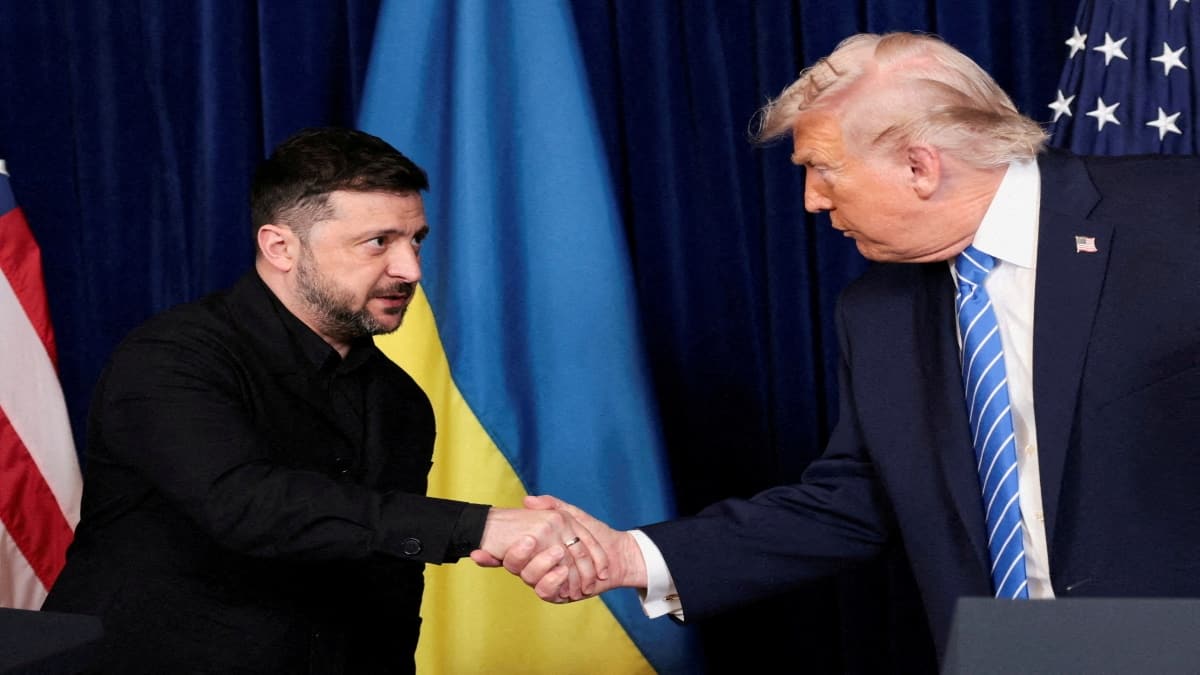
The announced bilateral talks between President Volodymyr Zelenskyy and United States officials—positioned as a precursor to broader trilateral discussions—signal a shift from general security assistance toward a structured, conditional framework for long-term endurance. This sequence reveals a deliberate prioritization of the Washington-Kyiv axis as the primary engine for European security architecture, effectively treating the subsequent trilateral engagement as a forum for ratification rather than negotiation. The strategic objective is to lock in commitment variables before broader multinational interests can dilute the specific requirements of the Ukrainian defense posture.
The Architecture of Anticipatory Diplomacy
Zelenskyy’s timing reflects a sophisticated understanding of diplomatic sequencing. By holding bilateral talks immediately before a trilateral summit, Ukraine creates a "anchoring effect." In negotiation theory, the first mover who establishes a concrete baseline often dictates the boundaries of the final agreement. If you liked this post, you should look at: this related article.
The bilateral track focuses on three non-negotiable vectors:
- Immediate Kinetic Sustainability: The procurement of specific munitions and high-altitude interceptors required to maintain the current attrition ratio.
- Institutionalized Security Guarantees: Moving beyond ad-hoc presidential drawdowns toward a codified, multi-year treaty or executive agreement that survives political cycles.
- Industrial Integration: The transition from a "donation-based" model to a "co-production" model, locating Western manufacturing facilities within Ukrainian territory to reduce logistics lag.
The trilateral session that follows acts as the implementation layer. By the time regional partners join the table, the core US-Ukraine parameters are likely already defined, forcing the third party into a role of logistical support or regional coordination rather than policy formation. For another perspective on this development, see the recent update from Al Jazeera.
The Cost Function of Defensive Attrition
A granular analysis of the conflict's current phase indicates that the "cost of inaction" is no longer a rhetorical device but a quantifiable metric. Ukraine’s defensive strategy relies on a specific ratio of expenditure versus asset protection.
- The Interception Ratio: For every cruise missile or loitering munition that reaches its target, the economic damage to Ukraine's energy infrastructure is estimated to be ten to fifteen times the cost of the interceptor.
- The Opportunity Cost of Delayed Authorizations: Each month of delay in approving long-range strike capabilities extends the conflict's duration by an unquantified but significant margin, as it allows the adversary to harden supply lines beyond the current 80km HIMARS threshold.
These talks are designed to solve the "Short-Term/Long-Term Paradox." Ukraine requires immediate hardware to survive the next quarter, but it also needs the long-term assurance that the Western defense industrial base (DIB) is scaling to meet 2026-2027 demand. The US talks will likely address the specific bottleneck of 155mm shell production and the prioritization of Patriot battery deliveries over other global customers.
The Three Pillars of the Washington-Kyiv Nexus
To understand the substance of these discussions, one must categorize the objectives into three distinct logical pillars.
Pillar I: Strategic Depth and Strike Sovereignty
The primary friction point in US-Ukraine relations has been the "geographic constraint" on Western-supplied weapons. Ukraine’s logic is built on the principle of Asymmetric Deterrence. If the adversary can launch strikes from a safe haven across the border, Ukraine’s defense is relegated to a permanent state of reactive interception. The bilateral talks aim to redefine the "Rules of Engagement" (ROE). This is not about escalation; it is about restoring the military balance by neutralizing the launch platforms before they can deploy their payloads.
Pillar II: Financial Liquidity and Economic Fortification
Security is impossible without a functioning internal economy. The talks must address the conversion of frozen Russian assets into a usable credit facility. The legal mechanisms for this are complex, involving sovereign immunity doctrines and international banking law. Ukraine’s position is that the risk of "de-dollarization" (a common concern in Washington) is secondary to the immediate collapse of the Ukrainian social contract if the budget deficit is not covered.
Pillar III: NATO Interoperability by Default
While formal NATO membership remains a distant political milestone, these talks focus on "Interoperability by Default." This means the total transition of the Ukrainian Armed Forces (AFU) to NATO standards in communications, command and control (C2), and logistics. By the time a formal invitation is extended, the AFU aims to be the most "NATO-ready" military in Europe, making the political decision a mere formality of an existing reality.
Logical Framework: The Trilateral Transition
The movement from bilateral (US-Ukraine) to trilateral talks represents a shift from Strategy to Scale. The US provides the high-end technology and strategic direction, but the trilateral partners (often European neighbors or the UK) provide the geographic depth and sustained logistical throughput.
The "Trilateral Logic" follows a strict cause-and-effect chain:
- Bilateral Agreement: US and Ukraine agree on the "Top Secret" requirements and strike authorizations.
- Trilateral Coordination: The third party is brought in to manage the "last-mile" delivery, training facilities, and regional maintenance hubs.
- Coalition Integration: The trilateral core sets the standard for the broader 50-nation contact group.
This structure prevents the "veto-by-committee" problem often found in larger international organizations. By consolidating the power in a smaller, bilateral-first approach, Zelenskyy ensures that the most critical decisions are made by the actors with the highest stakes and the largest capabilities.
The Mechanism of Risk Calibration
A significant portion of the Washington dialogue will center on "Risk Calibration." The US administration operates under a framework of "Controlled Escalation Management." This theory posits that providing too much power too quickly could trigger a non-linear response from the Kremlin.
Ukraine’s counter-argument is based on the Boiling Frog Fallacy. They argue that the gradual introduction of capabilities (Javelins, then HIMARS, then Tanks, then F-16s) has not prevented escalation but has instead given the adversary time to adapt their tactics and fortifications. The "Zelenskyy Strategy" for these talks is likely to push for a "front-loading" of capabilities, arguing that decisive military superiority is the only path to a stable diplomatic settlement.
Structural Bottlenecks in Modern Diplomacy
Despite the high-level optics, these talks face three systemic limitations:
- Legislative Lag: No matter what the executive branch promises, the funding is subject to the friction of the US Congress. This creates a "Credibility Gap" that Zelenskyy must navigate when planning long-term military operations.
- Industrial Throughput: Strategic intent cannot override the physical limitations of factory floors. The US DIB is currently operating at near-capacity for several critical components, creating a zero-sum game between Ukraine's needs and other global hotspots.
- Intelligence Divergence: There is often a delta between what Kyiv sees on the ground and what Washington perceives through overhead imagery and signals intelligence. Aligning these two "Operating Pictures" is a prerequisite for any new offensive planning.
The strategic play here is the deliberate isolation of the US-Ukraine relationship as the supreme arbiter of the conflict's trajectory. By finalizing the bilateral terms 24 hours before the trilateral meeting, Zelenskyy ensures that any subsequent negotiations are built upon a foundation of American-backed certainty. The success of this maneuver depends on Ukraine's ability to present a "Compelling Use Case" for advanced systems that outweighs the political risks of escalation.
The immediate tactical priority is the synchronization of the Ukrainian counter-battery fire with US real-time targeting data—a move that would effectively blind-side the current adversary offensive in the East. If these talks result in a signed memorandum of "Perpetual Readiness," it marks the transition of Ukraine from a security consumer to a permanent, hardened outpost of the Western defensive perimeter.