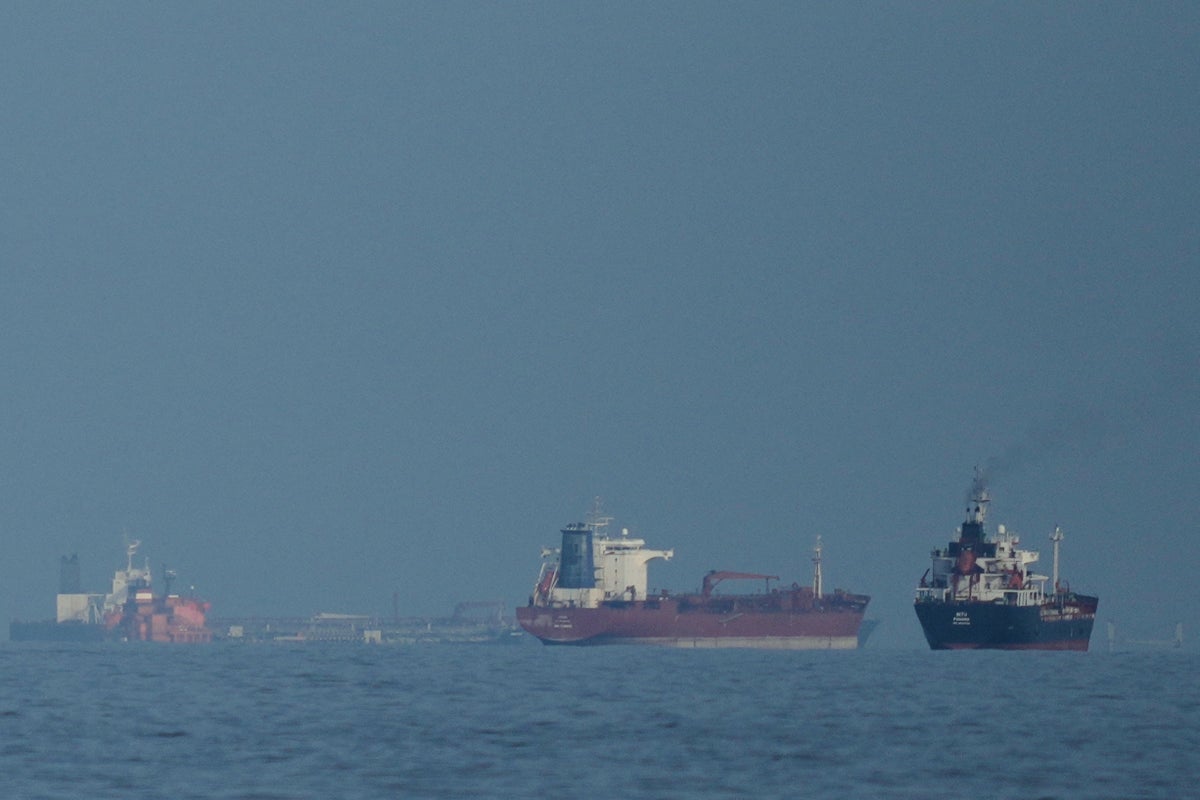
The report of a shipping firm paying $2 million for safe passage through the Strait of Hormuz represents more than a localized bribery incident; it signifies the formalization of a "shadow toll" system within one of the world's most critical maritime chokepoints. This transaction transforms a geopolitical risk into a quantifiable operational expense, altering the fundamental cost-benefit analysis for global logistics. When non-state actors or sanctioned entities extract direct payments to bypass kinetic threats, they establish a precedent that erodes international maritime law and creates a tiered security environment where safety is a purchasable commodity rather than a sovereign guarantee.
The Triad of Maritime Extortion Logic
The mechanism of this $2 million payment operates within a three-part framework: threat generation, verification of compliance, and the delivery of "safe" transit. To understand the strategy behind the payment, one must deconstruct the specific pressures acting upon the shipping firm’s decision-making matrix. For an alternative perspective, read: this related article.
- Asset Seizure Arbitrage: The value of a modern Suezmax or VLCC (Very Large Crude Carrier) ranges from $80 million to over $120 million, excluding the value of the cargo, which can easily exceed $100 million. A $2 million payment represents less than 1% of the total Value at Risk (VaR). From a purely cold-blooded actuarial perspective, the payment is a high-yield insurance premium against total asset loss.
- Temporal Decay of Value: Maritime logistics operates on razor-thin schedules. A ship detained in Bandar Abbas for "investigation" incurs daily demurrage costs, lost opportunity costs for the next charter, and compounding legal fees. If a detention lasts 30 days, the indirect costs can surpass the $2 million "toll" before a single legal motion is filed.
- Insurance Premium Cascading: Once a vessel is flagged as "high risk" or is involved in an incident, its War Risk Insurance premiums spike globally. By paying secretly to avoid a public incident, the firm attempts to keep its fleet-wide insurance profile stable, preventing a permanent shift in its OpEx (Operating Expenditure) baseline.
The Cost Function of Contested Waters
The Strait of Hormuz is roughly 21 miles wide at its narrowest point, with shipping lanes only two miles wide in each direction. This geographic constraint creates a physical bottleneck that simplifies the "target acquisition" for entities looking to exert pressure. The cost of transiting this space is no longer just a function of fuel ($P_f$) and labor ($L$). It now includes a variable for Geopolitical Friction ($G$).
We can express the total cost of transit ($C_t$) as:
$$C_t = (F_c + O_c) + (I_w \times V_r) + G$$ Similar insight regarding this has been provided by MarketWatch.
Where:
- $F_c$ is Fixed Costs (vessel depreciation, crew).
- $O_c$ is Operational Costs (fuel, port fees).
- $I_w$ is the War Risk Insurance multiplier.
- $V_r$ is the total Value at Risk (hull + cargo).
- $G$ is the "Shadow Toll" or extortion payment.
The shipping firm’s decision to pay $G$ is a calculated move to prevent $I_w$ from increasing across their entire fleet. If one ship is seized, the $I_w$ variable increases not just for that transit, but for every subsequent transit in the region for the foreseeable future. Thus, the $2 million is a sacrificial loss intended to protect the broader portfolio.
Institutional Decay and the Normalization of the "Toll"
When a private entity pays for passage, it creates a moral hazard that reverberates through the industry. This is not merely "doing business"; it is the subsidization of the very apparatus that creates the threat. This creates a feedback loop:
- Revenue Injection: The $2 million provides immediate liquid capital to the entity interdicting the ships, allowing for the upgrade of surveillance drones, fast attack craft, and intelligence networks.
- Target Selection Refinement: By paying, the firm signals its price elasticity. It informs the aggressor exactly what the "market rate" for a safe transit is, leading to price discovery in the extortion market.
- Erosion of Naval Deterrence: If private firms bypass official naval escorts or international protections (like IMSC - International Maritime Security Construct) in favor of private payoffs, the perceived authority of state-sponsored security diminishes.
The transaction indicates a failure of the United Nations Convention on the Law of the Sea (UNCLOS). Article 37 and 38 define "transit passage" as the exercise of the freedom of navigation solely for the purpose of continuous and expeditious transit. By demanding payment, the coastal state or its proxies are effectively reclassifying international straits as internal waters subject to discretionary taxation.
The Intelligence Gap in Maritime Security
The competitor article notes the payment but fails to address how such a transaction is even executed under heavy sanctions regimes. A $2 million transfer to an Iranian-linked entity is a massive violation of OFAC (Office of Foreign Assets Control) regulations in the U.S. and similar frameworks in the EU.
This implies the existence of a sophisticated financial "laundry" system, likely involving:
- Nested Shell Companies: Payments disguised as "consultancy fees" or "ship husbandry services" in third-party jurisdictions like Dubai or Singapore.
- Cryptocurrency Settlement: The use of stablecoins to move value outside the SWIFT system, reducing the digital paper trail that lead banks usually monitor.
- Commodity Barter: In some instances, "payments" are made through the transfer of fuel or supplies to smaller vessels, masking the transaction as an operational loss or "shrinkage."
The risk for the shipping firm is now dual-layered. They face the kinetic risk of the Strait and the regulatory risk of the "long arm" of Western finance. A firm that pays $2 million to avoid a seizure might eventually lose $200 million in frozen assets if the Department of Justice uncovers the payment trail.
Strategic Realignment: The Hard Pivot
For global trade participants, the $2 million "toll" at Hormuz is a signal to aggressively de-risk. The reliance on this specific chokepoint is a structural vulnerability that cannot be solved by individual payoffs.
The immediate strategic play for heavy-tonnage operators is a shift toward Bypass Infrastructure and Fleet Diversification.
- Pipeline Utilization: Maximizing throughput in the East-West Pipeline (Saudi Arabia) and the Habshan–Fujairah pipeline (UAE) to move crude to terminals outside the Persian Gulf. This reduces the number of VLCCs that must enter the Strait, effectively starving the extortion model of high-value targets.
- Contractual Force Majeure Rewriting: Shippers must now integrate specific "Geopolitical Toll" clauses into their contracts. These clauses should define who bears the cost of "unofficial" passage fees—the shipowner, the charterer, or the cargo owner. Without this clarity, the $2 million cost remains a toxic liability on the shipowner's balance sheet.
- Autonomous and Dark-Transit Protocols: Increasing the use of "dark" transits—turning off AIS (Automatic Identification System) in high-risk zones—despite the safety risks. While controversial, this reduces the "visibility" of the asset to shore-based radar and drone surveillance used by the entities demanding tolls.
The era of "freedom of navigation" as a free global utility is ending. It is being replaced by a privatized, high-friction model where security is an unbundled service. Shippers who continue to view the Strait as a standard transit route are miscalculating their exposure. The $2 million payment is not an anomaly; it is the opening price in a new, volatile market for maritime sovereignty.
Expand your internal audit to include "third-party facilitation" risks immediately. If your vessels are transiting the 26th parallel North, your compliance team must assume that any "local agency fee" exceeding standard market rates is a potential sanction-breaking payoff that could trigger a total enterprise shutdown.
.png?width=1200&auto=webp&trim=0%2C0%2C0%2C0)