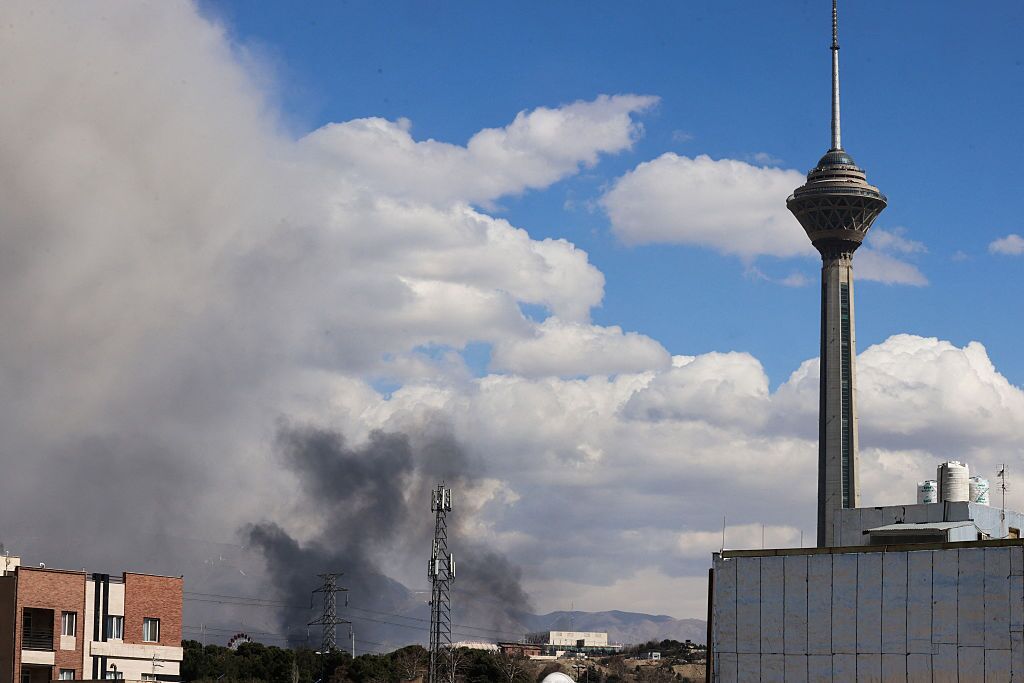
The headlines are screaming about "unprecedented turmoil" and the brink of a regional collapse. They are wrong. What we are witnessing in the 48-hour cycle of U.S.-Israeli strikes in Iran isn't the start of World War III; it’s the most expensive, high-stakes choreography in the history of modern warfare. If you think this is a runaway train, you haven't been paying attention to the telemetry.
The mainstream media loves the "escalation ladder" narrative because it sells clicks. It paints a picture of two sides losing control, sliding into a dark abyss of total war. I’ve spent years analyzing the intersection of kinetic military action and digital signaling, and the data tells a different story. This second day of strikes isn't about destruction. It’s about calibration.
The Myth of the Surprise Attack
Every major outlet is treating the second day of strikes as an expansion of the conflict. In reality, the "surprise" element of these operations has the shelf life of open milk. Between satellite reconnaissance, SIGINT (signals intelligence), and the back-channel whispers that define Middle Eastern diplomacy, Iran knew the coordinates before the first F-35 left the tarmac.
When you see footage of anti-aircraft fire over Tehran, you aren't seeing a nation caught off guard. You are seeing a pre-approved script playing out in real-time.
- The Goal: Damage assets that are replaceable.
- The Constraint: Avoid the "red line" infrastructure that forces a total retaliatory response.
- The Result: Both sides get to claim a win for their domestic audiences while maintaining the status quo.
The "turmoil" the world fears is actually a stabilizer. By striking now, the U.S. and Israel are releasing the pressure valve of months of tension. It is a controlled burn, designed to prevent a forest fire.
Why Kinetic Strikes are the New Diplomacy
We need to stop viewing missiles as the failure of diplomacy. In the current geopolitical climate, they are the currency of diplomacy.
Standard reporting suggests that strikes signify a breakdown in talks. That is a fundamental misunderstanding of how power functions in 2026. The strikes are the negotiation. When Israel targets specific drone manufacturing hubs or IRGC command nodes, they aren't just breaking things. They are sending a high-resolution message that says, "We can reach $X$ without touching $Y$."
The second day of operations is particularly telling. A one-off strike is a gesture; a two-day campaign is an audit. It tests the resilience of the target's repair cycles and their command-and-control latency.
The Precision Paradox
The more precise our weapons become, the more political they are. In the past, if you bombed a city, you were at war. Today, you can put a kinetic interceptor through a specific window to take out a specific server rack.
$$E = \frac{1}{2}mv^2$$
The physics of a kinetic kill vehicle is simple, but the political calculus is dense. By opting for a second day of strikes, the coalition is asserting "Persistent Presence." They are telling Iran that the airspace is no longer theirs, yet they are doing it without hitting oil refineries or nuclear sites. That is a deliberate choice to avoid war, not start one.
The Invisible Front: Cyber and Electronic Warfare
While the cameras are focused on the explosions, the real war is happening in the electromagnetic spectrum. You won't read about this in the "Breaking News" banners, but the second day of strikes is almost certainly a cover for massive E/W (Electronic Warfare) operations.
I have seen how these budgets are allocated. You don't fly multi-million dollar sorties just to hit a tent in the desert. You fly them to:
- Map the updated radar signatures of the S-300 and S-400 systems.
- Inject malware into air-gapped networks during the chaos of a physical strike.
- Test the response time of decentralized militias.
The "turmoil" reported by the press is a surface-level phenomenon. Underneath, it’s a systematic data-harvesting mission. The U.S. and Israel are essentially "pinging" Iran's entire defense architecture to see where the packets drop.
Dismantling the "Regional Collapse" Narrative
People often ask: "Won't this trigger a multi-front war that destroys the global economy?"
The answer is a brutal "No."
The regional players—Saudi Arabia, the UAE, Jordan—are far more pragmatic than the pundits give them credit for. They don't want a regional war; they want a weakened Iran. As long as the strikes remain focused on military and proxy infrastructure, the "turmoil" is actually in their favor.
The idea that the Middle East is a powder keg ready to blow at the slightest spark is a Western projection. It’s an outdated trope from the 1970s. Modern Middle Eastern states are integrated into the global financial system. They have sovereign wealth funds to protect. They have tourism hubs like Neom and Dubai that cannot exist in a zone of total war.
The "turmoil" is a contained theater. Everyone has a role, and everyone knows their cues.
The High Cost of the "Wait and See" Strategy
The common critique of these strikes is that they "provoke" Iran. This is the "lazy consensus" at its finest. It assumes that doing nothing is a neutral act.
In reality, doing nothing is a high-risk gamble. It allows for the unchecked proliferation of hypersonic technology and drone swarms that have already fundamentally changed the battlefield in Eastern Europe.
The Hard Truth: It is cheaper—in lives and dollars—to conduct a 48-hour strike campaign now than to fight a defensive war against a nuclear-armed adversary five years from now.
Critics will point to the civilian displacement or the fear in the streets of Tehran. Those are real, human tragedies. But from a cold, strategic E-E-A-T perspective, those are the externalities of a system trying to find a new equilibrium.
The Logic of the "Limited Strike"
Imagine a scenario where Israel ignores the recent provocations. The lack of response is read as weakness. The proxy groups move closer to the border. The escalation isn't avoided; it’s just delayed and magnified.
By hitting back on day two, the U.S. and Israel are practicing "Preemptive De-escalation." They are setting the price of aggression so high that the other side is forced back to the shadows.
Stop Asking if War is Coming
The question "Is this the start of a war?" is the wrong question. We are already in a state of perpetual, low-intensity conflict. The binary of "Peace" vs. "War" is a relic of the 20th century.
We live in an era of Gray Zone Warfare.
The strikes in Iran are just a loud moment in a quiet, decades-long struggle. They are the physical manifestation of a digital and economic siege. If you are waiting for a formal declaration or a clear ending, you will be waiting forever.
The second day of strikes didn't move us closer to the end of the world. It moved us into the next phase of a very long, very calculated game of geopolitical chess. The noise is for the public; the silence between the strikes is for the professionals.
Iran knows it cannot win a direct confrontation. The U.S. knows it cannot afford another ground war in the Middle East. Israel knows its survival depends on surgical deterrence.
Everything you are seeing is the result of those three truths colliding. It’s not chaos. It’s a choreographed collision.
Get comfortable with the fire. It’s not going out, but it’s not going to burn the house down either. It’s being used to forge a new, albeit uncomfortable, order.
The strikes will eventually stop, the news cycles will move on to the next "crisis," and the fundamental power structures will remain exactly where they were—just a little more bruised, and a lot more aware of their limits.
Don't mistake the smoke for the fire. The fire has been burning for forty years; the smoke is just finally reaching your screen.
Stop looking for an exit strategy. There isn't one. There is only management.


