The United Kingdom's decision to pause legislation regarding the transfer of the Chagos Archipelago to Mauritius reveals a fundamental conflict between post-colonial diplomacy and the rigid requirements of global power projection. While the initial agreement sought to resolve a decades-long territorial dispute, the intervention of the United States underlines a critical reality: the legal sovereignty of the islands is secondary to the operational integrity of the Diego Garcia military base. This pause is not a mere bureaucratic delay; it is a recalibration of a strategic asset that serves as the primary "unsinkable aircraft carrier" for Western operations in the Indo-Pacific.
The Strategic Value of Diego Garcia
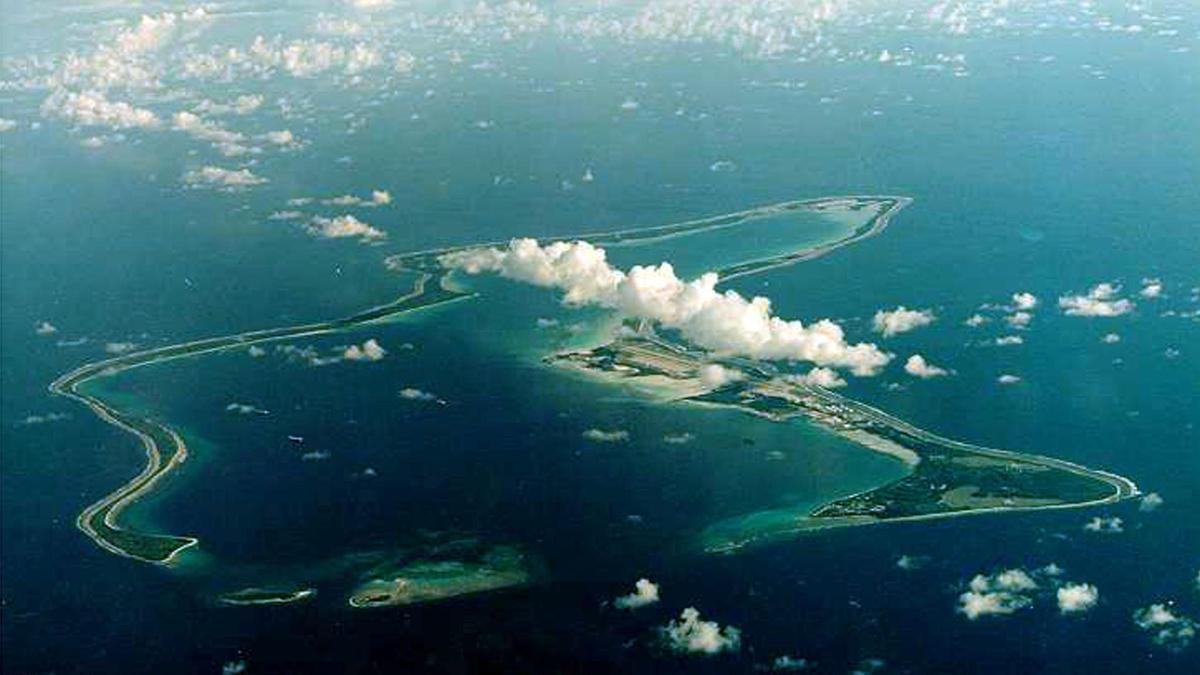
To understand the delay, one must quantify the unique utility of Diego Garcia within the Global Strike framework. The base is one of the few locations worldwide capable of supporting long-range bomber operations, such as those involving the B-2 Spirit and B-21 Raider, without the political volatility associated with continental land bases.
Its value is defined by three specific vectors:
- Geographic Insulation: Situated in the central Indian Ocean, the archipelago is distant from the immediate strike range of most regional adversaries, providing a secure "rear-area" for logistics and command.
- Infrastructure Density: The site hosts massive fuel storage facilities, a deep-water harbor for submarine tenders, and a Space Surveillance Network (SSN) station that is vital for tracking orbital assets.
- Legal Exceptionalism: Under British Indian Ocean Territory (BIOT) status, the U.S. enjoys a degree of operational freedom that would likely be constrained under Mauritian domestic law or international oversight.
The Mauritian Sovereignty Paradox
The core of the dispute involves the 1965 excision of the Chagos Islands from Mauritius prior to its independence. International courts, including the International Court of Justice (ICJ) in 2019, have consistently ruled this separation illegal. However, the U.K.’s attempt to finalize a treaty transferring sovereignty encountered a structural bottleneck: the "99-year lease" model.
The proposed deal grants Mauritius sovereignty while guaranteeing the U.S. and U.K. control over Diego Garcia for 99 years. This creates a fragmented legal landscape. If Mauritius holds ultimate sovereignty, its future domestic political shifts—or its susceptibility to third-party influence—could jeopardize the base's long-term security. The U.S. Department of Defense views this as an unacceptable risk profile, preferring the status quo of British administration, which offers a more predictable legal and security environment.
The Mechanism of the Legislative Pause
British ministers have clarified that the pause is intended to "ensure the base's future is secure." In practical terms, this means the U.K. is currently negotiating a "Side Agreement" or a "Status of Forces Agreement" (SOFA) that would supersede Mauritian domestic law within the perimeter of Diego Garcia.
This negotiation involves a two-stage verification process:
- Operational Ring-Fencing: Establishing clear physical and legal boundaries where Mauritian officials, environmental inspectors, or civilian populations would be prohibited from entering.
- Third-Party Exclusion Zones: Developing a legal mechanism to prevent Mauritius from allowing rival powers—specifically China—to establish a presence or conduct signals intelligence (SIGINT) operations on the outer islands of the archipelago, such as Peros Banhos or Solomon Islands.
Security Implications of the Outer Islands
A significant portion of the debate centers on the "right of return" for the Chagossian people. While the proposed deal allows for resettlement on the outer islands, the U.S. intelligence community expresses concern regarding the "proximity threat."
The logic of the pause suggests that the U.K. and U.S. are calculating the electronic interference and surveillance risks posed by any civilian habitation within the archipelago. Modern signals intelligence does not require a large-scale military installation; a commercial fishing port or a telecommunications hub on a nearby island could serve as a platform for monitoring sensitive communications originating from Diego Garcia. Therefore, the pause likely involves drafting "restrictive covenants" that Mauritius must agree to, limiting the types of infrastructure permitted on the resettled islands.
The Fiscal and Political Weight of Compensation
Mauritius expects significant financial compensation as part of the sovereignty transfer. This introduces a "Rent-Seeking Variable" into the geopolitical equation. The U.K. is currently assessing the long-term cost of this settlement against the cost of maintaining the current legal limbo.
The fiscal structure of the deal includes:
- Annual Rental Payments: A recurring fee paid by the U.K./U.S. to Mauritius for the use of Diego Garcia.
- Development Funds: Lump-sum investments into Mauritian infrastructure to secure political buy-in.
- Environmental Management Costs: Funding for the Chagos Marine Protected Area, which has previously been used as a tool to prevent resettlement.
The U.S. remains wary that once sovereignty is transferred, the price of the lease could be subject to inflationary pressure or political "shakedowns" during future administration changes in Port Louis.
Geopolitical Friction with the "Global South"
The U.K.'s delay is being scrutinized by the international community as a test of its commitment to the "rules-based order." By ignoring ICJ rulings to prioritize military utility, the U.K. risks undermining its diplomatic leverage in other territorial disputes, such as those in the South China Sea.
However, the British government is operating under a "realist" framework. The strategic necessity of the Indian Ocean base outweighs the reputational cost of a delayed treaty. The pause signals that while London is willing to concede on the symbolism of sovereignty, it will not compromise on the mechanics of military power. The intervention of the U.S. provides the U.K. with the necessary "diplomatic cover" to slow-walk the process until every security loophole is closed.
Technical Limitations of the Transfer
The transition of administrative services—such as air traffic control, maritime patrolling, and environmental monitoring—from the British Indian Ocean Territory administration to Mauritian authorities presents a massive logistical hurdle. Mauritius currently lacks the specialized naval assets required to patrol the vast Chagos Marine Protected Area effectively.
If the U.K. withdraws its patrol vessels, a "security vacuum" is created, potentially leading to illegal fishing or, more critically, unmonitored maritime traffic near Diego Garcia. The legislative pause allows for the creation of a "Transitional Technical Authority" that will likely see British personnel remain in key administrative roles for decades, even after a formal change in sovereignty.
The current trajectory indicates that the legislation will not proceed until a tripartite agreement is reached that effectively renders Mauritian sovereignty "nominal." The strategic play for the U.K. is to engineer a legal fiction where Mauritius owns the land on paper, but the U.S. and U.K. retain absolute, unchallengeable jurisdiction over the archipelago’s air, sea, and electromagnetic space. Any final treaty will likely include a "Security Override Clause," allowing the U.S. to suspend civilian access to the entire archipelago in the event of a regional conflict.
The U.K. must now finalize the technical annexes of the treaty to ensure that the "Sovereignty Transfer" does not become a "Security Liability." This requires a definitive move toward a dual-layered governance model: one for the civilian resettlement of the outer islands and an entirely separate, extraterritorial regime for the Diego Garcia footprint.