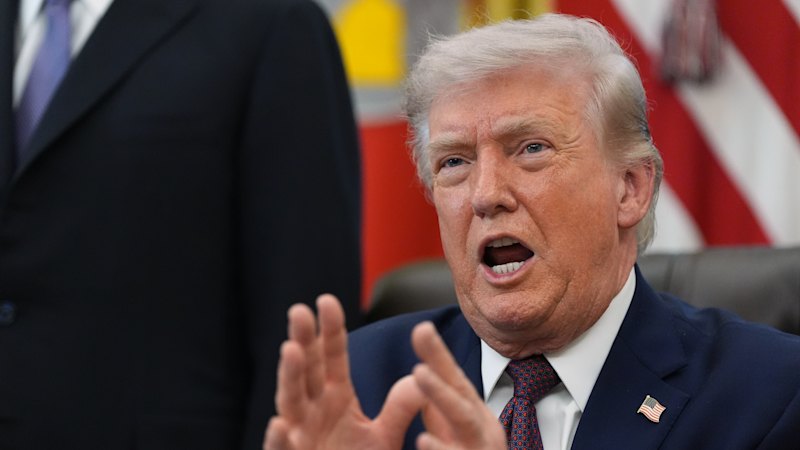
The current friction between the United States and Iran has moved beyond mere diplomatic disagreement into a state of kinetic signaling where the primary objective is escalation dominance. When a superpower threatens to dismantle its foundational security alliances (NATO) while concurrently preparing a domestic address on Middle Eastern hostilities, it isn't just managing a crisis—it is reassessing its global risk-reward ratio. The structural integrity of international relations depends on the predictability of deterrence, yet the current variables—denied ceasefires, billion-dollar domestic economic cushions, and threats of isolationism—suggest a move toward a high-volatility, multipolar equilibrium.
The Triad of Strategic Friction
To analyze the current surge in tensions, we must look at the three distinct vectors of pressure currently converging on the geopolitical stage.
- The Deterrence Vacuum: As the U.S. signals potential withdrawal from NATO, the psychological safety net for Western allies evaporates. This creates a vacuum where regional powers like Iran feel incentivized to test the boundaries of "red lines" that no longer appear backed by a unified global front.
- The Deniability Loop: Iran’s rejection of ceasefire claims serves a dual purpose. It maintains the morale of proxy networks while preserving the state's leverage at the negotiating table. If a ceasefire is acknowledged too early, the perceived cost of continued aggression drops, weakening the defensive posture of the aggressor.
- Domestic Insulation as a War Precursor: The pledge of $1b to businesses by the Prime Minister functions as a strategic shock absorber. By subsidizing the private sector, a government attempts to decouple the domestic economy from the inflationary or supply-chain shocks inherent in an escalating conflict.
Quantitative Analysis of the NATO Leverage Strategy
The threat to withdraw from NATO is rarely about the alliance itself; it is about the redistribution of the "Defense Burden." In a data-driven view, the U.S. contributes roughly 3.5% of its GDP to defense, while many European allies struggle to hit the 2% benchmark. By introducing the threat of withdrawal during a crisis with Iran, the administration is effectively weaponizing its security export.
The logic follows a basic cost-benefit function:
If $C_{allied}$ (the cost of providing security) exceeds $V_{strategic}$ (the value gained from the alliance), the dominant power will seek to renegotiate the contract. By doing this during a live Iranian crisis, the U.S. forces allies to choose between increased defense spending or facing an uncontained Iran without a guaranteed American shield. This isn't irrationality; it is a brutal application of game theory where the most powerful player intentionally introduces instability to extract a higher "premium" from its partners.
The Mechanics of the Iranian Ceasefire Denial
The denial of a ceasefire by Tehran is a calculated move in the "escalation ladder." In conflict theory, the person who admits they want peace first is often viewed as the party with the lower endurance threshold.
The Iranian strategy relies on Strategic Ambiguity. By denying that a ceasefire is even on the table, Iran achieves two operational goals:
- Information Asymmetry: It forces U.S. intelligence to second-guess their internal sources, creating a lag in decision-making cycles.
- Proxy Alignment: It ensures that non-state actors (Hezbollah, various militias) remain in a state of high readiness. A premature ceasefire announcement can lead to "operational decay," where combatants lose the psychological edge required for sustained engagement.
This creates a bottleneck for mediators. If one side denies the existence of negotiations, the diplomatic "on-ramp" is effectively blocked, leaving kinetic action as the only remaining language of communication.
Economic Fortification: The $1b Business Hedge
The allocation of $1b to businesses is an exercise in Macroeconomic Resilience. In any war scenario, the "Home Front" is the first point of failure. Inflation, resource scarcity, and business closures lead to civil unrest, which undermines the legitimacy of a war effort.
This capital injection focuses on three specific failure points:
- Liquidity Preservation: Ensuring that small to medium enterprises (SMEs) do not collapse during the initial "shock and awe" phase of a conflict.
- Supply Chain Continuity: Incentivizing businesses to stockpile essential goods or pivot production to support national interests.
- Public Sentiment Management: Lowering the "Misery Index" (the sum of unemployment and inflation) to prevent internal dissent from synchronizing with external military pressure.
The limitation of this strategy is the "Burn Rate." A billion dollars is a significant sum for a mid-sized economy, but in the context of a total war or a prolonged blockade, it is a finite resource. It buys time, not victory. If the conflict lasts longer than the fiscal runway, the economic collapse will be more severe because the government has exhausted its intervention capacity.
The Prime-Time Address as a Narrative Pivot
A prime-time address to the nation serves as the formal transition from "Grey Zone" conflict to "State of Exception." When a leader takes to the airwaves, they are seeking to consolidate the National Will.
The structure of such an address usually follows a specific logical sequence:
- Identification of the Existential Threat: Defining Iran’s actions not as regional skirmishes, but as a direct challenge to the global order.
- The Ultimatum: Setting a binary choice for the adversary.
- The Burden Sharing Demand: Reminding allies (NATO) that protection is a service, not a right.
The risk here is "Rhetorical Over-extension." If the address promises more than the military or the economy can deliver, it results in a "Credibility Gap." Once the gap between words and capabilities becomes visible, deterrence fails completely.
Mapping the Escalation Trajectory
The current situation is not a static state of "updates," but a dynamic system moving toward a "Phase Shift." We can categorize the potential outcomes based on the interaction of the variables discussed:
Scenario A: The Realignment (High Probability)
The U.S. successfully leverages the Iran threat to force NATO members into immediate, binding increases in defense spending. Iran, sensing a newly unified front, enters back-channel negotiations while publicly maintaining its stance of denial.
Scenario B: The Fractured Response (Medium Probability)
The NATO threat causes a rift. European powers, fearing American abandonment, open independent diplomatic channels with Iran. This gives Tehran the ability to "wedge" the West, effectively neutralizing the impact of U.S. sanctions.
Scenario C: Kinetic Escalation (Low but Rising Probability)
Domestic pressures in both the U.S. and Iran make retreat politically impossible. The $1b stimulus fails to curb inflation, the NATO withdrawal becomes a reality, and Iran interprets the chaos as a green light for a preemptive strike on regional energy infrastructure.
Strategic Operational Recommendations
The immediate requirement for stakeholders—whether they are corporate entities or regional governments—is the implementation of a Volatility Hedge.
- For Corporate Entities: Move from "Just-in-Time" to "Just-in-Case" inventory models. The $1b government stimulus suggests that the state anticipates a breakdown in normal market functions. Secure credit lines now before the "Conflict Premium" drives up interest rates.
- For Regional Diplomats: Shift focus from "Ceasefire Agreements" (which are currently being denied) to "De-escalation Protocols." Stop looking for a permanent peace and start looking for "Minimum Viable Stability"—small, verifiable pauses in hostility that do not require either side to lose face publicly.
- For Defense Planners: Account for a "Post-NATO" security architecture. Even if the withdrawal does not happen, the threat has fundamentally altered the trust-based system of the alliance. Diversify procurement and intelligence-sharing networks immediately to reduce single-point-of-failure reliance on U.S. assets.
The pivot toward isolationism combined with an increase in Middle Eastern friction is not a series of disconnected events. It is a fundamental reordering of the global security hierarchy. The era of "Guaranteed Deterrence" is over; we have entered the era of "Transactional Security."