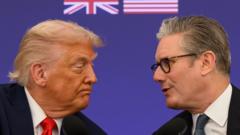
The phone call between Donald Trump and Keir Starmer following the US-led strikes on Iranian missile infrastructure signals a fundamental fracture in the Western security architecture. While the strikes represent a tactical escalation aimed at degrading Tehran’s kinetic capabilities, they expose a strategic misalignment between Washington’s "Maximum Pressure 2.0" and London’s preference for "Calibrated Containment." The divergence is not merely rhetorical; it is rooted in differing risk tolerances regarding energy markets, domestic political stability, and the long-term viability of the Joint Comprehensive Plan of Action (JCPOA) frameworks.
The current friction exists within a triadic constraint model: the necessity of maritime security in the Red Sea, the prevention of a regional hegemonic war, and the maintenance of global oil price stability. Each actor—the US, the UK, and the broader EU—is currently optimizing for a different variable within this set.
The Mechanics of Kinetic Degradation vs. Strategic Deterrence
Military action against Iranian assets or their proxies functions on two distinct logical planes. The first is Kinetic Degradation, a measurable reduction in the enemy’s hardware, logistics, and personnel. The second is Strategic Deterrence, an intangible psychological state where the adversary calculates that the cost of an action outweighs the benefit.
The US strikes, conducted with precision-guided munitions and carrier-based sorties, achieved high levels of kinetic degradation. However, the feedback loop from Tehran suggests that strategic deterrence remains unestablished. This failure stems from a mismatch in the "Escalation Ladder." For the US, a strike is a signal to de-escalate through strength. For Iran, an asymmetric actor, a strike is a justification for lateral escalation—attacking soft targets or disrupting the Strait of Hormuz where Western conventional superiority is less relevant.
The UK’s participation, while militarily significant, is primarily a diplomatic signaling exercise. Starmer’s government is attempting to balance the "Special Relationship" with a European desire to keep diplomatic channels open. This creates a "Strategic Buffer" where the UK acts as a bridge, yet this bridge is thinning as Trump’s administration moves toward a binary "with us or against us" foreign policy.
The Economic Cost Function of Middle Eastern Instability
The primary friction point between the US and Europe is the economic sensitivity to energy shocks. The US is a net exporter of energy, protected by a vast domestic shale industry. Europe remains a net importer, highly vulnerable to fluctuations in Brent Crude and liquefied natural gas (LNG) delivery via the Suez Canal.
- The US Position: High tolerance for regional volatility. If Iranian oil is removed from the market through sanctions or strikes, US producers capture a larger market share, and the domestic inflationary impact is dampened by internal supply.
- The European Position: Low tolerance. Any disruption in the Persian Gulf translates immediately to higher heating and transport costs, fueling right-wing populist movements that threaten the internal cohesion of the EU and the UK’s fragile economic recovery.
The divergence in strike doctrine is, at its core, a disagreement over the Insurance Premium of Peace. Europe is willing to pay a high diplomatic price (tolerating Iranian proxy activity) to avoid a high economic price (energy spikes). The US, under Trump, views the diplomatic price as a sunk cost with zero ROI, preferring a high-risk, high-reward strategy of regime paralysis.
The Three Pillars of the Transatlantic Fracture
To understand why Starmer and Trump are operating on different frequencies, one must deconstruct the three pillars of their respective foreign policies.
1. The Legality of Preemption
The UK operates under a strict interpretation of international law, requiring a "Clear and Present Danger" or a "Self-Defense" justification that satisfies the UN Charter. The Trump administration utilizes a "Preemptive Neutralization" framework, arguing that the mere existence of certain capabilities in an adversary justifies their destruction. This legal gap makes joint operations increasingly difficult to authorize within the British Parliament.
2. Proxy Management vs. State Accountability
The Starmer government views the Houthi rebels and Hezbollah as semi-autonomous entities that can be influenced through local political levers. The US view has shifted toward "Total Accountability," where every action by a proxy is treated as a direct command from the Islamic Revolutionary Guard Corps (IRGC). This removes the "deniability buffer" that previously allowed for localized de-escalation.
3. The Nuclear Threshold
Europe still clings to the ghost of the JCPOA, believing that economic incentives can prevent a nuclear breakout. The US analysis suggests that the "Breakout Clock" has already reached a point where only physical intervention or total economic collapse can stop the process.
The Intelligence Bottleneck and Information Asymmetry
A critical failure in the current alliance is the way intelligence is synthesized into policy. The "Five Eyes" network ensures that data is shared, but the interpretation of that data is increasingly siloed.
A specific example is the assessment of IRGC Command and Control (C2) resilience. UK intelligence often highlights the decentralized nature of these units, suggesting that killing top commanders creates a vacuum filled by more radical, less predictable actors. US military planners, conversely, apply a "Centrosymmetric Model," believing that removing the core nodes of a network will lead to a systemic collapse.
This difference in network theory application leads to conflicting recommendations on target lists. The UK might advocate for hitting a munitions depot (low political cost, high tactical gain), while the US targets a high-ranking officer (high political cost, speculative strategic gain).
The Risk of Strategic Decoupling
The "Trump-Starmer" call was an attempt to synchronize watches, but the watches are set to different time zones. The UK’s "Pivot to Europe" in the wake of Brexit requires a degree of alignment with French and German foreign policy, both of which are staunchly opposed to an uncontained conflict with Iran.
If the US continues to escalate without a clear "Off-Ramp" strategy, the UK faces a binary choice:
- Total Alignment with the US: Risking economic blowback and a break with European security partners.
- Strategic Autonomy: Risking a trade and security rift with the US, which would leave the UK isolated in a hostile global environment.
The current trajectory points toward a "Tiered Alliance" where the US acts unilaterally or with a small "Coalition of the Willing," while the UK and Europe provide humanitarian and logistical support but refrain from direct combat roles. This creates a "Force Multiplier Gap" that Iran is already exploiting by targeting the political will of European capitals.
The Structural Realignment of the Middle East
The US-Iran conflict is no longer a localized dispute; it is a node in a larger "Multipolar Competition" involving Russia and China. Iran’s integration into the BRICS+ framework and its defense cooperation with Moscow (providing drones for the Ukraine theater) has changed the math.
For the US, hitting Iran is a way to indirectly degrade Russian military supply lines. For the UK, this adds a layer of complexity: how to confront Iran without triggering a wider Eurasian conflict that would stretch the Royal Navy beyond its current operational capacity. The Royal Navy’s surface fleet is currently at its lowest hull count in decades, creating a "Capacity Constraint" that dictates Starmer’s cautious approach more than any ideological preference.
Operational Recommendations for the UK Ministry of Defence
The UK must move beyond "Reactive Alignment" and develop a "Dual-Track Deterrence" model. This involves:
- Hardening Maritime Assets: Accelerating the deployment of Laser Directed Energy Weapons (LDEW) to reduce the cost-per-intercept against cheap Iranian-made drones.
- Economic Resilience: Diversifying LNG sources to decouple energy prices from Persian Gulf stability, thereby increasing the UK's strategic "Room to Maneuver."
- Cyber-Kinetic Integration: Shifting the focus from physical strikes to "Grey Zone" operations that degrade Iranian C2 without the visual optics of a missile strike, which triggers domestic protests and diplomatic friction.
The failure to harmonize these strategies will result in a "Disjointed Escalation" where Western actions are just forceful enough to provoke a response, but not decisive enough to end the threat. The US and UK are currently in a "Strategic Deadlock" where the primary obstacle is not the enemy’s strength, but the allies' inability to agree on the definition of victory.
The next 12 months will require the UK to define its "Red Lines" independent of Washington. If the US moves toward a full-scale air campaign against IRGC infrastructure, the UK must have a pre-negotiated "Security Partition" that protects its interests in the Levant and the Gulf without committing to a war it cannot afford to sustain. The Starmer government must leverage its intelligence assets to provide the US with an "Alternative Victory Path" that focuses on internal Iranian fractures rather than external kinetic pressure. This is the only way to maintain the Transatlantic alliance while preventing a total regional collapse.
Establish a Permanent Joint Task Force on Asymmetric Threats that operates outside the standard NATO framework to allow for rapid, bilateral decision-making between London and Washington. This task force must be empowered to execute "Proportional Counter-Value" strikes that target the financial assets of IRGC leadership rather than physical infrastructure, hitting the regime’s stability without providing the visual propaganda of "Western Aggression."