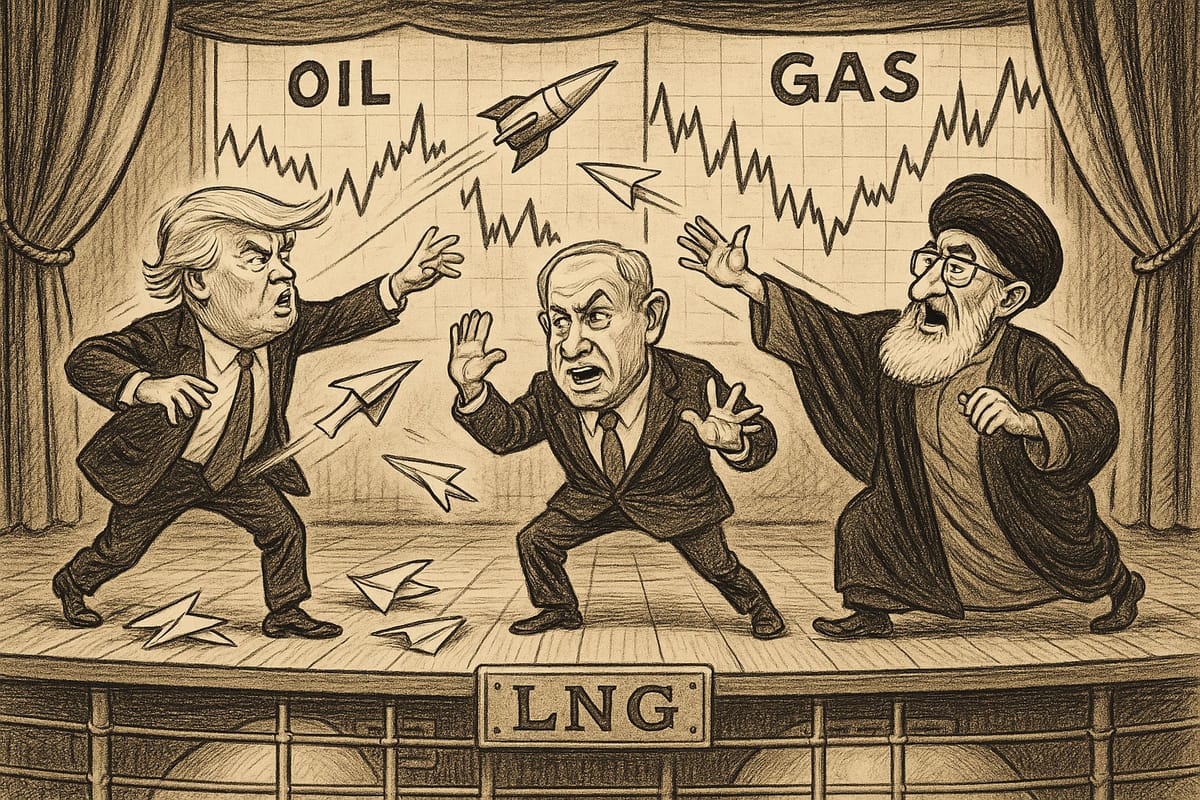
The assertion that a conflict between the United States and Iran can be "wrapped up soon" to produce a "much safer world" ignores the structural inertia of Middle Eastern proxy networks and the kinetic reality of modern asymmetric warfare. To evaluate the validity of such a claim, one must move beyond political rhetoric and analyze the three specific pillars that govern Iranian-American engagement: Asymmetric Deterrence Thresholds, Economic Choke Point Mechanics, and the Breakout Velocity of Nuclear Proliferation.
The Architecture of Iranian Forward Defense
Iran operates on a doctrine of "Forward Defense," which decentralizes its military risk by outsourcing kinetic activity to the "Axis of Resistance." This creates a decoupled risk profile where the Iranian state can remain technically at peace while its proxies engage in high-intensity attrition against U.S. interests.
Any strategy aiming for a rapid resolution must account for the Decoupling Coefficient. This is the degree to which a ceasefire signed in Tehran actually translates to a cessation of hostilities by Houthi rebels in the Bab el-Mandeb or Kata'ib Hezbollah in Iraq. Historically, this coefficient is high; local actors often maintain independent operational cycles. A "fast" wrap-up of hostilities is a logistical impossibility when the command-and-control structure is intentionally fragmented to avoid a single point of failure.
The Strait of Hormuz as a Binary Switch
A safer world, in a macroeconomic sense, is defined by the stability of energy transit. The Strait of Hormuz represents a systemic bottleneck where 20% of the world's liquid petroleum passes daily. In a high-friction scenario, Iran does not need to win a naval engagement; it only needs to raise the Insurance Risk Premium to a level that effectively closes the strait to commercial traffic.
The mechanics of this closure involve:
- Saturation Diving and Mines: Low-cost, high-impact denial of sea lanes.
- UAV Swarm Integration: Using Tier 1 and Tier 2 drones to overwhelm the Aegis Combat System’s target-tracking capacity.
- Anti-Ship Cruise Missiles (ASCMs): Positioned in hardened, mobile silos along the jagged coastline, creating a "no-go" zone for non-stealth surface combatants.
The "safer world" promised by political actors assumes that Iran will trade its most potent leverage—the ability to crash the global economy—for a seat at a new negotiating table. However, game theory suggests that Iran’s leverage disappears the moment the threat is neutralized or the deal is signed. This creates a commitment problem where neither side can trust the other to maintain the status quo post-disarmament.
The Nuclear Breakout Math
The timeline for "wrapping things up" is tethered to the $t=0$ point of nuclear breakout. Analysts track this through the volume of Uranium Hexafluoride ($UF_6$) enriched to 60%. At this level, the jump to 90% (weapons-grade) is a matter of days or weeks, not months, due to the physics of enrichment cascades.
$$SWU = \dot{m}_p V(x_p) + \dot{m}_t V(x_t) - \dot{m}_f V(x_f)$$
The Separative Work Unit (SWU) required to reach weapons-grade material decreases exponentially as the starting enrichment level increases. Because Iran has already mastered the fuel cycle and possesses advanced IR-6 centrifuges, the "safety" of the world is now dependent on a Verification Latency. If the time it takes for the IAEA to detect a breakout is longer than the time it takes to produce the pit, the deterrent value of "red lines" drops to zero.
A rapid diplomatic resolution must address the "Sunk Cost of Knowledge." Even if every centrifuge is dismantled, the internalized engineering expertise cannot be unlearned. This makes any future "safe" state inherently brittle.
The Kinetic Attrition Loop
If a conflict moves from "cold" to "wrapped up" via military means, the U.S. faces the Cost-Exchange Ratio problem. Using a $2 million interceptor missile to down a $20,000 Shahed-series drone is a mathematically losing strategy over a long-duration campaign.
The Iranian military industrial complex has optimized for:
- Agnostic Platforms: Weapons that can be launched from civilian trucks or fishing dhows.
- GPS-Independent Navigation: Utilizing terrain contour matching and optical sensors to bypass electronic warfare jamming.
- Quantity Over Sophistication: Overwhelming sophisticated BMD (Ballistic Missile Defense) through sheer volume.
For a conflict to end "soon," the U.S. would have to transition from defensive interception to "left-of-launch" strikes. This requires an escalation into Iranian sovereign territory, which triggers the Mutual Destruction Feedback Loop. Once the Iranian mainland is hit, the internal political pressure on the regime to strike "Global City" targets (Dubai, Riyadh, Doha) becomes existential.
Operational Constraints of "Safer" Outcomes
The term "safer" is a subjective variable. For the United States, safety might mean the end of the nuclear threat. For regional players like Israel or Saudi Arabia, safety requires the total dismantling of the proxy network. These two definitions of safety are often in direct competition.
- The Diplomatic Friction Point: Reducing nuclear capacity often requires granting Iran regional hegemony or sanctions relief, which funds the very proxies the neighbors fear.
- The Intelligence Gap: Transitioning to a post-conflict state requires a high-fidelity inventory of Iran’s underground facilities (e.g., Fordow). Without total transparency—which Iran views as a prelude to targeted assassination—the "safety" remains unverified.
The transition from a high-tension environment to a "safe" one is limited by the Security Dilemma. Any move Iran takes to defend itself (buying S-400 systems) is viewed by the West as an offensive preparation, and any move the U.S. takes to "secure" the region (increasing carrier presence) is viewed by Tehran as an imminent invasion.
Strategic Forecast: The Shift to Managed Friction
The most probable outcome is not a "wrapped up" resolution, but a transition to Managed Attrition. The U.S. will likely move toward a "Small Footprint, High Intelligence" model that utilizes cyber-kinetic operations (similar to Stuxnet) rather than traditional troop surges.
The primary risk factor remains the Miscalculation Threshold. In a world of high-speed autonomous weapons and low-latency communication, the window for a leader to de-escalate a localized skirmish before it triggers a regional firestorm has shrunk from hours to minutes.
To achieve the "safer world" mentioned in the reference, the strategic pivot must move away from the hope of a "quick end" and toward the construction of a Multilateral Deterrence Framework. This involves:
- Hardening regional infrastructure to reduce the "payoff" of an Iranian strike.
- Establishing a direct "Red Line" communication link to prevent accidental escalation during naval maneuvers.
- Decoupling global energy prices from Hormuz transit via increased terrestrial pipeline capacity through the Saudi interior.
The path to stability is found in increasing the cost of aggression while simultaneously lowering the cost of compliance. Any claim of a rapid conclusion fails to account for the decades of "Deep State" entrenchment within the Iranian Revolutionary Guard Corps (IRGC), for whom a state of perpetual friction is a prerequisite for domestic survival.
Would you like me to map the specific financial impact of a 48-hour Hormuz closure on global Brent Crude futures?