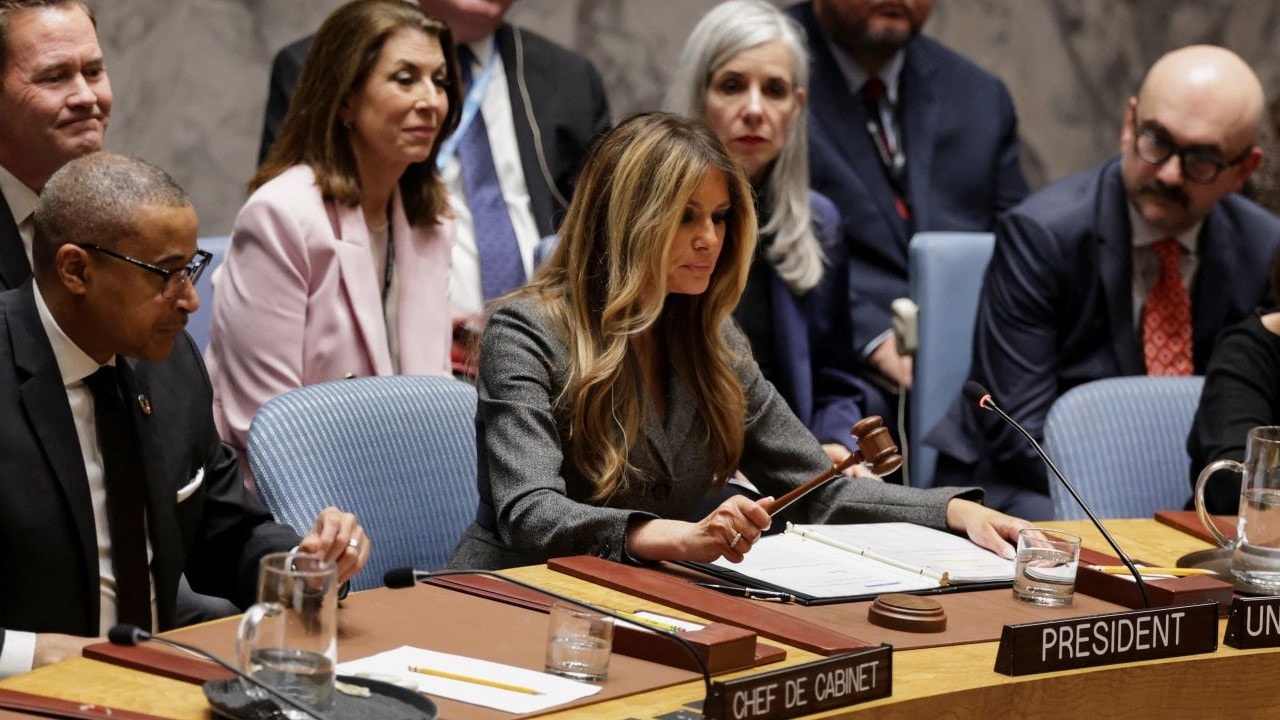
The air inside the United Nations briefing room in New York carries a specific, sterile weight. It smells of expensive floor wax and filtered oxygen, a climate-controlled sanctuary where the world’s most powerful people gather to discuss catastrophes from a safe, carpeted distance. On this Tuesday, Melania Trump sat at the center of that sanctuary.
She looked exactly as the world expects her to look: composed, architectural, and draped in the kind of quiet luxury that signals a total absence of chaos. She was there to chair a high-level meeting on the protection of children in armed conflict. It is a noble cause, the kind of objective truth that no one in their right mind would argue against. Children should not be targets. Children should not be collateral.
But as the First Lady’s voice moved through the scripted cadences of diplomacy, a different sound seemed to vibrate just beneath the floorboards. It was the echo of a scream from 6,000 miles away.
The Math of a Massacre
Less than seventy-two hours before the gavels began to click in Manhattan, a sky over Iran turned white with heat.
A joint U.S.-Israeli strike, described by military officials as a surgical operation targeting high-value insurgent infrastructure, hit its mark. In the clinical language of a Pentagon press briefing, these events are "kinetic actions." They are "strategic degradations." In reality, they are a tearing of the world.
The strike did not just hit a bunker or a depot. It tore through a residential sector where 151 girls were sleeping, eating, or perhaps dreaming of the very future the United Nations claims to protect.
One hundred and fifty-one.
Think of a school bus. Now imagine four of them, packed to the windows with bright-eyed girls, disappearing in a flash of pressurized fire. That is the scale. It is a number so large it becomes a statistic, and statistics are the armor we use to protect ourselves from feeling the truth.
When Mrs. Trump spoke about the "universal right to safety," she wasn't lying. She was articulating a dream. But for the families in that Iranian rubble, the dream is a cruel joke told in a language they don’t speak.
The Geography of Disconnect
There is a profound, almost hallucinogenic irony in watching the machinery of peace operate while the machinery of war is still warm to the touch.
In New York, the delegates used words like "implementation," "framework," and "multilateral cooperation." They sipped sparkling water from glass bottles. They Adjusted their ties. Meanwhile, in the Isfahan province, a father was likely sifting through gray dust to find a single shoe that belonged to his daughter.
He isn't thinking about frameworks. He is thinking about the way she used to braid her hair or the specific way she laughed at the neighbor’s cat. To him, the United Nations isn't a beacon of hope; it is a giant, glowing television screen showing a world that doesn't actually exist.
This is the invisible stake of modern diplomacy. It isn't just about whether a resolution passes or fails. It is about the widening chasm between the people who make the rules and the people who have to live—and die—under them. When a First Lady chairs a meeting on child safety while her husband’s administration provides the coordinates for the fire that kills those children, the very concept of "protection" begins to dissolve.
It becomes a performance. A high-stakes, beautifully lit piece of theater.
The Ghost at the Table
Imagine, for a moment, a girl named Samira. She is a hypothetical child, but she is built from the very real facts of the Isfahan strike.
Samira liked math. She found the logic of numbers comforting because, unlike the world outside her window, numbers always stayed the same. Two plus two was always four, no matter who was in power or whose flag was flying over the local government building.
On the night of the strike, Samira was likely tucked under a heavy wool blanket. She didn't hear the drone. You never hear the thing that kills you from twenty thousand feet. There is just a sudden, violent reorganization of the atmosphere. The walls of her home, which she believed were solid, became shrapnel. The ceiling became a tomb.
If Samira were alive, she would be exactly the kind of child Melania Trump was speaking for. She would be the face on the brochure. She would be the reason for the gala.
But Samira isn't in the room. She is the ghost sitting in the empty chair next to the French delegate. She is the static in the microphone. She is the reason why, despite all the elegant words and the rustle of silk, the meeting feels hollow.
The disconnect isn't just political; it's visceral. It’s the difference between discussing the "ethics of heat" and being burned alive.
The Language of Justification
How do we square this? How does a government facilitate a massacre on Friday and lead a prayer for peace on Tuesday?
It happens through the sanitization of language. We have become experts at building linguistic walls between our actions and our conscience. We don't say "we killed 151 girls." We say "collateral damage was sustained during a complex counter-terrorism operation."
By the time the news reaches the gilded halls of the UN, the blood has been washed off the words. They are clean. They are professional. They are digestible.
Mrs. Trump’s speech focused heavily on "ending the cycle of violence." It’s a phrase we hear so often it has lost its meaning. A cycle implies a wheel, something that turns of its own volition. But violence against children isn't a weather pattern. It isn't a natural disaster. It is a choice. It is a series of codes entered into a computer, a series of signatures on a desk in D.C. or Tel Aviv, and a series of silences from the people who have the power to stop it.
The cycle doesn't just happen. We pedal the bike.
The Weight of a Silence
As the meeting progressed, there were moments of silence. These are standard in UN proceedings—brief, choreographed pauses to honor the fallen.
In those seconds, you could hear the hum of the air conditioning. You could hear the scratch of a pen. But you couldn't hear the 151 voices that were silenced forever in Iran. You couldn't hear the sound of a mother’s grief, which is a sound that tears through the fabric of the universe.
There is a specific kind of arrogance in thinking that a meeting can fix a wound that a missile created. We want to believe in the power of the podium. We want to believe that if we just get the right people in the right room with the right lighting, we can make the world a gentler place.
But the girls in Iran don't need a meeting. They needed a chance to wake up. They needed the world to care more about their lives than it cared about "strategic objectives" or "regional stability."
The Mirror in the Room
The most uncomfortable truth about the UN meeting isn't what was said, but what was reflected.
Melania Trump, in her poise and her distance, is a mirror for all of us. We watch the news on our phones while we wait for our lattes. We "like" a post about a tragedy and then scroll to a video of a golden retriever. We are all chairs of our own little UN meetings, expressing concern for the world's children while our taxes and our silence fund the drones.
The tragedy in Isfahan wasn't an accident of history. it was a product of a system that values certain lives over others. A system where 151 girls in Iran are a "unfortunate byproduct," while a meeting in New York is "historic progress."
When the First Lady finally stood up to leave, the cameras flashed. She smiled—that practiced, enigmatic smile that has become her trademark. She walked out of the room, followed by a phalanx of security and aides, leaving the sterile sanctuary behind.
Outside, the New York traffic was screaming. The sun was setting over the Hudson, casting long, golden shadows across the skyscrapers. It was a beautiful evening in the most powerful city on earth.
Somewhere in the rubble of a fallen house, a wind was blowing through the ruins of a bedroom. It stirred the pages of a math book that would never be finished. It carried the scent of dust and extinguished dreams.
The meeting was over. The minutes were recorded. The world remained exactly as broken as it was when the gavel first fell.
The ghosts are still waiting for an answer that no speech can provide.
Would you like me to analyze the specific international laws cited during the UN session and how they conflict with the operational protocols of the Isfahan strike?