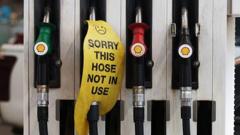
Panic buying represents a psychological breach of the supply chain rather than a failure of physical inventory. When political leaders move to reassure the public regarding fuel security, they often inadvertently signal a fragility that accelerates the very behavior they aim to prevent. The current Australian fuel context is a study in the misalignment between sovereign reserves, distribution logistics, and consumer game theory. Effective intervention requires shifting from rhetorical comfort to an operational understanding of how fuel flows through a modern economy and why the perception of a shortage is, in itself, a self-fulfilling economic reality.
The Architecture of Induced Scarcity
The transition from a stable market to a state of panic buying follows a predictable mathematical progression. It is not a random outburst of emotion but a rational response to perceived systemic risk. Within this framework, three distinct variables dictate the severity of the disruption.
- The Extraction Rate vs. Refill Rate: Retail fuel stations operate on a "Just-in-Time" replenishment model. Tanks are typically sized to handle standard daily throughput with a buffer of 24 to 72 hours. When consumer behavior shifts from "buy as needed" to "top off at all costs," the extraction rate (liters sold per hour) triples or quadruples. The refill rate—constrained by the number of available tankers and driver hours—remains static. This mismatch creates "dry-outs" at the pump even when the primary storage terminals are at 90% capacity.
- Inventory Hoarding Displacement: Panic buying moves fuel from optimized industrial storage (large, safe, monitored tanks) to unoptimized private storage (vehicle tanks and jerry cans). This displacement creates a massive "phantom demand" spike. The fuel hasn't been consumed; it has merely been moved, but the supply chain treats this displacement as a total loss of inventory, triggering emergency protocols.
- The Information Feedback Loop: Social media and traditional news reporting serve as a high-frequency trading floor for fear. A single photo of a "No Fuel" sign at one station creates a localized information asymmetry. Residents in the surrounding 20-kilometer radius react by fueling up immediately, creating a wave of depletion that moves outward from the initial point of failure.
The Sovereign Reserve Calculation
Australia’s fuel security is often measured against the International Energy Agency (IEA) 90-day mandate. However, the raw number of days of supply is a deceptive metric. To understand true resilience, we must apply a functional decomposition of what constitutes a "reserve."
The physical stock is divided into three tiers:
- Primary Stock: Crude oil and finished product held at refineries and major import terminals.
- Secondary Stock: Product currently in transit via coastal shipping, pipelines, or road tankers.
- Tertiary Stock: Inventory held at retail sites and end-user storage.
The bottleneck in the Australian model is the lack of domestic refining capacity. By relying on imported refined products (petrol, diesel, and jet fuel) primarily from hubs in Singapore and South Korea, the supply chain is vulnerable to maritime "choke points." A disruption in the South China Sea or the Malacca Strait would not manifest as an immediate outage but as a gradual tightening of the secondary stock. The Prime Minister's reassurance relies on the primary stock levels, but the consumer's experience is entirely dependent on the tertiary stock's ability to withstand a demand surge.
The Cost Function of Logistic Resilience
Increasing the resilience of the fuel network involves a direct trade-off with economic efficiency. To eliminate the risk of "dry pumps" during a panic, the system would require significant over-capacity in trucking and storage.
Let $C_{total}$ be the total cost of the fuel delivery system:
$$C_{total} = C_{ops} + C_{inv} + C_{risk}$$
Where:
- $C_{ops}$ represents operational costs (transport, labor).
- $C_{inv}$ is the carrying cost of holding excess inventory.
- $C_{risk}$ is the economic loss associated with a fuel shortage.
Current market structures prioritize minimizing $C_{inv}$ and $C_{ops}$. This keeps fuel prices lower for the consumer during periods of stability but leaves $C_{risk}$ uncapped during a crisis. When the government intervenes to "reassure" the public, they are attempting to lower $C_{risk}$ through communication because they lack the physical infrastructure to rapidly adjust $C_{inv}$.
Behavioral Interventions and Market Signaling
Government communication during a fuel scare often fails because it ignores the "Prisoner's Dilemma" inherent in panic buying. If everyone follows the advice to buy normally, the system remains stable. However, if an individual believes others will panic buy, their rational move is to buy fuel immediately to avoid being the one left with an empty tank.
To break this cycle, the state must move beyond verbal reassurance and implement structural deterrents:
- Quantity Caps: Limiting purchases to 20 or 30 liters per vehicle during a declared "supply stress event." This serves as a physical throttle on the extraction rate, allowing the refill rate to catch up.
- Price Signal Suppression: Ensuring that retailers do not spike prices during a panic, which can signal "scarcity" and further fuel the frenzy. Conversely, some economists argue for "scarcity pricing" to naturally dampen demand, though this is politically unpalatable.
- Priority Access Lanes: Visible, pre-planned logistics for emergency services and essential transport (food delivery, medical supplies). When the public sees that essential services are decoupled from the retail panic, the perceived "total collapse" risk diminishes.
Structural Vulnerabilities in the Australian Grid
Beyond the psychological drivers, there are two hard-coded vulnerabilities in the Australian fuel landscape that make panic buying particularly dangerous.
The first is the Diesel Dependency Ratio. While petrol is largely used for private transport, diesel powers the entire logistics backbone of the country. If a panic spreads from petrol to diesel, the nation’s ability to move food and medicine is compromised within 48 hours. The current "Just-in-Time" delivery model for supermarkets means that a fuel shortage is, by extension, a food shortage.
The second is Terminal Concentration. Most of Australia’s fuel enters through a handful of major ports (Botany, Melbourne, Brisbane, Perth). If a technical failure or industrial action occurs at a single terminal, the local "secondary stock" cannot be easily replenished from another state due to the vast distances and the lack of a national pipeline network. This geographic isolation forces each state to act as an island, making localized panics more difficult to manage via cross-border resupply.
Operational Realities of Refinery Decline
The closure of domestic refineries has shifted the risk profile from "production risk" to "maritime risk." When Australia refined its own crude, the supply chain was shorter and more controllable. Today, the nation is an "end-of-the-line" destination for global shipping routes.
A critical nuance often missed in political rhetoric is the Quality Grade Variance. It is not enough to have "90 days of fuel." The reserves must match the specific Euro-standard requirements of the modern Australian vehicle fleet. You cannot simply dump high-sulfur crude into a system designed for ultra-low sulfur diesel. This specificity reduces the "liquid" nature of the global market, meaning that in a crunch, Australia cannot simply buy any available tanker on the ocean; it must find specific, compatible products.
Strategy for Systemic Stabilization
The objective for policy makers and industry leaders is to decouple "supply reality" from "demand perception." This is achieved not through a single speech, but through a multi-layered operational pivot.
Immediate action must focus on the Transparency of the Secondary Stock. Creating a real-time, public-facing dashboard of fuel tanker arrivals and terminal levels would provide a factual counter-narrative to social media rumors. When consumers can see that three tankers are currently offloading in the harbor, the impulse to hoard 20 liters of petrol diminishes.
Furthermore, the government should formalize a Strategic Distribution Reserve (SDR). Unlike the static IEA reserves, an SDR would consist of a fleet of "floating storage" or dedicated inland depots that are only tapped during retail spikes. This acts as a circuit breaker. By injecting supply directly into the retail level when sensors detect an abnormal extraction rate, the government can physically prove there is no shortage, thereby killing the panic at its source.
The final strategic move is the mandatory integration of Back-to-Base refueling for critical industry fleets. By moving the heaviest fuel users off the retail grid and onto private, high-capacity tanks, the pressure on the "mums and dads" petrol stations is reduced. This provides a buffer that ensures even if the public panics, the economy’s foundational logistics continue to move. The goal is not to stop people from wanting fuel, but to ensure the system is too robust for their wanting to break it.