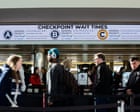
The collapse of the American aviation network during federal shutdowns or systemic technical failures is not an anomaly; it is the logical result of a low-margin, high-complexity system operating at peak theoretical capacity. When the Federal Aviation Administration (FAA) or Transportation Security Administration (TSA) face labor shortages or budgetary freezes, the "hub-and-spoke" model transitions from an efficiency driver into a cascading failure mechanism. The midnight train from Georgia to the Northeast corridor represents more than a nostalgic alternative; it is a live-test of national logistical redundancy in an era of fragile sky-corridors.
The Triad of Aviation Fragility
Aviation stability rests on three interdependent pillars. When any single pillar is compromised by administrative or technical disruption, the entire cost-benefit ratio of air travel inverted.
- Labor-Dependent Throughput: Unlike autonomous or semi-automated systems, airport security and air traffic control (ATC) require high-density, specialized human capital. Because these roles cannot be "surged" with temporary contractors, any reduction in headcount leads to an exponential increase in dwell time.
- The Perishable Nature of Flight Windows: An aircraft sitting on a tarmac during a ground stop is a depreciating asset with zero utility. In contrast, rail networks operate on "continuous flow" dynamics where the track itself serves as the storage medium for the transit vehicle.
- Network Topology: Most US air travel relies on a few critical nodes (Atlanta, Chicago, Dallas). A 10% reduction in processing speed at Hartsfield-Jackson (ATL) creates a "logjam effect" that paralyzes regional spokes, even those with no local disruptions.
The Economic Physics of the Rail Alternative
The decision to abandon the airport for the train during a crisis is a calculation of "guaranteed velocity" versus "potential velocity." While a Boeing 737 maintains a cruise speed of approximately 530 mph, its effective velocity—calculated from the moment a passenger arrives at the terminal to the moment they exit the destination—drops precipitously during a shutdown.
If security delays exceed 180 minutes and tarmac holds exceed 60 minutes, the effective velocity of a 500-mile flight falls below 60 mph. At this juncture, the Amtrak Crescent or similar long-haul rail services, which maintain a consistent, albeit lower, average speed of 50-70 mph, become the mathematically superior choice for time-sensitive transit.
The Cost Function of Systemic Delay
Passengers often fail to account for the Shadow Cost of Uncertainty. In a functioning aviation market, the primary cost is the ticket price. In a shutdown-stressed market, the cost includes:
- Opportunity Cost of Stasis: Time lost in terminals where productive work is hindered by environmental factors.
- Re-accommodation Risk: The statistical probability that a canceled flight will not be rebooked within a 24-hour window due to high load factors (often exceeding 85% on domestic routes).
- Linear vs. Nonlinear Recovery: If a train is delayed by two hours, it usually arrives two hours late. If a flight is delayed by two hours, it may miss its landing slot, blow past crew duty-hour limits, and result in a 12-hour cancellation.
Structural Advantages of Ground-Based Mid-Distance Transit
The "Midnight Train" route from Georgia to the North serves as a case study in Linear Resilience. Rail infrastructure possesses inherent properties that aviation lacks during federal instability.
Decoupled Security Protocols
Rail travel in the United States does not currently utilize the centralized, high-friction security apparatus of the TSA to the same degree as aviation. This decoupling allows rail throughput to remain constant even when federal personnel are furloughed or "calling out" in protest of unpaid wages. The boarding process is a distributed function handled by the carrier rather than a centralized federal bottleneck.
Kinetic Continuity
Aircraft require a "sterile" environment for take-off and landing, governed by strict ATC separation minimums. During a shutdown, these minimums are often increased to compensate for reduced staffing, effectively shrinking the "pipe" through which planes can flow. Trains operate on fixed guideways with signaling systems that are significantly less labor-intensive per passenger-mile. A single engineer and a small onboard crew can move 500 people across 1,000 miles, whereas that same passenger volume requires dozens of ATC interactions and multiple flight crews.
The Operational Reality of the Long-Haul Sleeper
For the strategist or the high-value traveler, the "View from the Tracks" is not about the scenery; it is about the Mobile Office Archetype. The layout of a long-distance train—specifically those with Roomette or Bedroom configurations—provides a private, high-bandwidth environment for deep work that is impossible in a cramped "Economy Plus" seat or a chaotic airport lounge during a crisis.
However, the limitations of the current US rail system must be acknowledged to avoid romanticized fallacies:
- Freight Interference: Outside the Northeast Corridor, Amtrak operates largely on tracks owned by Class I freight railroads (CSX, Norfolk Southern). Under the "Principle of Dispatching Preference," passenger trains should come first, but in practice, freight congestion frequently introduces 1-4 hours of unpredictable delay.
- Infrastructure Age: Much of the rolling stock on the Georgia-to-New York line is decades old, leading to mechanical failures that can be just as disruptive as an aviation ground stop.
- Capacity Caps: A single train consist has a hard limit on cabin availability. Unlike airlines, which can occasionally swap a narrow-body for a wide-body aircraft to clear a backlog, rail capacity is fixed by the length of the station platforms.
Redefining National Transit Redundancy
The friction observed at the airport during a shutdown reveals a critical lack of Intermodal Synchronicity. A resilient national strategy requires that air and rail are not viewed as competitors for the same dollar, but as tiered responses to logistical demand.
- Tier 1 (High Velocity/Low Resilience): Aviation for transcontinental and urgent business needs.
- Tier 2 (Medium Velocity/High Resilience): High-speed and long-haul rail for regional corridors (500-800 miles).
- Tier 3 (Low Velocity/Total Flexibility): Autonomous and traditional vehicular transit for the "last mile."
The failure of Tier 1 during administrative crises forces a mass migration to Tier 2. If Tier 2 is underfunded or technically stagnant, the economy suffers a "Transit Stroke"—a complete blockage of the movement of people and ideas.
Strategic Recommendation for High-Stakes Logistics
Corporate travel departments and individual high-performers should move away from a "Default to Flight" posture. In any scenario where the federal "VIX" (a hypothetical volatility index for administrative stability) rises—indicated by budget deadlocks or major ATC software legacy issues—the following protocol should be implemented:
- The 600-Mile Rule: For any journey under 600 miles, if airport security wait times are forecasted to exceed 90 minutes, pivot immediately to rail or private ground transport. The time-to-destination delta is neutralized by the elimination of "Buffer Time" requirements.
- Asset Diversification: Secure "Flex-Tickets" on rail corridors as a hedge against flight cancellations during peak disruption windows (e.g., holiday seasons or fiscal year-ends).
- Data-Driven Route Auditing: Utilize real-time historical data on "Delay Cascades." If the incoming flight to your hub is delayed by more than 45 minutes, there is a 70% statistical probability your departure will be delayed by over 90 minutes. Use this window to exit the aviation system before you are "trapped" behind the security perimeter.
The goal is to maintain a constant "Flow State" of transit. While the airport represents a high-risk, high-reward gamble on systemic perfection, the train represents a calculated, low-variance path to the destination. In a world of increasing administrative instability, the master of logistics prioritizes the certainty of the track over the volatility of the sky.
Would you like me to analyze the specific ROI of high-speed rail investment versus airport expansion in the Southeast corridor?