The escalation of Israeli kinetic operations against Hezbollah infrastructure in Beirut has triggered a systemic failure in the Lebanese Republic’s remaining governance structures. This is not merely a humanitarian crisis; it is the terminal phase of a "dual-sovereignty" model where the non-state actor’s military utility has finally decoupled from the state’s survival requirements. When a proxy organization’s external conflict draws total-war responses into the host’s urban core, the resulting friction destroys the informal power-sharing agreements that have held Lebanon in a state of "functional paralysis" since 2005.
The Mechanics of Sovereignty Decoupling
The current conflict identifies a critical flaw in the Lebanese political architecture: the assumption that Hezbollah’s military capabilities served as a national deterrent. In practice, this "deterrence" functioned as a high-interest loan with the state’s physical infrastructure as collateral. As Israeli airstrikes dismantle the command-and-control nodes in Dahiyeh, the Lebanese government is forced to reckon with three distinct categories of structural erosion.
1. Internal Displacement as a Fiscal Stress Test
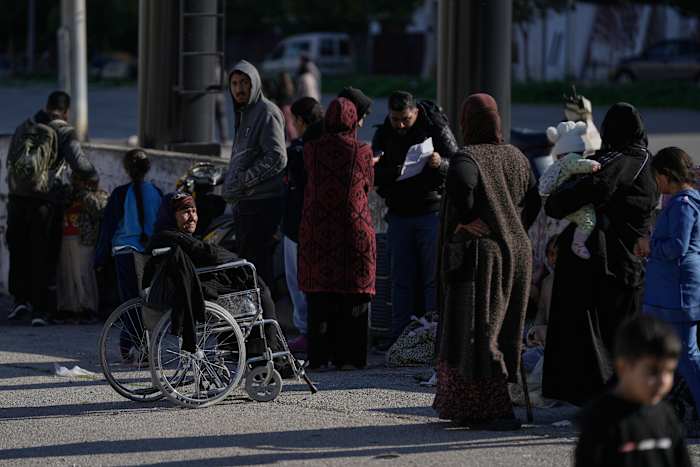
The mass migration of civilians from southern Lebanon and the southern suburbs of Beirut creates a liquidity crisis for a state already operating in a post-default economy. This is not a population movement; it is a rapid reallocation of demand toward regions with zero surplus supply capacity.
- Infrastructure Overload: Public schools and government buildings, repurposed as shelters, effectively cease their primary functions, halting what remains of the educational and administrative pipeline.
- Resource Competition: In the absence of a central distribution grid, the reliance on private generators and decentralized water trucking creates a black market where the most vulnerable are priced out of basic survival.
- Sociopolitical Friction: Displacement into traditionally non-Hezbollah-aligned areas (such as Christian or Druze heartlands) reintroduces civil war-era sectarian anxieties, turning a military conflict into a potential internal security rupture.
2. The Collapse of the Lebanese Armed Forces (LAF) Legitimacy
The LAF exists in a perpetual state of "strategic bystanderism." While theoretically the national defender, it lacks the anti-access/area-denial (A2/AD) capabilities required to intercept Israeli air assets and the political mandate to disarm Hezbollah. This creates a security vacuum where the national army is relegated to humanitarian logistics, further diminishing its authority in the eyes of the populace. The divergence between the LAF’s nominal role and its functional output creates a crisis of confidence that signals to the international community that the Lebanese state has no monopoly on the use of force.
3. The Decimation of Non-State Service Provision
Hezbollah’s "state-within-a-state" model relied on its own hospitals, schools, and social welfare systems. As these facilities are targeted or overwhelmed by the intensity of the kinetic campaign, the "safety net" for a significant portion of the Lebanese population vanishes. This forces a sudden, unplanned reintegration of these citizens into the failing national system, which has neither the budget nor the personnel to accommodate them.
The Economic Cost Function of Urban Air Interdiction
The Israeli strategy in Beirut is designed to maximize the "friction cost" of Hezbollah’s presence. By targeting high-value logistics and intelligence hubs within densely populated civilian areas, the operational goal is to force a choice upon the Lebanese political class: the preservation of the state or the protection of the proxy.
This creates a Compound Degradation Effect:
- Logistical Severance: The destruction of transport corridors and communication towers does more than just hinder Hezbollah movement; it severs the supply chains for food, medicine, and energy for the entire capital.
- Capital Flight and Brain Drain: The "perpetual instability" tax has reached its ceiling. The middle class, which had managed to survive the 2019 financial crisis, is now opting for permanent emigration. This loss of human capital is an irreversible blow to any future reconstruction efforts.
- Risk Premium Hyperinflation: For any remaining businesses, the cost of insurance, shipping, and credit becomes prohibitive. Lebanon is being effectively de-coupled from the global trade network, moving toward a purely subsistence or aid-reliant economy.
The Political Reorientation of the Elite
For years, the Lebanese political elite (the "Zu'ama") maintained a symbiotic relationship with Hezbollah, trading sovereignty for internal stability. That equilibrium has been shattered. The current rhetoric from leaders like Nabih Berri or Najib Mikati indicates a desperate attempt to salvage the 1701 UN Resolution framework, which Hezbollah has historically ignored in practice.
The shift in rhetoric is not born of a newfound nationalist fervor, but of existential political risk. The political class realizes that if the state completely evaporates under the weight of the war, their own patronage networks—and the power they derive from them—will vanish. They are attempting to pivot toward a "state-first" narrative to secure international mediation, even as they lack the leverage to enforce any ceasefire terms on the ground.
The Geopolitical Trap: Why Mediation Fails
Diplomatic efforts are currently stalled by a fundamental misalignment of objectives between the three primary stakeholders:
- The Israeli Objective: Achieving a permanent shift in the northern border's security through the physical destruction of Hezbollah's Radwan forces and their long-range strike capabilities. This is a military goal that cannot be satisfied by Lebanese government "promises."
- The Hezbollah Objective: Survival through attrition. Their goal is to maintain a "resistance" presence regardless of the cost to Lebanese infrastructure, viewing the state’s pain as a secondary concern to their regional ideological commitments.
- The Lebanese Government Objective: A ceasefire that preserves the status quo ante, which is exactly what Israel and Hezbollah’s regional rivals find unacceptable.
This misalignment ensures that any "peace" will likely be a temporary cessation of hostilities rather than a structural resolution. The Lebanese state is being treated as a theater of operations rather than a sovereign negotiator.
Strategic Play: The Path of Managed Dissolution
The most probable path forward is not a grand political bargain, but a managed dissolution of the current Lebanese governance model. As the central state fails to provide security, electricity, or welfare, power will continue to devolve into localized, sectarian-based enclaves. These "micro-states" will provide for their own, further eroding the concept of a unified Lebanon.
The strategic pivot for any external stakeholder—be it a humanitarian agency or a diplomatic entity—must be to recognize that the Beirut-centric model of Lebanese governance is functionally dead. Future stability operations must focus on strengthening the Lebanese Armed Forces as the only cross-sectarian institution remaining, while bypassing the central government to support municipal-level infrastructure.
Success in the Levant now depends on accepting the reality that the dual-sovereignty model has failed. The Lebanese state cannot coexist with a parallel military structure that possesses an independent foreign policy. Until the monopoly on force is returned to the state, any reconstruction aid is simply subsidizing the next cycle of destruction. The final strategic move for the Lebanese leadership is not to "negotiate" with Hezbollah, but to leverage the current crisis to demand a total implementation of the Taif Agreement and UN 1559, effectively forcing a choice between national survival and the proxy's agenda. Failure to execute this shift immediately will result in a total state failure that will take decades to reverse.
Would you like me to map the specific financial flows between the Lebanese Central Bank and the reconstruction efforts to identify the likely points of systemic corruption in the next aid cycle?