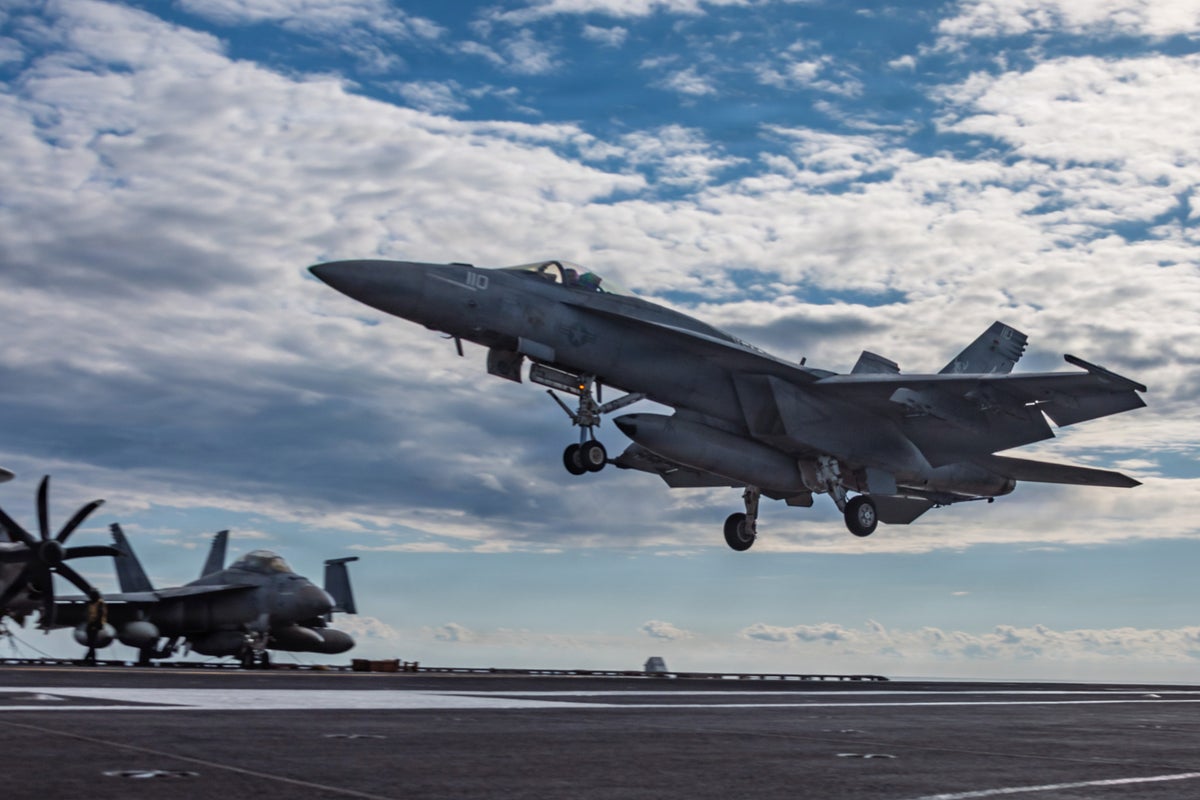
The desert is never truly silent. Even when the wind dies down, there is a hum—a vibration of heat rising off the sand that feels like a low-frequency warning. On a clear afternoon over the Udairi Range in Kuwait, that hum was shattered by the scream of two F/A-18 Hornets. These machines are the apex of engineering, billion-dollar predators designed to dominate the horizon. They represent the absolute certainty of modern warfare.
Until they don't. For a different view, check out: this related article.
In an instant, the certainty evaporated. Two of the world’s most advanced fighter jets were gone, reduced to falling scrap and plumes of black smoke. The initial reports were frantic. People looked for an enemy. They looked for a mechanical failure, a stray bird, or a catastrophic engine flameout. But the truth that eventually trickled out of the investigation was far more chilling than a technical glitch.
The jets were brought down by the very people tasked with keeping the world safe. This wasn't an ambush by a foreign power. This was "friendly fire"—a sterile, bureaucratic term that does a poor job of describing the visceral horror of a mistake made by your own side. Similar insight on the subject has been published by NPR.
The Illusion of Total Control
We like to believe that technology has moved us past the era of "fog of war." We have GPS that can track a smartphone to within a few feet. We have thermal imaging that can see a human heartbeat through a wall. We have identification systems designed specifically to tell a friend from a foe.
But technology is a thin veneer over a very old, very human problem.
Imagine a pilot—let's call him Miller. Miller is strapped into a cockpit that feels more like a spacecraft than a plane. He is traveling at hundreds of miles per hour. His body is being crushed by G-forces that make his own blood feel like lead. He isn't looking out the window; he is looking at a green-tinted digital display. He is processing a thousand data points a second.
On the ground, a controller is doing the same. They are staring at blips on a screen. Each blip is a life, a family, a multimillion-dollar asset. The pressure is a physical weight. In this environment, a "split second" isn't a figure of speech. It is the entire margin between a successful mission and a tragedy.
The crash in Kuwait wasn't a failure of the jets' wings or their engines. It was a failure of the handshake between man and machine.
When Systems Lie
The technical term for what went wrong often involves "Identification Friend or Foe" (IFF) systems. These are transponders that shout a digital "I’m one of you!" to any radar that pings them. When it works, the screen stays clear, and the missiles stay on the rails.
But systems are built by humans, and humans are fallible. Sometimes a code is entered incorrectly. Sometimes a signal is masked by the terrain. Sometimes, in the heat of a live-fire exercise, the sheer volume of data overwhelms the person responsible for interpreting it.
Consider the physics of a modern missile. These are not the "dumb" bombs of the 1940s that fell where gravity dictated. These are autonomous hunters. Once the "fire" button is pressed, the human is largely out of the loop. The missile doesn't have a conscience. It doesn't have a feeling for its pilots. It just has a seeker head that wants to find a target and a proximity fuse that wants to explode.
When a pilot is fired upon by their own side, the betrayal is complete. The very shields they were taught to trust become the swords that strike them. The desert sand in Kuwait, white-hot and indifferent, became a graveyard for that trust.
The Human Cost of a Digital Error
The official reports will talk about "loss of airframe." They will talk about "operational readiness" and "technical malfunctions." But behind every one of these crashes is a pilot who went up into the sky and didn't come back—or who came back to find out they were the ones who pulled the trigger.
Imagine the silence that follows such a mistake. The radios go dead. The radar screens clear. The base commander has to make a call that no one wants to make.
This isn't just about a crash in a desert far away. It is about the fundamental limit of our own control. We have built tools that can outthink us in milliseconds. We have created a world where the stakes of a single keystroke or a missed radio call are life and death. The Kuwait incident is a stark reminder that as we push the limits of technology, we are also pushing the limits of human psychology.
Rebuilding the Safety Net
The military's response to these tragedies is always the same: "More training. More systems. More checks."
But how do you train for a mistake that hasn't happened yet? How do you build a system that can account for the sheer chaos of a human mind under fire? The answer is that you can't. Not completely. The sky will always be a dangerous place, and the machines we send into it will always be prone to the same flaws as the people who fly them.
We are living in an era where we trust the digital over the physical. We trust the screen over the window. We trust the code over our own eyes. And sometimes, the code is wrong.
The wreckage of the F/A-18s has long since been cleared from the Kuwaiti sand. The official investigation is a dusty file in a drawer somewhere. But for the pilots, the controllers, and the families involved, the echo of that afternoon remains. It's a reminder that even in an age of "smart" weapons and "perfect" technology, there is no such thing as a clean war. There is only the messy, terrifying reality of human error in a high-speed world.
The wind has returned to the Udairi Range. The hum of the heat has replaced the roar of the engines. And somewhere, another pilot is strapping into a cockpit, trusting that today, the machines and the people behind them will get it right. They have to. Because in the sky, there are no second chances. Just the long, silent wait for the next heartbeat.
The desert keeps its secrets, but the sky—the sky remembers every mistake we've ever made.