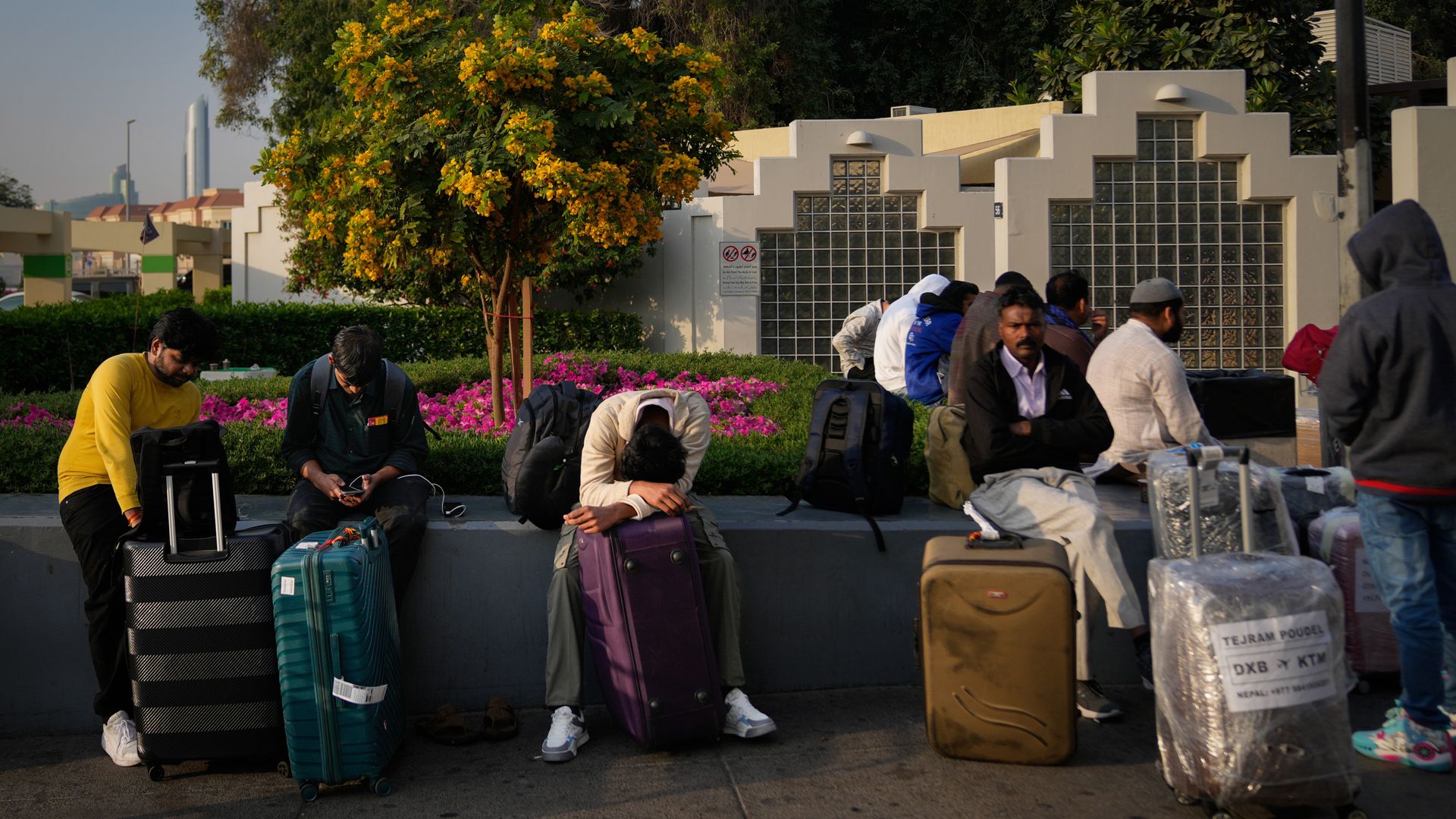
The shadow of a drone is small, but in the glass-and-steel canyons of Dubai, it feels large enough to eclipse the sun.
For years, the relationship between Washington and Tehran was a series of headlines—abstract, distant, and confined to the dry prose of diplomatic cables. But when the rhetoric shifted from posturing to physical strikes, the ripples didn't stop at the Persian Gulf’s edge. They washed up on the beaches of the Jumeirah, into the gold souks of Deira, and through the boardrooms of the DIFC.
To understand the weight of a geopolitical grudge, you have to look at a man like "Arash."
Arash is a hypothetical composite of the thousands of Iranian-born entrepreneurs who have built their lives in the United Arab Emirates. He owns a small trading firm that moves everything from heavy machinery to high-end electronics. For Arash, a tweet from the White House or a televised speech from the Grand Ayatollah isn't just news. It is a direct threat to his children's tuition. It is the reason his bank account—held by a local branch that has suddenly become skittish—might be frozen by tomorrow morning.
Dubai has always been a miracle of neutrality. It is the place where everyone comes to trade when they cannot talk to each other anywhere else. It is the Switzerland of the sands. Yet, when the conflict between Donald Trump’s administration and the Iranian leadership turned "personal," that neutrality began to fray at the edges.
The Geography of a Grudge
Look at a map.
The distance between Dubai and the Iranian coast is roughly 100 miles. On a clear day, from the top of the Burj Khalifa, the horizon feels like a thin, vibrating string held taut between two worlds. One world is an international hub of hyper-capitalism, luxury influencers, and global finance. The other is a revolutionary state under a decades-long siege of sanctions.
When the "Maximum Pressure" campaign began, it wasn't just a policy paper. It was a suffocating blanket. The logic in Washington was simple: if you squeeze the Iranian economy hard enough, the leadership will break. But the UAE is the lungs through which the Iranian economy breathes. When you squeeze the neck, the lungs are the first to feel the burn.
Consider the dhows. These traditional wooden sailing vessels have crossed the water for centuries, carrying carpets, spices, and increasingly, refrigerators and car parts. They are the capillaries of a massive, informal trade network. During the height of the tensions, the captains of these ships began to look at the horizon with a new kind of dread. A stray mine, a misidentified tanker, or a sudden seizure by the Revolutionary Guard could turn a routine cargo run into an international incident.
The Invisible Tax of Uncertainty
Conflict is expensive, even if a single shot is never fired.
In the real estate offices of Dubai Marina, the tension manifested as a quiet, steady withdrawal. For decades, Iranians were among the top five nationalities investing in Dubai property. They saw the city as a safe harbor—a place to park wealth that the rial’s volatility couldn't touch.
But as the "war" became personal, that harbor started to feel like a trap.
New regulations, driven by the need to comply with U.S. sanctions, meant that having an Iranian passport became a liability. Imagine trying to buy a home, or even rent an office, and being told that your nationality makes you a "high-risk" entity. This is the human cost of high-level statecraft. It is the humiliation of a middle-class family being told their money is no longer good, not because of what they did, but because of where they were born.
The fear wasn't just about money. It was about the physical reality of living in a target zone.
When the 2019 attacks on tankers in the Gulf of Oman occurred, followed by the strike on Saudi Aramco’s facilities, the "indestructible" image of the Gulf began to crack. Dubai sells one thing above all else: stability. People don't move to a desert to live in a war zone; they move there because it’s the one place where the chaos of the Middle East supposedly cannot reach.
If that illusion fails, the economy fails.
A Tale of Two Cities
In Tehran, the rhetoric was defiant. In Washington, it was aggressive. In Dubai, it was silent.
The UAE government found itself in an impossible position. They are a core ally of the United States, hosting thousands of American troops at Al Dhafra Air Base. Yet, they are also a neighbor to a power that could, in theory, shut down the world’s most important oil transit point in an afternoon.
The personal nature of the conflict—the way leaders traded insults on social media—removed the professional "buffer" that usually exists in diplomacy. When politics becomes a vendetta, there is no room for the quiet, back-channel deals that keep a region like the Gulf functioning.
For the shopkeepers in the "Little Tehran" district of Dubai, the pressure was felt in the price of bread and the cost of shipping. The rial plummeted. The dirham, pegged to the dollar, became an unattainable luxury.
"The water used to be a bridge," one merchant told a journalist at the time. "Now, it feels like a wall."
This wall wasn't made of stone or barbed wire. It was made of compliance forms, "Know Your Customer" protocols, and the unspoken anxiety that today might be the day the flights between Dubai and Tehran are grounded for good.
The Architecture of Fear
We often think of war as something that happens "over there." We imagine trenches, smoke, and uniforms.
But the modern war with Iran was fought in the ledger books. It was a war of attrition where the casualties were the aspirations of the merchant class.
The "personal" aspect of the Trump-Iran conflict changed the stakes because it bypassed the traditional cooling-off periods of statecraft. Decisions were made at the speed of a thumb-tap. For a city like Dubai, which operates on long-term investment cycles and twenty-year infrastructure projects, that kind of volatility is a poison.
Think about the tourism industry. Dubai thrives on being the world’s playground. But who wants to take their family to a playground if they think a missile might fly over the slide? During the peak of the 2020 tensions, after the assassination of Qasem Soleimani, the silence in the high-end hotels was deafening. The cancellations didn't just come from Americans or Europeans; they came from everywhere.
The world looked at the map and saw a flashpoint. Dubai looked at the map and saw its home.
The Resilience of the Merchant
Despite the pressure, the human element persists.
The Gulf has a long memory. It has survived the Iran-Iraq war, the Gulf War, and the Arab Spring. There is a specific kind of resilience found in a trading culture. They know that while leaders may rage and empires may rise and fall, the need to exchange goods and services is eternal.
Arash, our hypothetical trader, didn't close his shop. He found ways to adapt. He moved his logistics through third parties. He used different currencies. He tightened his belt and waited.
This is the "invisible" part of the story. For every headline about a carrier strike group moving into the region, there were ten thousand stories of people finding ways to keep their lives together in the face of tectonic shifts. They are the shock absorbers of history.
But shock absorbers can only take so much.
The real danger of the conflict becoming personal was the erosion of trust. Once you show the world that a city’s stability is contingent on the mood of a leader thousands of miles away, the "magic" of that city begins to fade. Dubai’s growth was built on the idea that it was a place where you could escape history. The war with Iran proved that no one escapes history.
The Horizon
The sun sets over the Gulf, turning the water into a sheet of hammered copper.
On the piers, the dhow captains are still loading. The cranes at Jebel Ali port continue to swing. Life has a way of smoothing over the jagged edges of a crisis, turning yesterday’s panic into today’s routine.
However, the scars remain. The bank accounts that stayed closed. The families that were split by visa bans. The businesses that vanished because they couldn't survive a three-month freeze on credit. These are the quiet casualties of a "personal" war.
The world watches the leaders. The leaders watch the polls. But the people on the ground—the ones who actually live in the 100-mile gap between ideologies—they watch the water.
They know that peace isn't just the absence of a war. Peace is the ability to trade, to travel, and to imagine a future that isn't dictated by someone else's ego. In the end, the conflict wasn't just between two governments. It was a struggle between the people who build things and the people who have the power to break them.
The merchant stands on the shore and looks toward Tehran. He looks back toward the Burj Khalifa. He is caught between a past he cannot return to and a future that feels as thin as the desert air.
He picks up his phone. He checks the news. He sighs.
And then, because there is nothing else to do, he goes back to work.
The skyscrapers continue to shimmer, beautiful and precarious, like a city built of gold and held together by nothing more than a collective hope that the wind doesn't change.