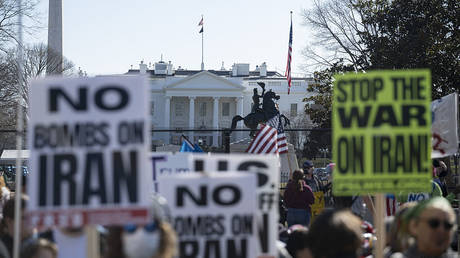
The smoke from a missile strike in the Middle East often clears long before the political dust settles in Washington. When the United States executes targeted kinetic actions against Iranian assets or leadership, the immediate military objective is usually clear, but the domestic fallout follows a predictable, jagged pattern of polarization. Americans are no longer just debating the merits of a specific strike; they are litigating two entirely different versions of national security. One side views these actions as a necessary restoration of deterrence, while the other sees them as an unconstitutional slide toward an unsanctioned regional war. This division is not merely a disagreement over tactics. It is a fundamental break in how the country defines its role in the 21st century.
The Myth of the Unified Response
In the decades following World War II, the phrase "politics stops at the water's edge" was a governing mantra. It suggested that once the commander-in-chief acted abroad, the nation stood in solidarity. That era is dead. Today, a strike on an Iranian IRGC commander or a drone manufacturing facility is instantly processed through a partisan filter.
Data from recent years shows that public support for Iranian interventions tracks almost perfectly with party affiliation. When a Republican administration strikes, Democratic support craters. When a Democratic administration takes a hard line, the opposition often critiques the move as "too little, too late" or "politically motivated." This tribalism turns intelligence assessments into Rorschach tests. We are seeing a shift where the "how" of the strike matters less to the public than the "who" ordered it.
The Deterrence Paradox
Military analysts argue that the primary goal of hitting Iranian targets is to establish "red lines." By making the cost of Iranian aggression higher than the benefit, the U.S. hopes to prevent a larger conflict. This is the logic of deterrence.
However, the American public is increasingly skeptical of this logic. To a significant portion of the electorate, every "limited strike" looks like a stepping stone to another "forever war." They see a paradox: we strike to prevent war, yet the act of striking is itself an act of war. This skepticism is rooted in the exhaustion of the post-9/11 era. Whether it is the 2020 strike on Qasem Soleimani or more recent retaliatory hits on proxy groups in Iraq and Syria, the question from the American street is the same. When does this actually end?
The Iranian government understands this internal American friction. Tehran does not need to win a conventional war against the U.S. Navy; it only needs to wait for the American public's patience to wear thin. Every internal protest and every Congressional spat over the War Powers Act is a data point for Iranian strategists. They see a superpower that is militarily unmatched but domestically overextended.
The Role of Instantaneous Misinformation
Modern strikes do not happen in a vacuum. They happen on social media in real-time. Within minutes of an explosion in Isfahan or Damascus, the information war begins.
- State-Sponsored Narratives: Iran-linked bot networks push images of civilian casualties, often recycled from other conflicts, to trigger domestic anti-war sentiment.
- Partisan Punditry: Domestically, influencers rush to frame the strike as either a brilliant tactical masterclass or a desperate distraction from internal scandals.
- Algorithmic Echo Chambers: The average citizen is fed information that confirms their existing bias. If you already believe the U.S. is an imperial aggressor, your feed will give you "proof." If you believe Iran is an existential threat, your feed will provide justifications.
This digital environment makes it impossible to have a sober, national conversation about the strategic necessity of military force. The nuance of "proportional response" is lost in a sea of 280-character hot takes.
The Legislative Vacuum
Congress has largely abdicated its role in foreign policy, leaving the executive branch to navigate these crises alone. The 2001 and 2002 Authorizations for Use of Military Force (AUMF) have been stretched to cover operations that their original authors never imagined. This legal grey area fuels public distrust.
When the President orders a strike without a fresh Congressional mandate, it creates a vacuum that is filled by conspiracy theories and partisan rage. The lack of a formal debate in the halls of power means the debate happens in the streets and on the internet, where it is far more volatile. Without a clear, updated legal framework for modern conflict, every strike against Iran will continue to be viewed by half the country as a "rogue" action.
The Economic Anxiety Factor
We cannot ignore the price at the pump. For the average American, Iran is not a map of military bases; it is a variable in the global oil market. There is a deep-seated fear that a strike will trigger a spike in energy prices, further squeezing a middle class already struggling with inflation.
This creates a transactional view of foreign policy. If a strike keeps the Strait of Hormuz open and prices stable, it is tolerated. If it leads to a regional flare-up that sends gas prices soaring, the political blowback is immediate and severe. This economic reality often outweighs ideological concerns about human rights or nuclear proliferation.
The Disconnect Between the Pentagon and the Public
Inside the E-ring of the Pentagon, Iran is a problem of geometry, payloads, and proxy networks. It is a technical challenge of containing a regional hegemon. But to a parent in Ohio or a student in California, it is a question of human cost.
The military talks about "degrading capabilities." The public thinks about "bringing the troops home." This disconnect is at the heart of the split. The government has failed to explain why a drone base in the Iranian desert matters to the security of a suburb in the Midwest. Without that narrative bridge, the military’s tactical successes will continue to be political liabilities at home.
The New Isolationism
We are witnessing the rise of a "New Isolationism" that cuts across traditional party lines. From the populist right to the progressive left, there is a growing consensus that America should stop policing the Middle East. This movement views Iran strikes not as a defense of the "liberal international order," but as an expensive hobby for the "Deep State."
This isn't just a fringe view. It is becoming a mainstream political platform. Candidates who promise to "end the wars" find a receptive audience, regardless of the strategic consequences of a U.S. withdrawal. When a strike occurs, these voices are the first to point out the schools or roads that could have been built with the cost of a single Tomahawk missile.
The Tactical Reality of 2026
As of 2026, the technology of warfare has made these strikes cleaner on paper but messier in reality. Precision-guided munitions and stealth platforms mean we can hit targets with surgical accuracy. But the "surgical" nature of the strike makes it easier for administrations to bypass the public's permission. It lowers the threshold for using force.
When war is easy to start, the public naturally becomes more suspicious of why it is being started. The ease of the "push-button" strike has removed the friction that once forced a national consensus.
Moving Toward a More Honest Dialogue
If the goal is to heal the domestic split, the solution isn't more "messaging." It is more transparency. The U.S. government needs to stop treating the American public as a passive audience to be managed and start treating them as stakeholders in a dangerous world.
- Define the End State: What does a "successful" Iran policy look like? Is it regime change, a new nuclear deal, or a permanent stalemate?
- Revisit the AUMF: Congress must vote on the record. Forces the debate into the open where it belongs.
- Acknowledge the Risk: Be honest about the potential for escalation instead of pretending every strike is a closed-loop event.
The divide over Iran strikes is a symptom of a larger American identity crisis. We are a nation that wants the benefits of global leadership without the costs, and a nation that wants security without the messy reality of maintaining it. Until we decide what we are willing to fight for—and why—every explosion in the Middle East will continue to trigger a secondary blast in our own backyard.
The next time a missile leaves a rail, don't just look at the target. Look at the data, the legal justification, and the long-term cost. Demand a strategy that survives a second glance.

.png?format=1500w)