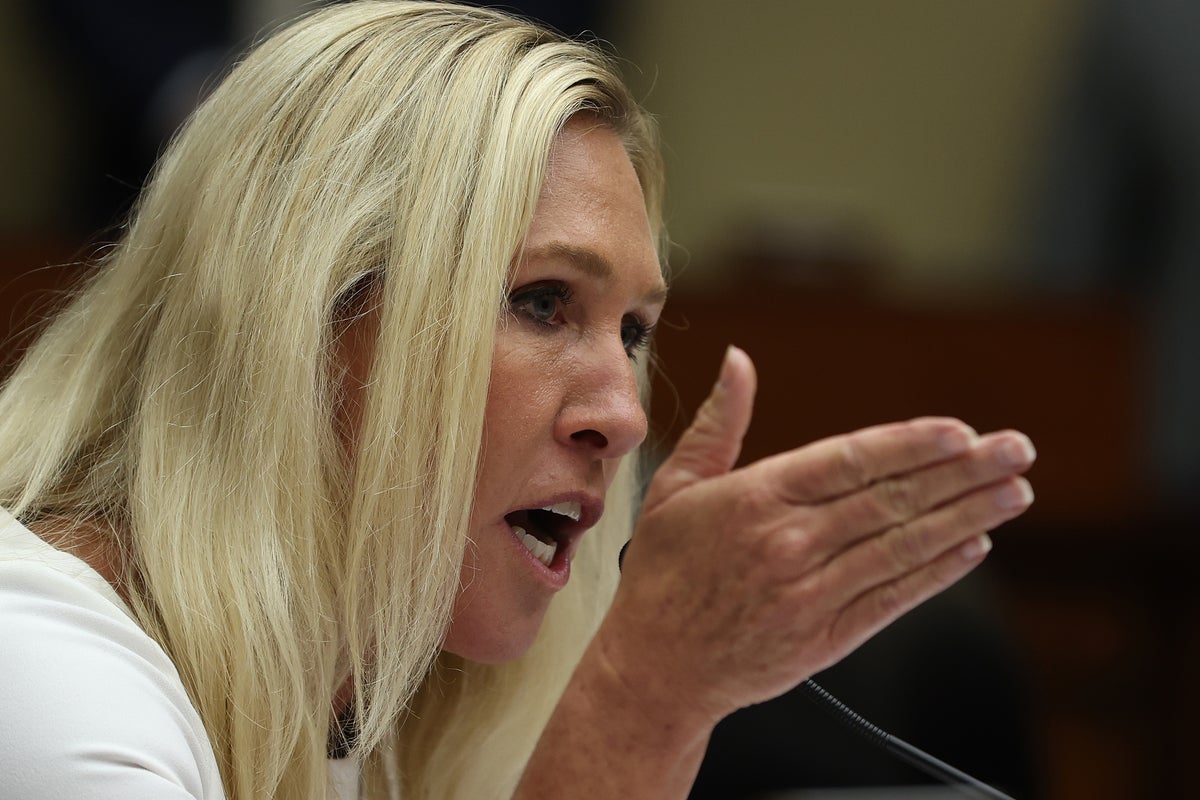
The air in the modern political arena doesn't smell like cigar smoke anymore. It smells like the ionized static of a smartphone screen and the metallic tang of a high-definition television studio. For decades, the American Right operated like a monolithic architecture—stone, mortar, and a shared set of blueprints. But look closely at the recent broadsides exchanged between Marjorie Taylor Greene, Megyn Kelly, and the anchors of Fox News, and you will see the stone beginning to spiderweb.
This isn't just a spat. It is a fundamental disagreement about what it means to be a man, what it means to lead, and where the boundaries of a nation should actually end.
The Litmus Test of the Living Room
Think of a dinner table in a small town in Ohio. On one side sits a veteran of the Bush era, a man who believes that American strength is a gift we export to the world, often at the end of a barrel. On the other sits his grandson, a young man who has watched two decades of "forever wars" result in nothing but a hollowed-out middle class and a sense of profound exhaustion. When Iran launched its recent drone and missile salvos toward Israel, that dinner table didn't just host a debate. It hosted a divorce.
The establishment—represented by the traditional voices at Fox News—reverted to the muscle memory of the 2000s. They spoke of deterrence. They spoke of American might. They spoke of the necessity of a forceful response.
Then came the counter-strike from the populist flank.
Marjorie Taylor Greene and Megyn Kelly didn't just argue against a military escalation. They went for the jugular. They targeted "manhood." By questioning whether the proponents of war were merely "tough guys" hiding behind teleprompters, they reframed the entire foreign policy debate as a crisis of authenticity.
The Ghost of the Neocon
To understand why this hit so hard, we have to look at the ghost that haunts the room. For thirty years, the conservative movement was defined by neoconservatism. It was an ideology that viewed the world as a garden that required constant weeding by an American gardener.
But the garden turned into a thicket.
The MAGA movement, at its core, is a massive immunological response to that era. When Greene calls out a news host for being a "warmonger," she isn't just talking about Iran. She is talking about the thousands of body bags that came back from Iraq and Afghanistan. She is talking about the trillions of dollars that vanished into the sands of the Middle East while the bridges in her district began to crumble.
The "manhood" comment is a specific, sharp-edged tool. In the world of high-stakes populism, bravery isn't measured by how many missiles you are willing to fire from a distance. It is measured by your willingness to stand alone against the consensus of the "Deep State" or the "Mainstream Media." To Greene and Kelly, the truly "masculine" trait isn't aggression—it’s protection. Specifically, the protection of one's own borders and one's own people.
The New Masculinity of Isolation
There is a profound irony in watching the Right debate masculinity. For a century, the conservative archetype was the soldier. The man who went over there so it wouldn't happen over here.
Now? The archetype is the gatekeeper.
Consider the hypothetical case of a young father in rural Georgia. He hears the drums of war beating on the news. Ten years ago, he might have felt a surge of patriotic duty. Today, he feels a surge of resentment. He looks at his bank account, he looks at the price of eggs, and then he looks at the billions of dollars being debated for foreign aid. When a politician like Greene suggests that the "war hawks" are overcompensating for a lack of genuine strength, she is speaking directly to that father’s skepticism.
She is suggesting that real strength is the courage to say "No" to the world.
This creates a cavernous divide within the MAGA movement itself. On one side, you have the traditionalists who believe that supporting allies like Israel is a moral and strategic imperative. On the other, you have the "America First" purists who view every foreign entanglement as a trap set by an elite class that hates them.
The Screen is the Battlefield
The medium is the message, but the medium is also the weapon.
Megyn Kelly’s involvement adds a layer of cultural credibility that is hard to ignore. She isn't a fringe legislator; she is a woman who navigated the highest peaks of corporate media and chose to jump off to build her own kingdom. When she aligns with Greene to mock the "machismo" of news anchors, she is signaling that the old guards of conservative thought no longer hold the keys to the kingdom.
The Fox News studio, once the undisputed cathedral of the American Right, now finds itself under siege from its own parishioners. The anchors are no longer the priests; they are increasingly seen as the bureaucrats of a dying empire.
The Stakes of the Schism
What happens when a movement loses its common enemy? For years, the Right was held together by what it hated. It hated the radical left. It hated overregulation. It hated the cultural shift toward progressivism.
But the Iran crisis has forced the movement to define what it loves.
Does it love the idea of American Hegemony? Or does it love the idea of a fortress America?
This isn't a policy debate that can be settled with a white paper or a committee hearing. It is an emotional struggle for the soul of the base. If the populist wing successfully redefines "strength" as "restraint," the entire architecture of American foreign policy for the next fifty years will shift.
We are watching the demolition of the post-WWII consensus in real-time. It is messy. It is insulting. It involves Twitter brawls and name-calling. But beneath the surface-level insults about "manhood" lies a terrifyingly serious question: Is the American empire worth the cost of the American home?
The Mirror of the Base
The divide is fractal. It repeats at every level. You see it in the comments sections, you see it at the rallies, and you see it in the voting patterns of the House of Representatives.
The traditionalists argue that a retreat from the world stage creates a vacuum that will be filled by chaos. They argue that "America First" will eventually lead to "America Alone." They see the populist rhetoric as a dangerous form of vanity—a performance of toughness that invites actual weakness.
The populists fire back that the traditionalists are the ones performing. They see the suits, the makeup, and the scripted outrage of the news hosts as a facade. To them, the "manhood" of the establishment is a hollow shell, propped up by defense contractor lobbyists and a desire to remain relevant in a world that has moved past them.
The tension is a live wire.
The Unseen Consequence
In the middle of this rhetorical firestorm, the actual humans involved—the soldiers, the families, the taxpayers—are often reduced to props. But their reality is the true anchor of the story. Every time a politician or a pundit uses the word "strength," a family somewhere is calculating whether that strength will require their son or daughter to deploy to a desert they can't find on a map.
The "Iran divide" isn't about Iran. Not really.
It’s about a deep-seated suspicion that the people in charge don't have skin in the game. When Greene and Kelly attack the "manhood" of the pro-war voices, they are really attacking the perceived lack of accountability. They are asking: If you want this war so badly, why aren't you the one fighting it?
It’s an old argument, popularized by folk singers in the sixties, now being wielded by the most powerful voices on the Right.
The political landscape is no longer a map of Left vs. Right. It is a map of the Center vs. the Edge. The Edge is winning because it is willing to be more visceral, more personal, and more insulting. It understands that in a world of infinite information, the only thing that sticks is an emotion.
The stone is cracking. The blueprints are being shredded. And as the dust settles, we may find that the "manhood" being debated isn't just about a few news anchors or a few congresswomen. It’s about the identity of a nation that no longer knows if it wants to be the world’s policeman or its own best friend.
The screen flickers. The notifications chime. The divide deepens.
Somewhere, in a darkened living room, a man watches the news and wonders if his country even recognizes him anymore. He sees the shouting matches and the insults, and he realizes that the people on the screen aren't just fighting over a foreign policy directive. They are fighting over the right to tell his story.
And for the first time in his life, he isn't sure who he wants to win.


