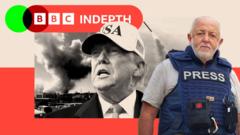
The professional punditry is currently obsessed with "uncertainty." You see it in every headline: three days into the conflict, and the experts claim we have no idea where the lines are moving or what the endgame looks like.
That is a lie. Or, at best, a comfortable admission of intellectual laziness.
The "fog of war" isn't a natural weather phenomenon that descends upon a battlefield to confuse the wise. In the modern era, it is a byproduct of looking at the wrong data points. While veteran correspondents sit in hotel lobbies waiting for official briefings, the reality of the conflict is already written in the logistics chains, the orbital shifts of private satellite constellations, and the cold logic of attrition.
Stop asking "where this is heading." Start looking at where the floor is falling out.
The Myth of the Strategic Surprise
We are told that the opening 72 hours of a modern conflict are a chaotic blur. This narrative serves the media because it allows them to sell minute-by-minute "updates" that signify nothing. In reality, the initial phase of any high-intensity engagement in the 2020s follows a predictable, almost mathematical trajectory.
The mistake most analysts make is focusing on kinetic strikes—the explosions that look good on a 24-hour news cycle. Kinetic strikes are the symptoms. The disease is the collapse of integrated air defense systems (IADS) and the electronic warfare (EW) envelope. If you can’t see the EW spectrum, you aren't watching the war; you're watching a light show.
I have spent years analyzing how state actors mask their movements. The "surprise" isn't that the attack happened; it’s that Western intelligence consumers still believe in the concept of a "fair fight" or a "balanced" escalation. When a superior force moves, the first three days aren't about taking ground. They are about deconstructing the enemy's ability to perceive reality.
If the defender’s radar goes dark and their comms start looping, the war is effectively over by hour 48. The rest is just a violent mop-up operation that the press mistakes for a "developing situation."
Logistics is the Only Truth
Amateurs talk strategy. Professionals talk logistics. This is an old cliché because it is fundamentally true, yet it is ignored every time a new conflict breaks out.
Look at the fuel. Look at the tires.
In the first three days of any invasion, the media focuses on the bravery of the defenders. Bravery, however, does not stop a T-90 or a swarm of loitering munitions when your own supply lines are severed. If an invading force has established forward arming and refueling points (FARPs) within the first 24 hours, the "uncertainty" the BBC and CNN talk about is a fantasy.
The Math of Attrition
Consider the basic equation of a high-intensity conflict:
$$R = \frac{S_t}{A_t}$$
Where $R$ is the sustainability ratio, $S_t$ is the total supply delivered to the front at time $t$, and $A_t$ is the rate of attrition of both material and personnel.
If $R$ drops below 1 for the defender for more than six consecutive hours, the front collapses. It doesn’t matter how many patriotic videos are posted to social media. It doesn’t matter what the "mood" is in the capital. The physics of the battlefield dictate the outcome.
The current "wait and see" attitude from the industry is a refusal to do the math. They see a tank burning and think it’s a sign of a shift. I see the thousand tanks behind it that haven't even engaged yet and realize the defender is trading their future for a temporary PR win.
The Social Media Distortion Field
We are living through the first era where the "first draft of history" is being written by algorithms designed to maximize engagement, not accuracy.
Every "People Also Ask" query on Google right now is some variation of "Who is winning?" The honest answer—the one that would get a journalist fired for being "biased"—is usually "the side with the better industrial base."
The public is fed a diet of "heroic stands" and "miraculous reversals." These stories are curated. They are the product of information operations (InfoOps) designed to keep morale high and foreign aid flowing. While these are useful tools for a government under fire, they are poison for a serious analyst.
- Fact: A video of a drone dropping a grenade on a single soldier is not a tactical trend.
- Fact: Capturing a border town with no strategic value is a distraction, not a breakthrough.
- Fact: If the aggressor still controls the skies, the ground movement is eventually irrelevant.
We’ve seen this before. In the early stages of the 2003 invasion of Iraq, or the 2022 escalation in Ukraine, the initial "confusion" was actually just a gap between the reality on the ground and the speed at which the public could process the death of their preconceived notions.
The "Unknown" is a Narrative Device
When Jeremy Bowen or any other veteran correspondent says we "have no idea" where this is heading, they are protecting their reputation. If they make a call and they’re wrong, they lose credibility. If they claim "it's complicated," they remain the sage on the hill.
But it’s not that complicated.
Wars end when one side can no longer physically sustain the cost of the fight. You can project this by looking at:
- Mean Time Between Failure (MTBF) of key equipment in combat conditions.
- Caliber parity: Does the defender have enough shells to match the invader’s fire rate? (Usually, the answer is no).
- The Deep State of Finance: Is the aggressor’s currency holding? Are their trade partners cutting them off, or are they finding workarounds in the gray market?
If the aggressor has spent a decade building a "fortress economy," three days of sanctions aren't going to stop the tanks. Expecting an immediate collapse because of a few frozen bank accounts is the height of Western arrogance. It ignores the reality of how sovereign states actually behave when they’ve decided to go all-in.
Why the "Experts" Want You to Stay Confused
There is a massive industry built around "geopolitical risk." If the world were predictable, these people would be out of a job. They need the "fog" to justify their high-priced newsletters and consulting fees.
They will tell you that the "human element" is the great wild card. It’s a nice sentiment. It makes for great cinema. But in the age of autonomous systems, thermal imaging that sees through walls, and satellite arrays that track every moving vehicle in a 50-mile radius, the "human element" is being squeezed out of the equation.
The bravery of a 19-year-old with an AT4 is inspiring. But it is a rounding error when compared to the systematic application of massed artillery and electronic suppression.
The Unconventional Truth
The war isn't "heading" somewhere unknown. It is moving toward a conclusion that was likely decided months ago in a series of tabletop exercises in a windowless room. The only variable is how many lives are spent before the inevitable is accepted.
If you want to know what happens next, stop watching the news. Stop listening to the "boots on the ground" reports that offer only a keyhole view of the carnage.
Instead, look at the dry, boring data.
Look at the rail schedules in the aggressor's heartland.
Look at the semiconductor trade flows.
Look at the energy spot prices in the neutral capitals.
The war is a machine. If you understand how the machine is fueled and where its gears are likely to grind, the "fog" disappears.
Stop pretending we don't know. We know. We just don't like the answer.
Go look at the satellite imagery of the bridgeheads and stop waiting for a reporter to tell you it's okay to be certain.


