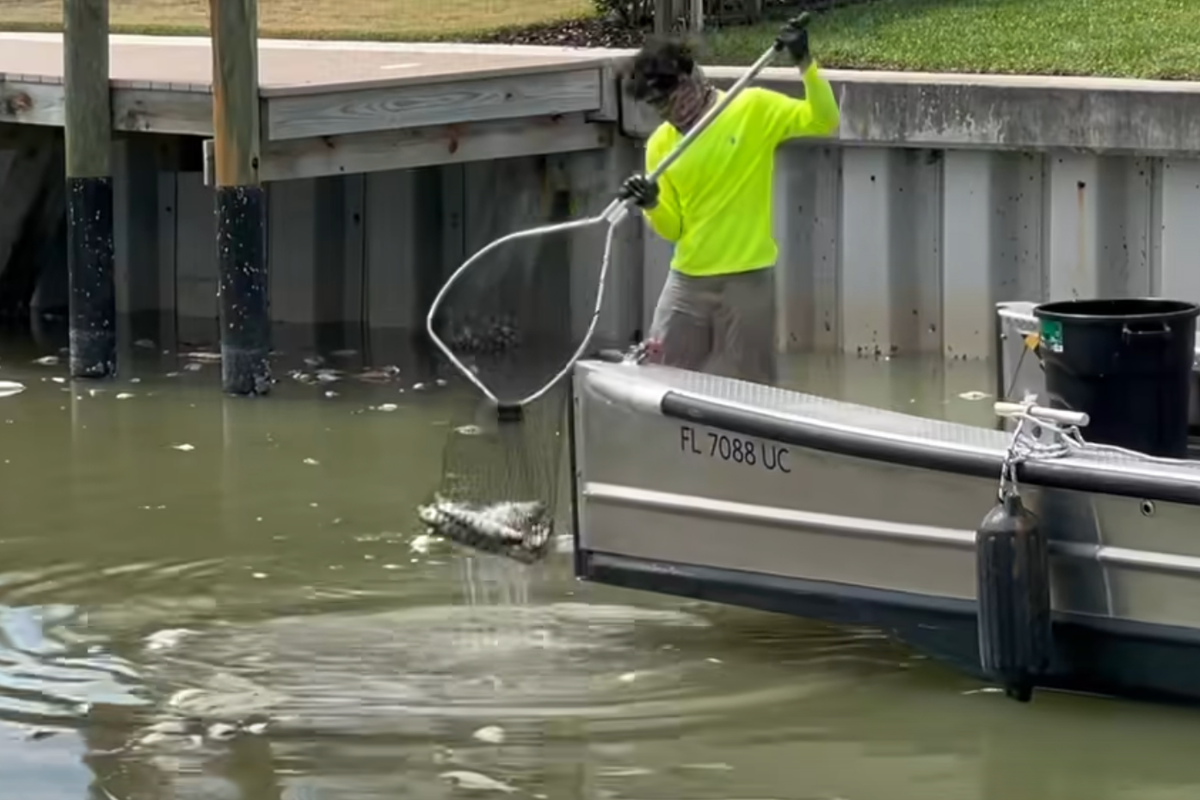
Florida’s water doesn't just look different lately. It smells like decay. In a quiet coastal town, officials recently stumbled upon a scene that's becoming hauntingly common: hundreds of fish floating belly-up, effectively suffocating in their own habitat. It’s a grim irony. These creatures live in water, yet they’re dying because they can't breathe. While the initial reports point to a "natural" process of oxygen depletion, the catalyst is anything but natural. It’s the stuff we put on our lawns to keep them emerald green.
We’re talking about fertilizer runoff. Specifically, the nitrogen and phosphorus that wash off manicured suburban landscapes and into storm drains during Florida’s frequent downpours. When those nutrients hit the warm, stagnant canal waters of places like Jupiter or St. Petersburg, they trigger an explosion of algae. That algae eventually dies and rots. The bacteria that break it down consume every scrap of dissolved oxygen in the vicinity. The result? A literal dead zone where fish have nowhere to run and nothing to inhale.
The Science of Underwater Suffocation
Most people assume fish kills happen because of "poison" in the water. That’s rarely the case with fertilizer. It’s more subtle and more devastating. Scientists call this process eutrophication. When a water body gets over-enriched with nutrients, it’s like giving a massive sugar rush to microscopic plants.
The algae bloom blocks sunlight from reaching the seagrass on the bottom. Without sunlight, the seagrass dies. Seagrass is the primary oxygen producer for many of these coastal ecosystems. So, you have a double hit: the oxygen producers are dying off, and the oxygen consumers—the bacteria eating the dead algae—are working overtime.
Dissolved oxygen levels normally fluctuate. They're higher during the day when plants are photosynthesizing and lower at night. But when a fertilizer-fueled bloom takes over, those levels crash to near zero. Fish start gasping at the surface. Their gills can't extract what isn't there. If they're trapped in a canal or a pond with limited tidal flow, they're toast. It’s a slow, agonizing way for an ecosystem to collapse.
Why Current Bans Aren't Cutting It
Florida actually has some of the strictest seasonal fertilizer bans in the country. Many counties prohibit the application of nitrogen and phosphorus between June and September. That’s peak rainy season. The logic is simple: don’t put chemicals on the ground when they’re just going to wash away in a thunderstorm.
But here’s the problem. The laws are full of holes.
First, these bans often apply to residential homeowners but have different sets of rules for golf courses or agricultural operations. Second, people still have half-used bags of "weed and feed" in their garages. They apply it in May, right before the ban starts. If we get an early tropical system or a heavy week of rain in late May, that "legal" application still ends up in the lagoon.
There's also the legacy issue. The muck at the bottom of Florida’s canals is already loaded with decades of nutrient buildup. Even if every single person stopped using fertilizer today, that "legacy load" would continue to fuel blooms for years. We aren't just dealing with today’s lawn care mistakes; we’re paying for the mistakes of the 1990s and early 2000s.
The Cost of a Green Lawn
We need to be honest about the trade-off. Is a uniform, weed-free St. Augustine grass lawn worth the death of the local fishing industry? Because that's where this is headed. When fish kills become "unusual" in frequency or size, it ripples through the economy.
Real estate values in Florida are tied to the water. Nobody wants a million-dollar waterfront home if the view consists of rotting mullet and dark, tea-colored water. Tourism takes a hit. Charter boat captains lose business. It’s an ecological disaster disguised as a landscaping preference.
Local officials often sound surprised when these events happen. They shouldn't be. The data from organizations like the Florida Fish and Wildlife Conservation Commission (FWC) and various water management districts has been screaming about nutrient loading for a long time. These "unusual numbers" of dead fish are the inevitable outcome of a state that continues to prioritize suburban aesthetics over hydrological health.
Beyond the Summer Ban
If we want to stop seeing these mass die-offs, we have to change the way we think about Florida landscapes. The obsession with non-native grasses that require constant chemical life support is the root of the issue.
Switching to native plants isn't just a "nice to do" thing for bird watchers. It’s a survival strategy for our waterways. Native plants like sea oxeye daisy or muhly grass don't need synthetic nitrogen to thrive in Florida’s soil. They’ve evolved to handle the heat and the sandy earth without being pampered.
We also need better stormwater infrastructure. Many of our older coastal developments pipe water directly from the street into the nearest canal. There’s no filtration. No retention ponds. No bioswales to soak up the nutrients before they reach the fish. Retrofitting these areas is expensive, but it’s cheaper than losing the entire Indian River Lagoon or the Caloosahatchee River.
What You Can Do Right Now
If you live in a coastal community, your choices matter more than the local government’s messaging. Don't wait for a town official to tell you there’s an "unusual" problem.
- Stop using high-nitrogen fertilizers altogether. Your lawn might not look like a golf course, but it won't be killing the local nursery for snook and redfish either.
- Plant a buffer zone. If you live on the water, leave the last ten feet of your property wild. Don't mow it. Don't fertilize it. Let the natural vegetation act as a filter for runoff.
- Check your reclaimed water. Many Florida neighborhoods use reclaimed water for irrigation. This water is already rich in nutrients. If you're using reclaimed water and adding fertilizer on top of it, you're essentially double-dosing the environment.
- Demand better from your HOA. Homeowners associations are often the biggest drivers of chemical use. They fine people for having brown spots, which forces residents to over-fertilize. Change the bylaws to allow for Florida-friendly landscaping.
The "unusual" number of fish suffocating in Florida isn't a freak accident. It’s a symptom of a broken system. We’ve traded our clear springs and vibrant estuaries for the illusion of a perfect lawn. If we don't fix the nutrient problem at the source, the only thing left in our canals will be the smell of what used to be there.