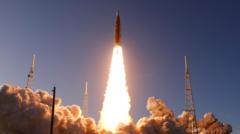
That first ping from the Artemis lunar mission isn't just data. It’s a heartbeat. When the Deep Space Network (DSN) picked up the initial signal from the Orion spacecraft, it didn't just tell engineers the hardware was alive. It confirmed that humanity’s bridge to the moon is officially open. We’ve spent decades staring at grainy 1960s footage, but this signal is different. It’s digital, high-bandwidth, and carries the weight of a permanent presence.
I’ve followed space launches for years, and there’s always this specific tension in the room before that first acquisition of signal. You can have the best rockets and the most expensive sensors, but if you can’t talk to the ship, you’ve got a billion-dollar piece of space junk. The scientists at NASA and the ESA weren't just relieved. They were ecstatic because this specific frequency confirms that the communication arrays can handle the massive data loads required for landing humans on the lunar south pole.
Why this signal matters more than Apollo’s pings
Most people think a signal is just a signal. They’re wrong. Back in the Apollo era, communication was a struggle of grainy voice transmissions and low-resolution telemetry. Artemis is a different beast entirely. This first signal proves we can maintain a high-speed link across 240,000 miles of vacuum.
We’re talking about more than just "Houston, we have a problem." This link has to support 4K live streams, complex navigation updates, and health monitoring for four astronauts simultaneously. If the signal had been weak or drifted in frequency, the entire mission timeline would’ve shifted. Instead, the clarity of the transmission shows that the Orion’s phased array antennas are performing exactly as modeled in the vacuum of space.
The role of the Deep Space Network
The DSN is basically Earth’s ears. It’s a collection of massive radio antennas in Goldstone, Madrid, and Canberra. Because the Earth rotates, we need stations scattered across the globe to keep a lock on the moon. The scientists were specifically watching the 34-meter dishes to see if the signal-to-noise ratio matched their predictions.
It did. In fact, it was cleaner than expected. That’s a huge win for the ground teams who’ve been prepping the ground stations for years. They’ve had to upgrade nearly every piece of hardware to handle the X-band and Ka-band frequencies that Artemis uses.
Technical hurdles the scientists finally cleared
Space is a noisy place. You have solar radiation, cosmic background interference, and the simple physics of signal degradation over distance. When Orion fired its engines to leave Earth's orbit, the vibration and heat could have easily knocked the antenna alignment out of whack.
The excitement we’re seeing from the team comes from the fact that the "handshake" between the spacecraft and the ground was nearly instantaneous. There was no hunting for the frequency. No panicked recalibrations. The ship knew where Earth was, and Earth knew where the ship was.
Data rates and what they mean for us
This isn't your home Wi-Fi. But for space, it’s blazing. The signal confirms we can move megabits of data per second.
- Real-time telemetry: Every sensor on Orion is sending data back about radiation levels.
- Video feeds: We are getting high-definition views of the Earth receding and the moon approaching.
- System health: The life support systems are checked every second.
Basically, if a single circuit breaker trips on Orion, the scientists in Houston know before the spacecraft’s onboard computer even finishes logging it.
The emotional weight of the lunar handshake
Scientists are usually pretty stoic. They like spreadsheets and thermal gradients. But when that first spike appeared on the monitor, the atmosphere changed. It’s the realization that the years of delays, the budget fights, and the technical setbacks are in the rearview mirror.
I’ve talked to people who work in mission control. They describe that first signal as a "digital umbilical cord." Once it’s established, the mission feels real. You aren't just looking at a rocket on a pad anymore. You’re looking at a vessel on its way to another world.
The excitement also stems from the international nature of this. This wasn't just a NASA win. The European Space Agency (ESA) provided the Service Module, which is the powerhouse of the Orion. That first signal confirmed that the American crew capsule and the European power system are playing nice together. They’re speaking the same language, electrically and digitally.
Addressing the skeptics and the technical snags
Let’s be honest. Not everything goes perfectly. Early on, there were concerns about how the Orion's power system would affect the comms. Some thought the electromagnetic interference from the solar arrays might drown out the weaker signals.
This first successful transmission puts those fears to bed. It proves the shielding works. It proves the software protocols—which have millions of lines of code—can handle the handoff between different ground stations without dropping a single packet of data.
People often ask why we can’t just use satellites like Starlink for this. The answer is distance. Starlink satellites are only a few hundred miles up. Orion is going a thousand times further. The power required to push a signal that far is immense, and the precision needed to aim it is like trying to hit a moving penny with a laser from a mile away.
How we track the mission from home
You don’t need a 34-meter dish to follow along, though it would help. NASA has been surprisingly transparent with the "Eyes on the Solar System" tool. You can actually see the real-time data being pulled from that Artemis signal.
When you see the velocity numbers change, you’re seeing the result of that signal. It’s a direct link to the physics of the mission. The scientists are currently looking at the Doppler shift in the signal. By measuring how the frequency of the radio waves changes as Orion moves, they can calculate the spacecraft’s speed down to a fraction of a millimeter per second.
Setting the stage for the moon landing
This signal is the foundation for the HLS (Human Landing System). Before we send humans down to the surface, we have to prove we can talk to them through the Gateway—the planned space station that will orbit the moon. This first Artemis signal is the proof of concept for that entire communication architecture.
If we couldn't get a clean signal now, there’d be zero chance of landing a crew in 2026 or beyond. The fact that the signal is "loud and clear" means we are on schedule. It means the lunar south pole isn't just a destination on a map; it’s a place we are already connected to.
If you want to stay updated, keep an eye on the DSN Now dashboard. It’s a public site that shows which antennas are talking to which spacecraft. When you see "Artemis" pop up on a dish in Madrid or Canberra, you’re looking at live data crossing the void. Check it during the next major engine burn. Watching the signal lock on in real-time is the closest most of us will ever get to being in mission control. Stay tuned to the live telemetry feeds—the mission is only getting faster from here.