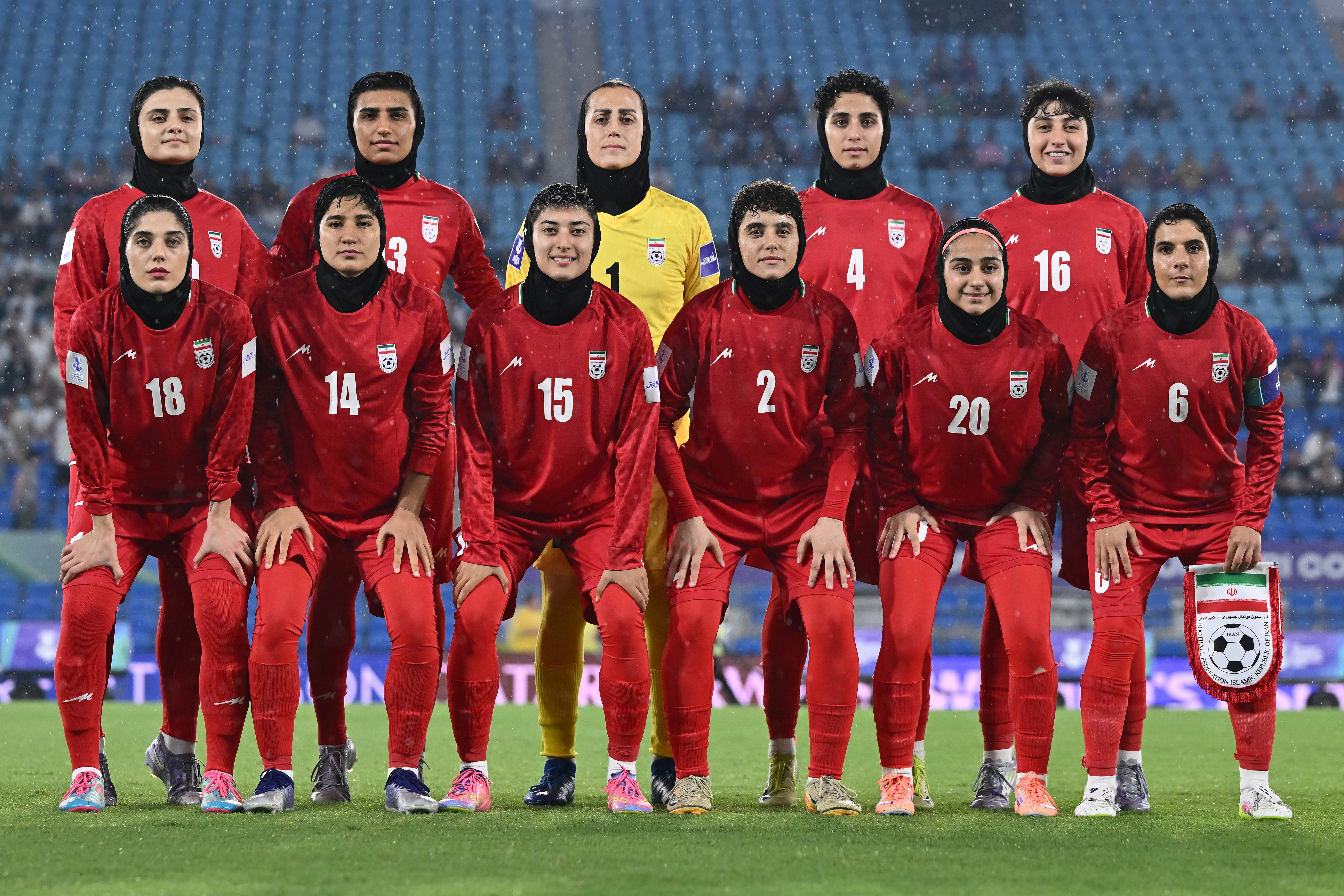
The grass under a footballer’s cleats is supposed to feel like solid ground. It is a stage of certainty, defined by white lines, ninety minutes of clear rules, and a ball that obeys the laws of physics. But for two more members of the Iranian national setup, the turf recently felt like a trapdoor.
They didn't just walk off the pitch. They walked out of a life.
When news broke that two additional members of the Iranian football delegation had claimed asylum during a trip abroad, the headlines treated it like a score update. Another two. A growing tally. A statistical trend in a geopolitical game of chess. But numbers are cold. They don't capture the sweat-slicked palms of a man standing in a foreign airport, clutching a passport that feels like a ticking bomb. They don't describe the specific, hollow ache of realizing that to save your future, you must bury your past.
Consider the weight of that choice. This isn't a career move. It isn't a "transfer" to a better league with a higher salary and a shinier car. It is an act of total erasure.
The Ghost in the Jersey
To understand why a professional athlete—someone who has reached the absolute pinnacle of their society—would choose the precarious, shivering life of a refugee, you have to look past the scoreboard.
In Iran, the jersey isn't just fabric. It’s a billboard for a regime. When you play for the national team, you aren't just representing a city or a fan base; you are a walking, breathing symbol of a government’s legitimacy. Every goal is a political victory. Every interview is a scripted performance.
Imagine a hypothetical player named Arash. Arash has spent fifteen years sprinting until his lungs burned, all for the chance to hear his national anthem play on a global stage. But as he stands on that grass, he knows that back home, the people who look like his sister or his mother are being met with batons for wanting the same air he breathes. He knows that his social media is monitored. He knows that a single "liked" post or a black wristband worn in mourning can turn him from a national hero into an enemy of the state before the half-time whistle blows.
The pressure isn't just to perform. It's to comply. When that pressure becomes atmospheric—when the very air of your homeland feels like it’s being sucked out of the room—the exit ramp of an international tournament becomes an irresistible, terrifying lifeline.
The Invisible Border on the Pitch
This isn't an isolated incident. It’s a hemorrhage.
Over the last few years, the Iranian sporting world has seen a steady exodus of its brightest lights. Wrestlers, chess grandmasters, and now, a growing contingent of the footballing elite. They are leaving behind families they may never see again. They are abandoning the roar of 80,000 fans in Tehran for the silence of a government processing center in a country where they barely speak the language.
Why now? Because the stakes have shifted from the political to the existential.
The death of Mahsa Amini in 2022 didn't just spark protests; it shattered the facade of the "apolitical athlete." Suddenly, silence was seen as complicity by the fans, while speech was seen as treason by the state. Athletes were caught in a pincer movement. If they supported the protesters, they faced prison or worse. If they stayed silent, they were booed by the very people they played for.
Football, the great equalizer, became a minefield.
When these two latest members of the delegation slipped away from their hotel or stayed behind as the team bus pulled toward the tarmac, they weren't just seeking "asylum" in a legal sense. They were seeking a version of themselves that didn't have to lie every time a microphone was shoved in their face.
The Cost of a Clean Slate
There is a misconception that claiming asylum is an easy way out.
It is a grueling, soul-crushing process of proving your own victimhood. You have to sit in rooms with fluorescent lights and convince a stranger that your life is in danger. You have to hand over your credentials, your medals, and your fame, and trade them for a case number.
For a footballer, whose entire identity is built on physical presence and public recognition, becoming a ghost is a special kind of agony. You go from being a name chanted in the streets to a man waiting for a work permit so you can wash dishes or drive a delivery van. You watch your former teammates on television, playing the game you love, while you sit in a studio apartment halfway across the world, wondering if the secret police are watching your parents back home because of what you did.
The bravery required to step into that void is immense. It is a different kind of courage than the one needed to take a penalty kick in the 90th minute. That is a sports courage. This is a human courage.
The Iranian government often dismisses these defections as "personal issues" or the result of "foreign influence." They try to diminish the men who leave, calling them traitors or weak. But the truth is much simpler and much more devastating for the authorities: people do not flee a home that feels like a home. They flee cages.
A Stadium with No Exit
We often talk about sports as an escape from reality. We turn on the match to forget about inflation, or war, or the stresses of our own lives. But for these players, the match is the reality. It is the only time they are allowed to leave the country. It is their only window to the world.
The tragedy of the Iranian national team is that they are arguably the most talented generation the country has ever produced. They are fast, technical, and possessed of a grit that comes from training under the weight of a thousand restrictions. Yet, instead of building a legacy of trophies, they are building a diaspora.
Every time a player defects, the regime tightens the leash on those who remain. More "minders" are sent on trips. Passports are confiscated the moment the plane lands. Families are used as collateral.
But you cannot guard every exit. You cannot police the heart of a man who has decided he can no longer breathe the air of a locker room filled with fear.
The two men who just claimed asylum are now safe from the immediate reach of the Revolutionary Guard. But they are not "free" in the way we usually mean it. They are in a state of suspension. They are waiting to see if the world will have a place for them once the novelty of their defection wears off. They are waiting to see if they will ever be able to play the game again without the shadow of a flag hanging over them like a shroud.
They traded the roar of the crowd for a chance to speak in their own voice. It is a lopsided trade, an expensive trade, and for many, the only trade left to make.
As the sun sets over a training ground in a country they now call a temporary refuge, these men don't look like heroes of a political movement. They look like tired men who have finally stopped running from a shadow, only to realize the shadow was the very ground they were standing on.
The game is over. The real life has just begun. It is quiet, it is cold, and for the first time in their lives, the boundaries of the pitch are wherever they choose to draw them.