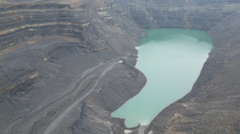
The Welsh Government has finally stepped in to decide the fate of the UK’s largest opencast coal mine, Ffos-y-fran, but the intervention arrives years late for a community left with a massive crater and a dwindling pot of restoration funds. For decades, the residents of Merthyr Tydfil were promised that once the coal was gone, the scarred earth would be transformed into a lush regional park. Instead, they are staring at a billion-pound liability. This is not just a local planning dispute; it is a systemic failure of corporate accountability and government oversight that threatens to set a dangerous precedent for industrial decommissioning across the United Kingdom.
Merthyr Tydfil has spent nearly twenty years living with the dust and noise of Ffos-y-fran. The deal was simple: the operator, Merthyr (South Wales) Ltd, would extract coal and, in exchange, fund the complete restoration of the site. That bargain has collapsed. Mining stopped in November 2023, but the "Landform Restoration" remains a distant fantasy. The Welsh Government’s decision to "call in" the restoration application takes the power away from the local council, but it does nothing to fill the 150-million-pound shortfall in the restoration fund. For a deeper dive into this area, we suggest: this related article.
The Shell Game of Corporate Liability
The financial mechanics behind Ffos-y-fran reveal a troubling trend in heavy industry. To ensure a site is cleaned up, companies are usually required to set aside "bonds" or payments into an escrow account. At Ffos-y-fran, the amount set aside was woefully inadequate. Merthyr (South Wales) Ltd, and its parent companies, have navigated a maze of corporate restructuring while the cost of fixing the site ballooned.
When the mine was first approved, the estimated cost of restoration was high, but manageable. As the years passed and the pit grew deeper, the mathematical reality shifted. The company failed to keep pace with the necessary payments. Local authorities, perhaps fearing that pushing too hard would trigger an immediate bankruptcy—leaving the council with the entire bill—allowed the deficit to grow. It was a game of chicken where the public was always going to lose. For broader details on this topic, in-depth coverage is available on TIME.
The Illusion of Private Sector Responsibility
We often hear that the "polluter pays" principle is the bedrock of environmental law. Ffos-y-fran proves that this principle is only as strong as the bank account behind it. If a company lacks the liquid assets to fulfill its obligations, the principle becomes a hollow slogan. The operator recently proposed a "revised" restoration plan that is essentially a cut-price version of the original promise. They want to leave much of the void as it is, potentially filling it with water to create a lake, rather than backfilling it to the original profiles.
This is a classic "de-scoping" tactic. By claiming that the original plan is now "technically unfeasible" or "economically unviable," the firm attempts to walk away from its legal requirements while keeping the profits from the 11 million tonnes of coal already extracted. The Welsh Government now faces a choice: hold the line and risk a messy insolvency, or approve a sub-standard restoration that leaves the people of Merthyr with a permanent scar.
Regulatory Paralysis and the Cost of Inaction
The local council's handling of the mine’s final years has been a masterclass in indecision. Mining continued for months after the official permit expired in September 2022. During this "limbo" period, coal was still being pulled from the ground and sold, yet the restoration fund did not see a proportional surge in deposits.
Campaigners and local residents pointed out the illegality of the ongoing extraction, yet enforcement was slow. This delay allowed the operator to extract the most accessible remaining coal before finally stopping when the legal pressure became insurmountable. By the time the machines went quiet, the most profitable assets were gone, leaving only the liabilities behind.
The Welsh Government’s decision to intervene is an admission that the local planning system broke down. However, the "call-in" power is a blunt instrument. It allows ministers to make the final call on the planning application, but it doesn't magically generate the tens of millions of pounds needed to move the millions of tonnes of earth required for a proper restoration.
A Warning for the Green Transition
Ffos-y-fran is a localized disaster with national implications. As the UK shifts away from fossil fuels, we are entering an era of mass decommissioning. It isn't just coal mines; it is North Sea oil rigs, gas terminals, and old manufacturing hubs. If the Ffos-y-fran model—extract the profit, stall the cleanup, and then plead poverty—is allowed to succeed, the taxpayer will be on the hook for billions in environmental remediation over the next thirty years.
The lack of mandatory, ring-fenced, and inflation-indexed restoration bonds is a glaring hole in UK industrial policy. In many US states, mining operations cannot even break ground without a third-party surety bond that covers the full cost of restoration, regardless of the company's financial health. The UK’s reliance on "trust" and "negotiated payments" has proven to be a catastrophic error.
The Human Cost of Broken Promises
For the people living on the edge of the pit in areas like Dowlais and Mountain Hare, the statistics are secondary to the daily reality. They were promised a park with trails, forests, and amenities. They were told the dust was a temporary price for a long-term community asset. Now, they face the prospect of living next to a fenced-off, dangerous "water body" for generations.
The psychological impact of industrial abandonment cannot be overstated. Merthyr Tydfil is a town built on the back of the industrial revolution; it has seen the heights of prosperity and the depths of neglect. Ffos-y-fran was supposed to be the first chapter of a new story where industry finally cleaned up after itself. Instead, it feels like a familiar tale of extraction without restitution.
Technical Hurdles and the "Lake" Myth
The company’s suggestion to simply let the pit fill with water is fraught with technical risks. An opencast mine is not a natural basin. The stability of the highwalls—the steep cliffs left behind by mining—is a major concern. Without proper backfilling and grading, these walls are prone to landslides.
Furthermore, the water chemistry in a former coal mine is rarely benign. Acid mine drainage is a persistent threat in South Wales. If the water levels are not managed with sophisticated (and expensive) pumping and treatment systems, the "lake" could become a source of pollution for the local watershed. The "passive" restoration being pitched by the operator is often just a code word for "abandonment."
The Financial Forensics of the Shortfall
Where did the money go? This is the question the Welsh Government must answer during its inquiry. Between 2007 and 2023, millions of tonnes of high-quality coal were sold to steelworks and heritage railways. While coal prices fluctuated, the mine was a productive asset for the majority of its lifespan.
A hard-hitting investigation into the cash flows between the operating company and its parent entities is required. In many similar industrial failures, we see management fees, internal loans, and dividend payments siphoning off capital that should have been reserved for environmental obligations. If the Welsh Government merely looks at the planning documents without looking at the ledgers, they are only seeing half the crime.
The Precedent of Neath Port Talbot
We have seen this play out before at the Selar and Margam mines. In those cases, the restoration was also compromised, but Ffos-y-fran is on an entirely different scale. It is the flagship of the industry. If the government allows a "restoration-lite" here, every other operator in the country will cite Ffos-y-fran as the benchmark for what they can get away with.
The Welsh Government has talked a big game about the "Well-being of Future Generations Act." This landmark piece of legislation requires public bodies to consider the long-term impact of their decisions. Leaving a massive, dangerous, and polluted hole in Merthyr Tydfil is a direct violation of the spirit of that Act. Ministers cannot claim to be leaders in sustainability while presiding over the largest environmental dereliction in modern Welsh history.
The Path Forward
The decision by the Welsh Government to take control must be followed by aggressive legal and financial action. First, there must be an independent audit of the operator’s finances to determine exactly what happened to the restoration funds. Second, the government must explore legal avenues to "pierce the corporate veil" and hold parent companies or directors personally liable for the restoration costs if negligence or asset stripping is found.
If the money truly isn't there, the government faces a grim choice. They can step in with public funds to fix the site—effectively subsidizing the coal company’s profits after the fact—or they can allow the site to remain a hazard. Neither option is palatable, but the worst outcome is continued paralysis.
The era of trusting industrial giants to do the right thing when the profits dry up is over. Merthyr Tydfil deserves the park it was promised, and the UK needs to prove that its environmental laws aren't just suggestions that can be ignored by any company with a clever enough accountant.
The Welsh Government must now decide if they are the regulators of industry or the janitors of its remains. If they don't move to secure the funding now, the Ffos-y-fran void will remain a permanent monument to a failed system of oversight.


