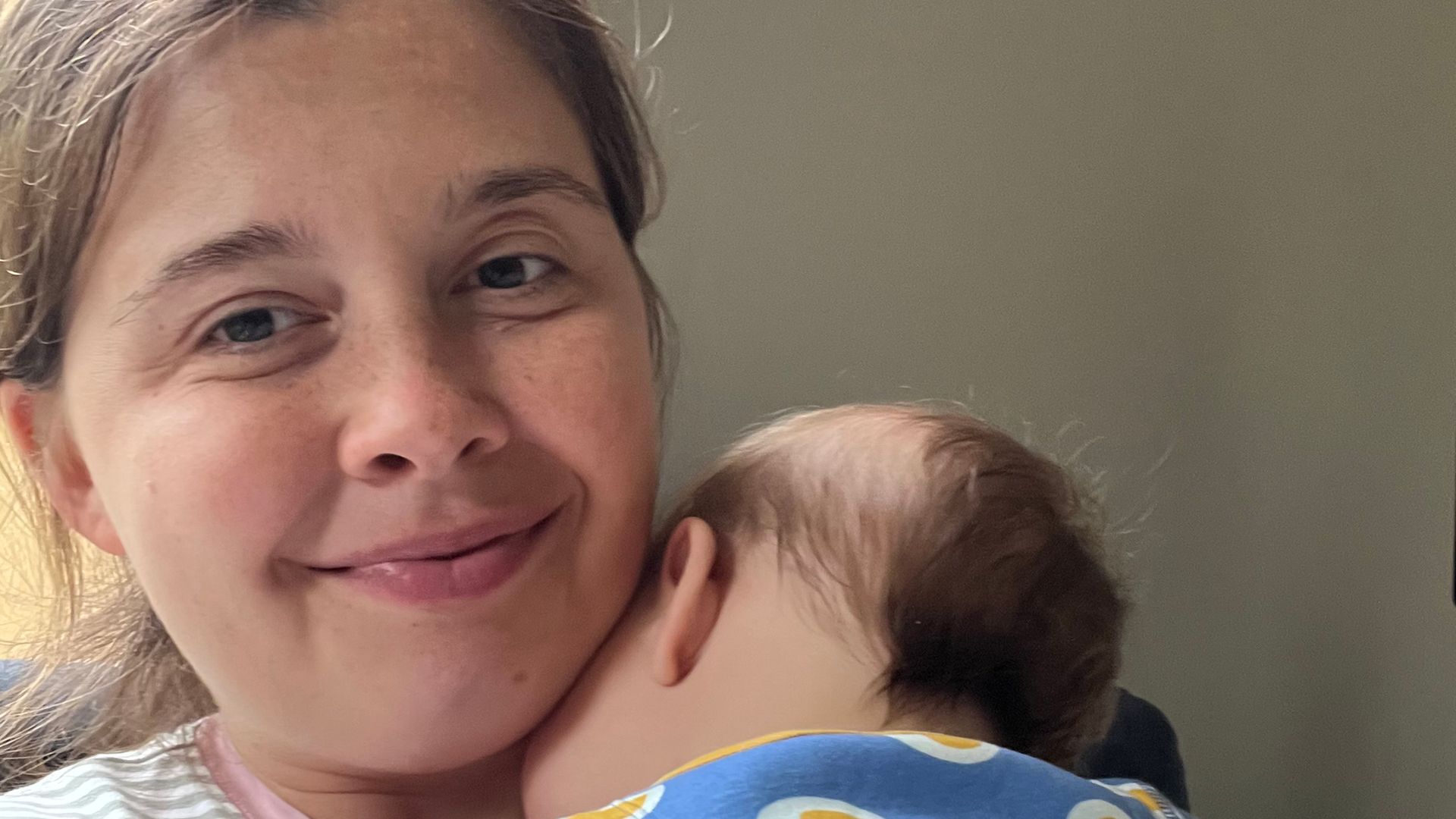
The world did not go black all at once. It dissolved into a cruel, milky haze, like a watercolor painting left out in a monsoon. For most mothers, the moments following childbirth are defined by the sharp, electric clarity of a first look—the way a newborn’s eyelashes knit together or the specific, frantic wiggle of a tiny finger. But for Jennifer, the birth of her son was the beginning of a long, suffocating veil.
A rare complication, a spike in blood pressure so violent it shattered the delicate communication between her eyes and her brain, stole the light. One day she was navigating the vibrant chaos of a nursery; the next, she was living in a sensory deprivation chamber of her own making. She could smell the talcum powder. She could hear the rhythmic, desperate cry of a hungry infant. But she could not see him. Not the color of his eyes. Not the shape of his mouth.
Blindness is often discussed in clinical terms—visual acuity, optical nerve atrophy, light perception. We treat it as a mechanical failure of a biological machine. We forget that sight is the primary currency of human connection. To lose it at the exact moment life begins is a special kind of psychological exile. Jennifer was a ghost in her own home, raising a child she knew only through the Braille of his skin.
The Architecture of the Dark
Living without sight is not just an absence of color. It is a constant, exhausting negotiation with space. Jennifer learned the precise number of steps from the crib to the changing table. She memorized the metallic click of the stove dial and the specific weight of a full bottle. But the most agonizing part of her condition was the conceptual drift.
As months bled into years, the mental image she held of her son began to fray at the edges. Was he growing the way she imagined? Did he have his father's jawline? When he laughed, did his nose crinkle? Memory is a fickle guardian, and without new visual data to reinforce it, her world became a series of echoes. She was a mother navigating a map with no landmarks, relying entirely on the grace of sound and touch to build a relationship that felt, in her darkest hours, cruelly incomplete.
The medical community often classifies these cases as "stable." Stable is a terrifying word when you are waiting for a miracle. It implies a plateau. It suggests that the damage—a result of preeclampsia-induced cortical blindness—is a closed book. The brain, they once thought, was a rigid organ. If the wiring was fried, the lights stayed off.
The Science of Second Chances
But the human brain is less like a circuit board and more like a river. It wants to flow. It wants to find a way around the debris. For years, Jennifer existed in the margins of clinical trials and specialist appointments, a data point in a sea of "unlikely candidates."
The breakthrough didn't come from a single pill or a flash of light. It came from a sophisticated surgical intervention designed to bypass the scarred tissue and re-establish the bridge between the retina and the visual cortex. Imagine a bridge that has collapsed into a canyon. You cannot simply wish the cars across. You have to build a temporary scaffolding, a bypass that allows the electrical impulses of sight to find a new path home.
The procedure was risky. It was experimental. It carried the weight of a decade’s worth of dashed hopes. But for a woman who had spent years kissing a forehead she couldn't see, the risk was irrelevant. Silence. Anesthesia. The cold, sterile hum of an operating room where the stakes were nothing less than the restoration of a person's reality.
The Moment the Veil Tore
The bandages do not come off like they do in the movies. There is no dramatic swelling of orchestral music, no instant transition from pitch black to 4K resolution. When the doctors finally began to unwind the gauze from Jennifer’s head, the room was kept in a deliberate, clinical dimness.
At first, there was only a stinging sensation. Then, a blur.
"Jennifer?" her husband whispered.
She blinked. The milky haze was still there, but it was thinner. It was vibrating. Shadows began to take on hard edges. The grey smears of the hospital room solidified into the sharp lines of a chair, the glint of a stethoscope, the blue of a nurse’s scrubs.
Then, she saw him.
Her son was no longer a collection of sounds and smells. He was a boy. A real, breathing, three-dimensional human being standing at the foot of the bed. He was older than the infant she remembered in her mind's eye, of course. He was a small person now, with messy hair and a look of profound, confused expectation.
She reached out, not to feel his way through the dark, but to bridge the gap that her eyes finally could.
"You’re so big," she whispered.
The boy didn't know how to react to a mother who was truly looking at him for the first time. He just smiled. And in that crinkle of his nose—the one she had spent years trying to visualize—the decade of darkness vanished. It was an erasure of trauma through the simple act of observation.
The Weight of the Visible
We take the "first look" for granted. We look at our phones, our reflection, the sidewalk, the sky. We consume billions of images a day until they become a background noise of existence. We forget that to see is to testify to someone else’s presence.
Jennifer’s recovery was not a finished event; it was a grueling re-education. Her brain had to relearn how to interpret depth, how to track movement, and how to filter the overwhelming sensory input of a world that had been muted for so long. Colors were too loud. Sunlight was an assault. The grocery store was a dizzying kaleidoscope of anxiety.
But every evening, she would sit and watch her son sleep. She wasn't looking for anything in particular. She was just practicing the miracle of presence. She was cataloging the rise and fall of his chest, the way the moonlight caught the edge of his blanket, and the sheer, impossible reality of his existence.
The medical facts will tell you that a specific surgical technique restored a mother’s vision. They will cite the success rate of the procedure and the recovery time of the neural pathways. But the facts are just the skeleton of the story. The heart of it is a woman who refused to let her son remain a ghost.
The miracle isn't just that she can see. The miracle is that he is no longer alone in her house. He is seen. And for a child, being truly seen by a parent is the first and most vital form of love. Jennifer now walks through a world that is sharp, bright, and occasionally overwhelming, but she never complains about the glare. She knows exactly what it cost to find the light again.
She keeps a photo of that first day on her nightstand. It’s a bit blurry, taken in a hurry by a crying nurse. In it, Jennifer is staring at her son with an intensity that looks almost like pain. It is the look of someone who has finally found a lost part of their soul and is terrified that if they blink, it might disappear back into the mist. But the mist is gone. The boy is real. And the light, for now, is here to stay.



