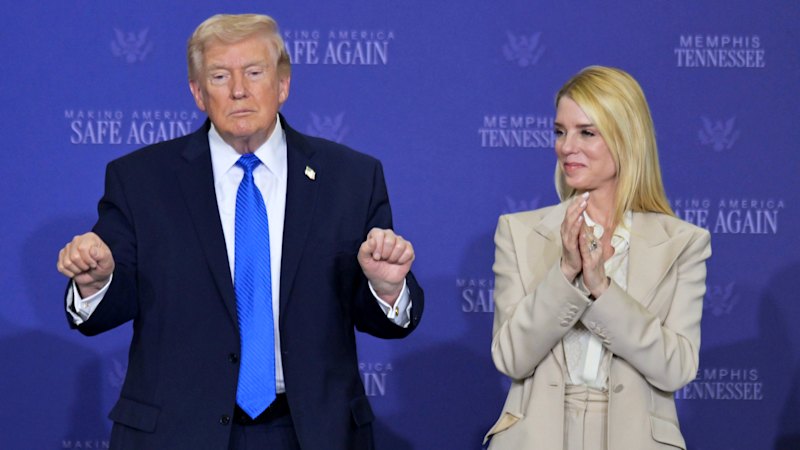
The removal of Pam Bondi as U.S. Attorney General represents more than a personnel shift; it is a stress test of the structural integrity between executive prerogative and Department of Justice (DOJ) independence. While political commentary often focuses on personality clashes, a rigorous analysis reveals a breakdown in the Executive-Institutional Alignment Loop. This mechanism requires that an appointee simultaneously satisfy the President’s policy agenda while maintaining the internal legitimacy necessary to command a 115,000-person bureaucracy. When the delta between these two requirements becomes too wide, the position becomes untenable.
The Mechanics of Executive Friction
The dismissal of a Cabinet official, particularly one as sensitive as the Attorney General, functions through three distinct pressure gradients:
- Policy Divergence: The gap between the President’s specific legal directives and the appointee’s execution strategy.
- Institutional Resistance: The friction generated by the career civil service when executive orders bypass established legal protocols.
- Political Capital Exhaustion: The point at which defending the appointee costs more in legislative or public approval than the value of their continued service.
Bondi’s departure suggests that the "Bondi-Trump Equilibrium"—the specific set of conditions that made her a viable candidate—shattered under the weight of these gradients. The DOJ operates on a foundation of stare decisis and procedural consistency. When an executive demands rapid, non-traditional shifts in litigation strategy or investigative focus, the institutional immune system of the DOJ reacts. If the Attorney General cannot bridge this gap, they are perceived by the White House as an obstacle and by the Department as a political interloper.
The Structural Anatomy of the US Attorney General Role
To understand why this specific dismissal occurred, one must deconstruct the DOJ’s dual-purpose mandate. The Attorney General is both a political appointee (Member of the Cabinet) and the nation’s chief law enforcement officer (Quasi-Independent Jurist).
This creates a Bimodal Distribution of Loyalty.
The first mode is Executive Utility. In this mode, the AG is judged on their ability to provide legal justification for the President’s platform. If the President perceives a lack of "aggression" in pursuing political rivals or defending executive orders, the utility score drops.
The second mode is Jurisprudential Integrity. Here, the AG is judged by the courts, the Bar, and the career staff on their adherence to the Constitution and the "Principles of Federal Prosecution."
The removal of Bondi indicates a failure to navigate this bimodal distribution. In high-stakes executive branches, an AG who prioritizes institutional norms over executive utility is often labeled "weak," while one who ignores norms entirely risks a "Saturday Night Massacre" scenario where the Department's internal structure collapses through mass resignations.
Identifying the Catalysts for Dismissal
While the public narrative may point to specific disagreements, the underlying cause is likely found in Functional Incompatibility. We can categorize the potential catalysts into three logical buckets:
1. The Litigation Bottleneck
The DOJ is currently managing a massive volume of high-stakes litigation, ranging from immigration enforcement to antitrust actions against Big Tech. If the Attorney General fails to achieve "litigation velocity"—the speed at which the Department can move a case from filing to a favorable judgment—the President’s broader agenda stalls. A dismissal often occurs when the White House determines that the legal leadership is "over-lawyering" issues rather than finding the shortest path to a policy win.
2. The Internal Authority Deficit
Leadership in the DOJ is not merely granted by a commission; it is earned through the perceived competence of the AG’s inner circle. If Bondi was unable to secure the cooperation of the "Main Justice" career leadership, the Department’s output would decrease in quality and quantity. This creates a feedback loop where the White House receives flawed legal advice, leading to court losses, which then further erodes the President's confidence in the AG.
3. The Investigative Divergence
The most volatile area of the DOJ is the control of sensitive investigations. The "Principle of Non-Interference" dictates that the President should not direct specific criminal inquiries. However, the political reality of the current administration often involves a desire for more direct oversight. A dismissal in this context suggests a fundamental disagreement over the Scope of Investigative Autonomy.
Quantifying the Cost of Leadership Turnover
The dismissal of an AG is not a "cost-free" maneuver. It introduces significant Institutional Churn, which can be measured through:
- Decision Paralysis: During the transition to an Acting Attorney General, major policy shifts are typically frozen. Career staff hesitate to commit to new strategies without knowing the philosophy of the permanent successor.
- Recruitment Degradation: Rapid turnover at the top makes it difficult to recruit high-caliber Deputy and Assistant Attorneys General. Top-tier legal talent is less likely to leave lucrative private sector roles for a position that may last only a few months.
- Legitimacy Discounting: Each time an AG is fired for political reasons, the "legitimacy discount" on DOJ actions increases. Judges may view the Department's filings with higher skepticism, perceiving them as political rather than legal documents.
The Successor’s Dilemma: The Strategic Pivot
The individual chosen to replace Bondi faces a rigid set of constraints. To avoid the same fate, the successor must execute a Strategic Re-Alignment based on the following framework:
- Establish a Redline Framework: Clearly define which executive requests are legally feasible and which require a "pivot" to a more defensible legal theory. This manages the President's expectations early.
- Decentralize Conflict: Instead of the AG being the sole point of friction with the White House, the successor should utilize the Office of Legal Counsel (OLC) as a buffer, using formal opinions to provide "legal cover" for either acting or refusing to act.
- Prioritize Symbolic Wins: To maintain executive confidence, the AG must deliver high-visibility "wins" in areas the President values (e.g., border enforcement or crime statistics) to build the political capital necessary to protect the Department's independence in more sensitive areas.
The dismissal of Pam Bondi serves as a data point in a broader trend of Executive Consolidation. This trend seeks to redefine the DOJ not as an independent arbiter of law, but as a direct extension of the President’s policy-making apparatus. The success or failure of this transition depends entirely on whether the next appointee can reconcile the inherent contradictions of the role or if they, too, will be consumed by the friction between the White House and the rule of law.
The move forward requires the administration to decide if it values a "Shield"—an AG who protects the President from legal overreach—or a "Sword"—an AG who uses the law to strike at political obstacles. Historically, the "Sword" approach leads to higher short-term gains but creates long-term institutional damage that eventually undermines the administration's legal standing in the Supreme Court. The immediate strategic priority for the White House is not just finding a replacement, but redefining the DOJ's operational charter to minimize the institutional friction that made Bondi's tenure untenable. Failure to address the underlying structural mismatch will result in a recursive loop of appointments and dismissals, further eroding the Department's operational capacity.


