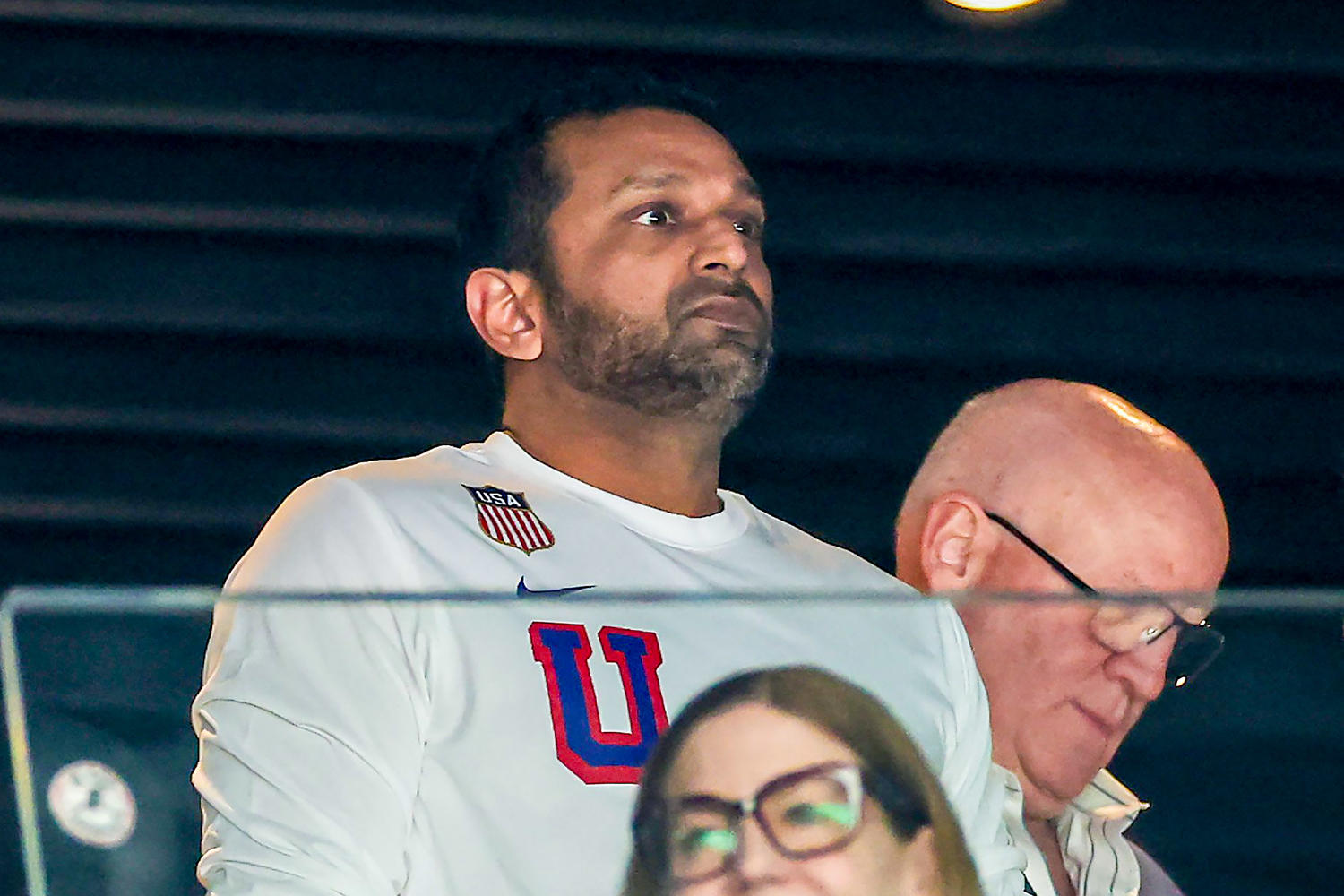
The public reprimand of FBI Director Kash Patel by President Donald Trump regarding "Olympics hijinks" represents more than a personal friction point; it is a clinical case study in Executive Alignment Failure. When a high-ranking subordinate engages in brand-diluting behavior—even while attempting to project loyalty—they create a "reputation tax" that the principal must eventually mitigate. In the high-stakes environment of federal law enforcement, where the FBI Director is the symbolic avatar of investigative sobriety, performative antics at global events create a structural misalignment between the agency’s mission and its leadership's optics.
To understand why this friction occurred, one must analyze the tension between Individual Brand Equity and Institutional Mandate. Patel’s presence at the Olympics, characterized by high-visibility social maneuvers, conflicted with the President’s requirement for a Director who project’s "law and order" stability rather than "influencer" visibility. If you found value in this piece, you might want to look at: this related article.
The Triad of Institutional Friction
The tension between the Oval Office and the FBI Director's office can be categorized into three distinct friction points that define why the "hijinks" were viewed as a strategic liability.
1. The Gravity Deficit
In the hierarchy of federal power, the FBI Director is expected to operate within a specific behavioral bandwidth. This bandwidth is defined by gravitas. When Patel engaged in informal or theatrical behavior during the Olympics, he breached the Gravitas Threshold. From an executive standpoint, any action that makes a Director look like a participant in the "spectacle" rather than an arbiter of "security" devalues the office. The President’s disapproval signals a demand for a return to a more traditional, stoic archetype of leadership. For another angle on this development, see the latest coverage from The New York Times.
2. Narrative Displacement
The primary objective of a Presidential appointee is to amplify the President’s agenda. When an appointee becomes the story—particularly for non-policy reasons like "hijinks"—they cause Narrative Displacement. The oxygen required to manage the fallout or media coverage of Patel’s personal conduct is oxygen taken away from the administration’s legislative or investigative priorities. The President’s intervention was a corrective measure to refocus the spotlight on the administration’s broader objectives rather than an individual’s personal brand-building.
3. Diplomatic and Agency Optics
The FBI maintains critical relationships with international intelligence and law enforcement partners. The Olympics serve as a high-density theater for these interactions. If the Director is perceived as being more interested in the "scene" than the "security," it creates a perception of Operational Laxity among foreign peers. The President’s reported displeasure likely reflects a concern that Patel’s conduct signaled a lack of seriousness to both the rank-and-file within the FBI and the global intelligence community.
The Cost Function of Performative Loyalty
A common pitfall for political appointees is the belief that high-energy, performative displays of loyalty act as a hedge against criticism. This is a flawed calculation. In a professional executive framework, loyalty is a baseline requirement, not a tradable asset for behavioral eccentricities.
The Cost Function of Performative Loyalty can be expressed as:
$$C_L = \frac{V_P}{I_M}$$
Where:
- $C_L$ is the cost of the behavior to the administration.
- $V_P$ is the Visibility of the Performative act.
- $I_M$ is the Institutional Maturity of the role.
As the Institutional Maturity ($I_M$) of the role increases—such as the FBI Directorship—the tolerance for high-visibility performative acts ($V_P$) decreases. When the ratio becomes unbalanced, the Executive ($Principal$) is forced to intervene to protect the brand of the organization. Patel’s Olympics activity represented a high $V_P$ in a role with maximum $I_M$, leading to an inevitable spike in $C_L$.
Behavioral Guardrails in Federal Leadership
The FBI Director operates under a unique set of constraints compared to other cabinet-level positions. While a Press Secretary or a political advisor might benefit from a degree of "hijinks" to manage the media cycle, the FBI Director is the "Chief Investigator."
- The Credibility Gap: Every time the Director appears in a context that is not strictly professional or investigative, a "credibility gap" opens. This gap is exploited by legal defense teams, political opponents, and internal detractors.
- Chain of Command Integrity: Presidential rebukes are rarely about the specific act (e.g., attending a party or taking a photo); they are about the Signal of Autonomy. If a subordinate feels comfortable enough to engage in "hijinks" without explicit clearance, it suggests a breakdown in the reporting structure.
The President’s feedback to Patel serves as a re-establishment of the Executive Boundary. It communicates that while Patel has the President's confidence to lead the bureau, he does not have the latitude to redefine the cultural norms of the position.
Strategic Realignment for the FBI Director
For Patel to bridge the gap created by this friction, a shift from Persona-Driven Leadership to Process-Driven Leadership is required. The "hijinks" were a symptom of a persona-first approach. The remedy is a rigorous adherence to the mechanics of the FBI’s mission.
- Visibility Auditing: Every public appearance must be measured against its contribution to the FBI’s core mission. If an event offers high social visibility but low investigative or administrative value, it represents a net negative for the Director’s standing with the President.
- Internal Cultural Anchoring: The Director must pivot toward reinforcing the culture of the 35,000+ employees who value anonymity and precision. "Hijinks" are culturally antithetical to the "G-Man" ethos.
- Communication Compression: Moving forward, the Director’s communication should be clinical and data-heavy. Reducing the "fluff" in public perception allows the President to view the Director as a tool of execution rather than a wild card of PR.
The incident at the Olympics functions as a stress test for the relationship between the President and his FBI Director. It reveals that the President’s patience for "outside the lines" behavior is thin, specifically when that behavior threatens the perceived integrity of a cornerstone institution.
The optimal play for the FBI Director is an immediate and total transition into Shadow Mode. By disappearing from the social and "hijinks" circuit and reappearing only in the context of high-impact indictments, counter-intelligence successes, and operational efficiency gains, the Director can recalibrate the Executive’s perception. The President does not want a celebrity at the head of the FBI; he wants a technician. Any further deviation from the "Technician Archetype" will likely result in a permanent degradation of the Director’s political capital, regardless of previous loyalty.