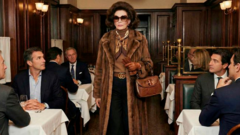
Gucci’s recent deployment of AI-generated imagery ahead of its Spring/Summer 2025 presentation represents a fundamental failure in Brand Asset Management. When a heritage house trades artisanal photography for "synthetic slop," it creates an immediate devaluation of its intangible assets. Luxury is defined by scarcity and high-cost signals; AI-generated images, characterized by blurred textures and anatomical inconsistencies, signal the opposite: infinite supply and zero marginal cost. This shift doesn't just alienate a core demographic; it fundamentally breaks the price-value perception that allows a brand to command margins of 300% or more.
The Three Pillars of Luxury Brand Integrity
The backlash against Gucci’s AI campaign can be categorized through three specific failures in luxury signaling.
1. The Cost-Signal Collapse
Luxury goods function as Veblen goods, where demand increases as the price increases because the price itself serves as a signal of status. This signal is reinforced by the high cost of production, which includes hiring world-class photographers, booking exclusive locations, and employing professional models. By utilizing generative AI—a tool with near-zero variable cost—Gucci removed the "proof of work" from its marketing. The consumer perceives a reduction in effort, which translates directly to a reduction in brand prestige.
2. The Fidelity Gap in Material Representation
High-end fashion relies on the "haptic visuality" of its marketing—the ability of a viewer to perceive the texture, weight, and quality of a fabric through a screen. Current generative models often struggle with consistent light physics and material density. When Gucci’s AI images fail to correctly render the drape of a garment or the specific grain of leather, it creates a "uncanny valley" effect. This technical failure suggests a lack of attention to detail, which is the antithesis of the Made in Italy value proposition.
3. Cultural Dilution and the Loss of Human Intent
Luxury is an expression of specific creative vision. AI models operate on the principle of "regression to the mean," essentially averaging the collective data of the internet to produce a result. This process is inherently derivative. A creative director’s role is to push boundaries; an AI’s role is to find the most probable pixel arrangement. For a brand like Gucci, which has historically thrived on eccentricity and human-led "ugly-chic" aesthetics, the transition to homogenized AI outputs represents a strategic pivot toward mediocrity.
The Technical Bottleneck of Synthetic Assets
The criticism of "AI slop" is not merely aesthetic; it is a critique of a specific technical failure. Generative Adversarial Networks (GANs) and Diffusion Models work by predicting noise patterns. In a high-stakes fashion environment, these models encounter three specific bottlenecks that result in the "slop" identified by critics.
- Anatomical Inconsistency: AI struggles with the complex geometry of the human body under specific lighting conditions. Distorted limbs or unnatural skin textures signal a lack of quality control.
- Environmental Coherence: The relationship between a model and the background in an AI image often lacks a shared "light source," making the subject appear disconnected from their surroundings. This destroys the immersion required for aspirational branding.
- Brand-Specific Constraints: General-purpose AI models are not trained on the specific archival history of a brand. Without a custom-tuned LoRA (Low-Rank Adaptation) or specialized training set, the AI produces "fashion-like" images rather than "Gucci" images.
This technical debt creates a feedback loop where the brand looks like a follower of technology rather than a leader of culture.
The Economic Risk of Algorithmic Homogenization
Fashion houses are currently miscalculating the trade-off between operational efficiency and brand equity. While the cost of a traditional campaign might range from $500,000 to $2 million, the long-term cost of brand dilution is significantly higher.
The Brand Equity Decay Function:
If $E$ is brand equity and $S$ is the proportion of synthetic vs. authentic content, we observe that $dE/dS$ is negative once $S$ crosses a critical threshold. This is because the luxury consumer pays for "exclusive human experience." As $S$ increases, the perceived exclusivity drops.
The mechanism at play here is "Contextual Inflation." When the internet is flooded with AI images, the visual language of AI becomes "cheap." By adopting this language, Gucci inadvertently associates its products with the low-tier, automated content found in dropshipping advertisements or "content farm" social media accounts.
Strategic Misalignment: Efficiency vs. Efficacy
The use of AI in the Gucci campaign highlights a confusion between marketing efficiency (doing things cheaper/faster) and marketing efficacy (driving brand desire).
The Automation Paradox
The more a brand automates its creative output, the less differentiated that output becomes. In a market where every mid-tier competitor can generate high-resolution AI images for $20 a month, the luxury brand's primary competitive advantage—its unique creative capital—is neutralized. Gucci's error was not in using AI, but in using it to replace the visible, high-value components of its branding rather than the invisible, backend optimizations.
The Audience Perception Barrier
Gen Z and Millennial luxury consumers, who are the primary targets for Gucci’s "digital-first" approach, are also the most literate in identifying AI-generated content. This demographic values "authenticity" and "transparency." When they encounter AI images in a campaign for a $3,000 handbag, they interpret it as a cost-cutting measure, not a creative choice. This creates a cognitive dissonance: why pay a premium for a product when the brand itself isn't willing to pay for a real photographer?
Operational Framework for Generative AI in Luxury
To avoid the "slop" trap, luxury houses must move away from using AI as a final output tool and instead integrate it into a "human-in-the-loop" workflow.
- Iterative Prototyping: Use AI for mood boarding and rapid concept testing, but never for public-facing assets.
- Hybridization: Employ AI for background extensions or complex lighting adjustments in shots featuring real human models and physical products.
- The "Artisanal AI" Approach: If synthetic media must be used, it must be developed using proprietary datasets and custom-trained models that reflect the brand's unique DNA, rather than off-the-shelf tools like Midjourney or DALL-E.
The objective is to ensure that AI remains a tool for the creator, not a replacement for the creation.
The Long-Term Forecast for Synthetic Luxury
We are entering a period of "Synthetic Correction." Brands that over-indexed on AI for cost-saving reasons will face a degradation in their "Heritage Score." Over the next 24 months, expect a sharp pivot back to analog mediums—film photography, hand-drawn illustrations, and physical runway experiences—as luxury houses attempt to re-establish their distance from the "digital average."
Gucci’s misstep serves as a case study in the dangers of prioritizing technological novelty over brand substance. The path forward for luxury is not to ignore AI, but to use it to enhance the human element. The true innovation will be found in "Invisible AI"—using machine learning to optimize supply chains, personalize clienteling, and refine fabric technology, while keeping the public-facing brand identity rooted in human excellence.
Brands must immediately audit their creative pipelines to identify "High-Value Human Touchpoints." Any asset that directly communicates the brand’s aesthetic to the consumer must remain human-led. The strategic play is to double down on artisanal production values while the rest of the market commoditizes itself through automation. Authenticity is becoming the ultimate luxury; those who automate it will find they have nothing left to sell but pixels.
Would you like me to develop a risk-assessment framework for your brand's AI implementation strategy?