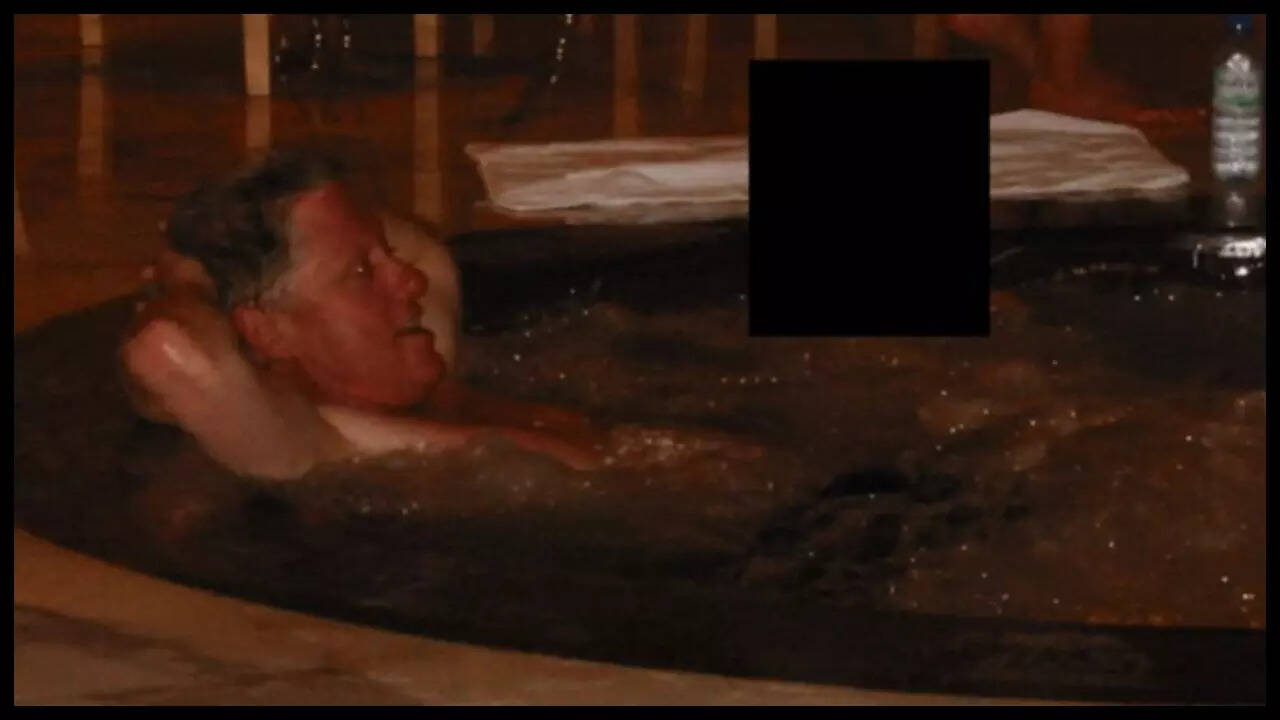
The 2002 Asian humanitarian tour involving former President Bill Clinton, Jeffrey Epstein, and Ghislaine Maxwell represents a critical case study in the intersection of non-state diplomatic actors and post-presidential influence. While tabloid narratives prioritize the salacious visual of a "hot tub photo," a rigorous strategic analysis focuses on the structural mechanics of the trip: the logistical integration of Epstein’s private transport infrastructure into the former President's public advocacy mission and the resulting erosion of traditional vetting protocols. This alignment created a high-risk environment where the boundaries between official statecraft and private billionaire interests became indistinguishable.
The Infrastructure of Influence: The Boeing 727 as a Diplomatic Asset
The primary variable in this 2002 itinerary was the utilization of Jeffrey Epstein’s Boeing 727, frequently referred to in flight manifests as the "Lolita Express." From an operational standpoint, this aircraft functioned as a mobile sovereign territory, bypassing the standard commercial or military logistics usually associated with high-level American figures. The efficiency of this asset provided Clinton with a rapid-deployment capability across Africa and Asia—spanning locations from Brunei to Bangkok—that would have otherwise required a massive bureaucratic footprint.
The cost-benefit analysis of this arrangement reveals a significant trade-off:
- Logistical Velocity: The ability to move a large entourage, including Secret Service detail and foundation staff, without the friction of commercial scheduling or the public scrutiny of government-chartered flights.
- Vetting Asymmetry: By accepting private transportation, the former President’s team effectively outsourced their security and social screening to Epstein’s organization.
- The Proximity Tax: The political cost of physical association, which, in a data-driven risk assessment, should have been flagged as a high-probability, high-impact liability given Epstein’s burgeoning legal "red flags" even at that early stage.
The Tri-Point Network: Analyzing the Social Dynamics
The presence of Ghislaine Maxwell and Bill Clinton in a shared social space—specifically the widely reported "hot tub" incident—is less about the act itself and more about the Access Elasticity Epstein cultivated. In strategic networking, access is often used as a currency. By placing a former world leader in a relaxed, non-professional environment (the hot tub at the Chiva-Som International Health Resort in Thailand), Epstein achieved a level of social "lock-in" that traditional lobbyists spend decades attempting to manufacture.
This dynamic operates under three specific pillars of power projection:
- The Validation Loop: Epstein used his association with Clinton to validate his standing among global elites, effectively "borrowing" the legitimacy of the U.S. Presidency.
- The Compromise Threshold: In intelligence circles, the goal is often to move a target from a formal setting to a casual one. Once a high-value individual is photographed in a state of undress or extreme relaxation with unvetted parties, the "Threshold of Deniability" drops.
- The Entourage Effect: The inclusion of figures like Maxwell served as a social lubricant, bridging the gap between cold political maneuvering and the high-society lifestyle that Epstein leveraged to maintain his network.
Geographical Strategy: The 2002 Itinerary as a Power Map
The choice of Asia for this specific tour was not incidental. In 2002, the region was a nexus for both humanitarian need (HIV/AIDS advocacy) and emerging billionaire wealth. The trip’s stops—Brunei, Thailand, and Hong Kong—allowed for a dual-track operation.
The Public Track
Clinton’s mission focused on the Clinton Foundation's nascent efforts to negotiate lower prices for antiretroviral drugs. This provided the "Moral Capital" necessary to justify the high-expense travel.
The Private Track
Epstein’s presence allowed him to shadow-operate within these high-level meetings. The "hot tub" incident at the Chiva-Som resort in Hua Hin, Thailand, serves as the pivot point where these two tracks collided. The resort, known for its extreme privacy, provided the "Dead Zone"—a space where typical press oversight is non-existent, and the only witnesses are the participants themselves.
The Mechanism of Plausible Deniability
A critical failure in the analysis of this 2002 trip is the assumption that the participants were unaware of the optics. A more logical framework suggests the use of Calculated Ambiguity. In this model, the former President’s staff maintains a "thin layer" of separation: they acknowledge the transport (the plane) but distance themselves from the social interactions (the resort activities).
However, the "hot tub" photograph functions as a data point that breaks this ambiguity. In forensic PR, a photo is a "hard asset" that cannot be countered by "soft denials." The presence of Chauntae Davies, a massage therapist associated with Epstein, further complicates the narrative. From a risk-management perspective, allowing an unvetted civilian into the immediate physical proximity of a protected person (Clinton) represents a catastrophic breach of Secret Service "Bubble" protocols.
The Cost Function of Post-Presidential Entanglements
The long-term impact of this 2002 association can be quantified through the lens of Reputational Degradation.
- The Immediate Yield: Clinton achieved his humanitarian goals and secured funding/support from Asian markets.
- The Deferred Debt: This debt came due in the 2010s and 2020s as Epstein’s criminal activities moved from rumors to judicial facts. Every flight mile logged in 2002 became a point of vulnerability in 2019.
- The Institutional Leakage: The Clinton Foundation’s brand became inextricably linked with Epstein’s "dark money" and "dark logistics," creating a permanent drag on its fundraising efficiency and public trust metrics.
The "hot tub" photo is not merely a piece of gossip; it is a visual receipt of a transaction. The currency was not money, but reputational equity. By entering that water, the former President effectively co-signed Epstein’s social standing, a decision that ignored the basic principles of sovereign risk management.
Strategic Realignment: The Future of High-Value Vetting
For organizations operating at the level of a former Head of State, the 2002 Epstein-Clinton-Maxwell trip serves as a "Black Swan" event—an outlier with massive consequences. To prevent such a recurrence, a shift from "Social Vetting" to "Algorithmic Vulnerability Assessment" is required.
This involves:
- Logistical Sovereignty: A mandatory ban on accepting transport assets from individuals whose net worth is derived from opaque or non-institutional sources.
- The "Optics Audit": Every itinerary must be stress-tested against the "Worst-Case Narrative" (e.g., "How does this look if my host is arrested in 10 years?").
- Decoupling Humanitarianism from High-Society: Ensuring that the "Public Track" of a mission is never facilitated by the "Private Track" of a controversial financier.
The 2002 trip was a failure of the Executive Buffer. In the pursuit of logistical ease and global influence, the actors involved ignored the fundamental law of political gravity: the higher the proximity to power, the more explosive the eventual fallout when that power is revealed to have been shared with the predatory class. The "hot tub" remains the definitive symbol of this oversight—a moment of perceived privacy that, in the age of digital permanence, became a permanent fixture of a legacy’s balance sheet.
For any entity managing the transition from public office to private influence, the operational directive is clear: the most expensive asset you can ever accept is a "free" ride from a billionaire with no clear source of legitimacy.
Would you like me to perform a similar structural breakdown of the flight manifests from the 2002-2005 period to identify other high-value overlap points?


