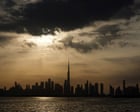
The image was always too perfect. For decades, the Gulf states—think Dubai’s shimmering glass towers, Qatar’s pristine stadiums, and Riyadh’s aggressive pivot toward luxury tourism—marketed themselves as a safe haven. They were the "Switzerland of the Middle East." You could fly in, shop at the world's biggest malls, and sip gold-flaked lattes while the rest of the region burned. But the escalating conflict in Iran just blew a hole through that marketing brochure.
It’s a wake-up call for anyone who thought geography didn't matter if you had enough money. When missiles start flying across the Persian Gulf, the distinction between a "war zone" and a "luxury hub" vanishes in seconds.
Why the luxury shield is failing
The Gulf’s success relied on a specific kind of magic trick. Leaders in the United Arab Emirates (UAE) and Saudi Arabia convinced the world that they were disconnected from their neighbors' chaos. They built an economy on "stability." If you're a Western CEO or a high-net-worth traveler, you go where the risk is low.
That risk isn't low anymore. The recent exchange of fire between Iran and regional powers has turned the flight paths over Dubai and Doha into potential tactical corridors. We aren't just talking about abstract political tension. We're talking about real-world disruptions. Global airlines are rerouting. Insurance premiums for shipping are spiking. The "peace and luxury" brand is hitting a wall because you can’t enjoy a five-star resort when the sky above it is filled with interceptors.
The conflict in Iran isn't just a border dispute. It’s a systemic threat to the entire business model of the Arabian Peninsula. These states don't produce much besides oil and "experiences." If the experiences feel dangerous, the money leaves. Fast.
The myth of the detached observer
For years, the Gulf monarchies tried to play both sides. They kept deep trade ties with Iran while hosting U.S. military bases. They wanted the benefits of a globalized economy without the baggage of a volatile neighborhood. It worked for a long time.
But the current escalation shows that neutrality is a luxury they can no longer afford. When Iran targets infrastructure or maritime routes, it doesn't always care about the "neutral" flag on a tanker. The Strait of Hormuz is a choke point that handles about a fifth of the world's oil. If that closes, the "peace" in the Gulf becomes a memory.
Look at the numbers. The tourism sector in the Middle East was projected to lead global recovery post-pandemic. Saudi Arabia's "Vision 2030" is an $800 billion bet that they can turn the desert into a global playground. But that bet assumes a baseline of security. You don't build Neom—a city of the future—next to a potential firestorm. The cognitive dissonance is becoming too loud to ignore.
What investors are actually worried about
If you talk to the people moving the money, they’re spooked. It’s not just about a temporary dip in hotel bookings. It’s about long-term capital flight.
- Supply Chain Fragility: Everything in the Gulf is imported. The food, the building materials, the talent. If the logistics routes through the Gulf are compromised, the cost of living in these "luxury" hubs hits the ceiling.
- The Talent Drain: The Gulf relies on an army of Western and Asian expats. These people are there for the tax-free salaries and the safety. If the safety goes, the talent goes back to London, Singapore, or New York.
- Sovereign Wealth Pressure: Countries like Qatar and the UAE have massive rainy-day funds. But those funds are now being diverted to defense spending and internal security rather than glamorous "giga-projects."
The reality is that "luxury" is a fragile commodity. It requires an environment where the biggest worry is the heat, not a drone strike.
The cracks in the glass towers
I’ve spent time in these cities. There’s a palpable sense of unease that hasn't made it into the official government press releases. You see it in the way people watch the news in the malls. You feel it in the shifting tone of business conferences.
The conflict in Iran has exposed the regional reality. You can't build a paradise in a vacuum. The Gulf states are physically tied to Iran by water and air. Their ports are within range of the simplest ballistic tech. The "image" was a great sales pitch, but the geography is a permanent fact.
The UAE, specifically, has tried to de-escalate. They've sent envoys to Tehran. They've tried to bridge the gap. But when the big players—the U.S. and Israel—get involved, the smaller Gulf states are essentially passengers on a very fast, very dangerous bus. They are realizing that their towers are made of glass, and the neighborhood is throwing stones.
Reassessing the region's value
Is the Gulf still a good place to do business? Maybe. But the "peace and luxury" premium is gone. You now have to price in the "conflict tax."
If you're an expat or an investor, you have to stop looking at Dubai as a standalone bubble. It’s part of a complex, interconnected web of ancient rivalries and modern grievances. The conflict in Iran didn't just break an image; it forced a return to reality. The era of the "consequence-free" Gulf is over.
Start diversifying your regional exposure. If your business depends 100% on the stability of the Persian Gulf, you're over-leveraged. Keep your bags packed and your assets liquid. The towers are still standing, but the foundation is shaking. It’s time to stop buying the marketing and start looking at the maps.