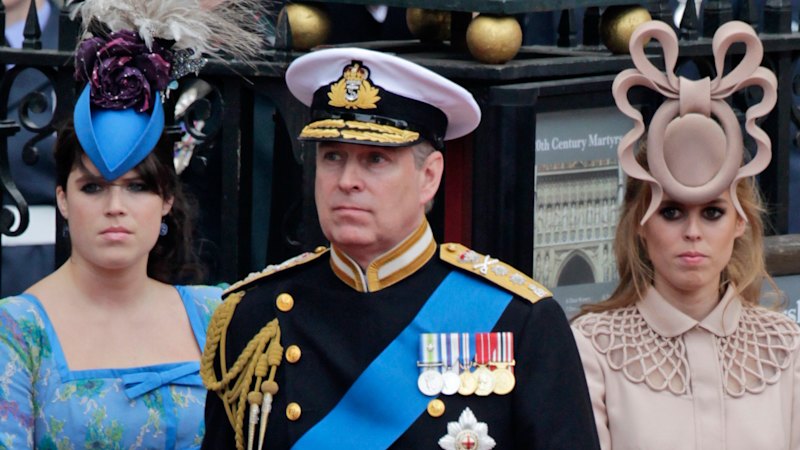
The gravel of the Windsor drive has a specific sound when trodden by royal boots. It is a sharp, rhythmic crunch—the sound of duty, of centuries of expectation, and of a family that has long understood that visibility is their only true currency. But this Easter, the rhythm is off. The silence where there should be footsteps tells a story far louder than any official palace bulletin.
Princess Beatrice and Princess Eugenie will not be walking the path to the Easter Mattins Service at St. George’s Chapel. On paper, it is a scheduling update. In reality, it is a disappearance. If you enjoyed this piece, you should look at: this related article.
For the York sisters, the walk to church has always been more than a religious observance. It was their stage. It was the place where the world analyzed the tilt of a Philip Treacy hat or the specific shade of a coat dress. It was their proof of belonging. To be absent now, amidst the long, cold shadow cast by the Mountbatten-Windsor scandal, is to acknowledge a shift in the very soil they stand on.
The Weight of a Surname
Imagine growing up in a house where the walls are literal history. You are told from birth that you represent something larger than yourself. Then, the foundation cracks. For another perspective on this development, refer to the latest update from BBC.
The scandal surrounding their father, Prince Andrew, has never just been about headlines or legal settlements. It is a corrosive force. It eats away at the edges of a reputation until there is nothing left but the bone. For years, Beatrice and Eugenie have navigated this with a quiet, almost desperate grace. They stayed. They showed up. They smiled through the flashbulbs even when the questions from the crowd were shouted with a jagged edge.
But grace has its limits. The institution of the monarchy is currently undergoing a brutal pruning. King Charles III has long envisioned a "slimmed-down" firm, a tighter, more efficient version of the royal machine. In that vision, the "blood princesses"—those born into the line of succession but not working as full-time royals—find themselves in a strange, topographical limbo. They are royal enough to be targets, but not royal enough to be shielded.
The Mountbatten-Windsor scandal acted as an accelerant. It gave the architects of the new monarchy a reason to pull the curtains shut. When the family gathers at St. George’s, the absence of the sisters isn't just a missed Sunday; it is the visual manifestation of a family tree being aggressively trimmed in real-time.
The Cost of the Invisible Stake
There is a specific kind of loneliness that comes from being public property. Most people think of fame as a shield, but for the York sisters, it has often been a cage. They have built lives outside the palace gates—Beatrice in the tech and venture capital space, Eugenie in the art world—yet they are tethered to a legacy they did not choose.
Consider the psychological toll of the "invisible stake." This is the unspoken agreement that their presence is a barometer for the family’s moral health. If they appear, it suggests a return to normalcy. If they stay away, it signals a crisis.
The decision for them to miss the Easter service suggests that the crisis has moved into a new phase. It is no longer about managing a PR disaster; it is about survival. The King is dealing with his own health battles, as is the Princess of Wales. The monarchy is thin on the ground. You would think, logically, that this would be the moment to bring the sisters into the fold, to let them take up the mantle and fill the gaps.
Instead, the door remains heavy and closed.
This isn't an accident. It is a strategic retreat. By keeping Beatrice and Eugenie away from the high-profile religious gatherings that define the royal calendar, the palace is attempting to decouple the "core" brand from the "tainted" branch. It is a clinical, almost surgical separation. But humans aren't made of spreadsheets and brand strategies. They are made of blood and history.
The Architecture of Exile
St. George’s Chapel is a masterpiece of Gothic architecture, but for those inside the family, it is a room of echoes. It is where they married. It is where they buried their grandparents. It is the site of their most intimate transitions, performed under the gaze of a billion people.
When the rest of the family files into those quire stalls this Easter, the empty spaces will be palpable. The absence of the sisters serves as a reminder of the fragility of the whole enterprise. The Mountbatten-Windsor scandal didn't just hurt the individuals involved; it broke the spell. It reminded the public that these are not mythical figures, but a family struggling with the same messy, tragic, and often shameful realities as anyone else.
The sisters are the collateral damage of a war they didn't start. They are the faces of a transition that feels less like an evolution and more like a dismantling.
We often talk about "the firm" as if it’s a faceless corporation, but the corporate decisions have human fingerprints. To be told—implicitly or explicitly—that your presence is a liability to your own family is a wound that no amount of royal protocol can heal. It is the ultimate exile: to be present in the line of succession, but erased from the family portrait.
The New Reality
The shift we are witnessing is permanent. The days of the sprawling, multi-generational royal balcony appearance are over. What replaces it is something far more isolated.
There is a logical deduction to be made here: the monarchy is betting its future on a very small number of people. It is a high-stakes gamble. By distancing the York sisters, they are narrowing the target, hoping that by making the family smaller, they make it harder to hit.
But there is a risk in being too small. There is a risk in losing the vibrant, if occasionally complicated, texture of the wider family. Beatrice and Eugenie represented a bridge to a younger, more modern Britain—a version of royalty that worked jobs, had careers, and navigated the world with a bit more relatability. Removing them from the narrative doesn't just solve a PR problem; it loses a connection.
The "scandal" is the reason given, but the "slimmed-down" ideology is the engine.
As the bells ring out over Windsor this Sunday, the sound will carry across the Long Walk and into the town. People will gather, cameras will be poised, and the usual suspects will emerge from their cars. But for those watching closely, the story isn't in who is there.
The story is in the silence of the gravel that remains undisturbed.
It is in the two women who, for the first time in their lives, are finding that the most powerful thing they can do for their family is to simply not exist in its presence. The pews will be filled, the hymns will be sung, and the incense will rise to the vaulted ceiling. But the image that remains is one of a shrinking circle, drawn tighter and tighter until there is barely room left to breathe.
The crown is a heavy thing, but the space where a crown used to be is often much heavier.