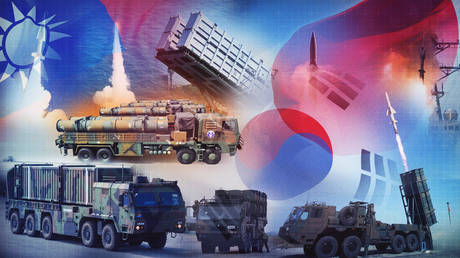
The era of relying solely on the American "nuclear umbrella" for safety in East Asia is over. You can see it in the factory lines of Japan, the testing ranges of South Korea, and the hidden silos of Taiwan. These nations aren't just buying weapons anymore; they're building massive, indigenous missile arsenals designed to strike back—hard. We're witnessing a fundamental shift from "deterrence by denial" (trying to stop an attack) to "deterrence by punishment" (promising to destroy the person who starts one).
This isn't just a reaction to a single threat. It's a calculated, frantic response to a neighborhood that’s become a warehouse of high-end explosives. While the world watches the Middle East or Ukraine, Japan, South Korea, and Taiwan are quietly turning themselves into "porcupines" with thousands of precision-guided quills.
Japan's Counterstrike Revolution
For decades, Japan’s military was basically a shield. It had great interceptors but no sword. That’s changed. The government under Prime Minister Sanae Takaichi has trashed the old 1% of GDP spending cap, aiming for 2% by 2025. The centerpiece of this new strategy? "Counterstrike capability."
Japan is no longer content waiting to be hit. They’ve realized that if you only have a shield, your opponent can keep swinging until they find a crack. By 2026, the Japanese Self-Defense Forces (JSDF) will start deploying the upgraded Type-12 Surface-to-Ship Missile (SSM). This isn't just a minor tweak to an old weapon. The new version has its range boosted from 200 kilometers to over 1,000 kilometers. That’s enough to reach deep into the Chinese mainland or North Korea from Japanese soil.
They aren't stopping there. Japan is also:
- Buying 400 U.S.-made Tomahawk cruise missiles to fill the gap while their own tech catches up.
- Developing Hyper Velocity Gliding Projectiles (HVGP) designed specifically for island defense. These fly at hypersonic speeds, making them almost impossible for current air defenses to stop.
- Investing in a massive constellation of satellites to provide the real-time targeting data these long-range missiles need.
Honestly, the "Self-Defense" label is looking more like a legal technicality every day. Japan is building a deep-strike capability that would have been unthinkable ten years ago.
South Korea and the Monster Missile
While Japan focuses on range and stealth, South Korea is obsessed with power and penetration. Their problem is unique: North Korea has spent 70 years digging. Everything important in the North—from command centers to missile factories—is buried under layers of granite.
To solve this, Seoul developed the Hyunmoo-5, also known as the "Monster Missile." This thing is a beast. It carries a conventional warhead weighing up to nine tons. To put that in perspective, most standard ballistic missiles carry about half a ton or maybe one ton. When the Hyunmoo-5 hits, it doesn't just explode; it creates a localized earthquake.
The logic here is "Korea Massive Punishment and Retaliation" (KMPR). It’s a message to the leadership in Pyongyang: even if you’re 100 meters underground, we can reach you. South Korea has already begun moving these into frontline units in late 2025. They don't need nuclear weapons to achieve strategic effects when they can drop a nine-ton hammer on a bunker.
The Three Pillars of Seoul’s Strategy
- Kill Chain: Detecting and striking North Korean missiles before they even launch.
- KAMD (Korea Air and Missile Defense): Intercepting whatever does get into the air.
- KMPR: The "Monster Missile" phase—decimating the enemy's leadership if they dare to strike.
Taiwan’s Porcupine Strategy is Reaching Critical Mass
Taiwan is in the most precarious position, and they know it. They can't match China ship-for-ship or plane-for-plane. Instead, they’ve adopted the "porcupine strategy." The idea is to make an invasion so bloody and expensive that Beijing decides it isn't worth it.
By the end of 2026, Taiwan is on track to have the highest density of anti-ship missiles in the world. They’re mass-producing the Hsiung Feng III, a supersonic "carrier killer" that skims the waves at speeds that leave very little reaction time for a ship's defense system.
Taipei is also integrating 400 American Harpoon missiles into their defense grid. Between their homegrown tech and U.S. imports, they’ll have over 1,400 missiles ready to greet any invasion fleet. They're focusing on mobile, truck-mounted launchers that are easy to hide in tunnels or forests. If China can't find the launchers, they can't stop the missiles.
Why This Isn't Your Standard Arms Race
In a typical arms race, you try to match your enemy. If they get ten tanks, you get eleven. That's not what's happening here. Japan, South Korea, and Taiwan aren't trying to match China’s total numbers. They're building asymmetric tools to exploit weaknesses.
There’s a real danger here, though. In the past, the U.S. acted as a "control rod" in the regional nuclear reactor. By providing the primary strike power, Washington could keep its allies from building their own offensive weapons. That lid is off. As the U.S. focuses on multiple fronts—Ukraine, the Middle East, and domestic politics—allies in East Asia feel they have to take their survival into their own hands.
The problem with thousands of long-range missiles is the "use it or lose it" dilemma. If a conflict starts, there's a massive incentive to fire your missiles first before the enemy destroys your launchers. This makes every crisis much more unstable. One mistake or a misinterpreted radar blip could trigger a massive exchange before anyone has a chance to pick up a phone.
What to Watch for Next
- Joint Exercises: Look for Japan and South Korea to start coordinating their missile defense data more closely, despite their historical baggage.
- Hypersonic Testing: Watch for more flight tests of Japan’s HVGP. If these work, the regional balance of power shifts overnight.
- Production Numbers: Keep an eye on Taiwan’s ability to maintain its production schedule through 2026. Any delay there is a window of vulnerability.
The missile age in East Asia isn't "coming." It’s already here. The regional powers have decided that the only way to keep the peace is to be ready for the most violent war imaginable.
If you're tracking these developments, your next step should be to look into the "Integrated Air and Missile Defense" (IAMD) initiatives being pushed by the U.S. in Guam. It’s the final piece of this regional shield-and-sword puzzle.