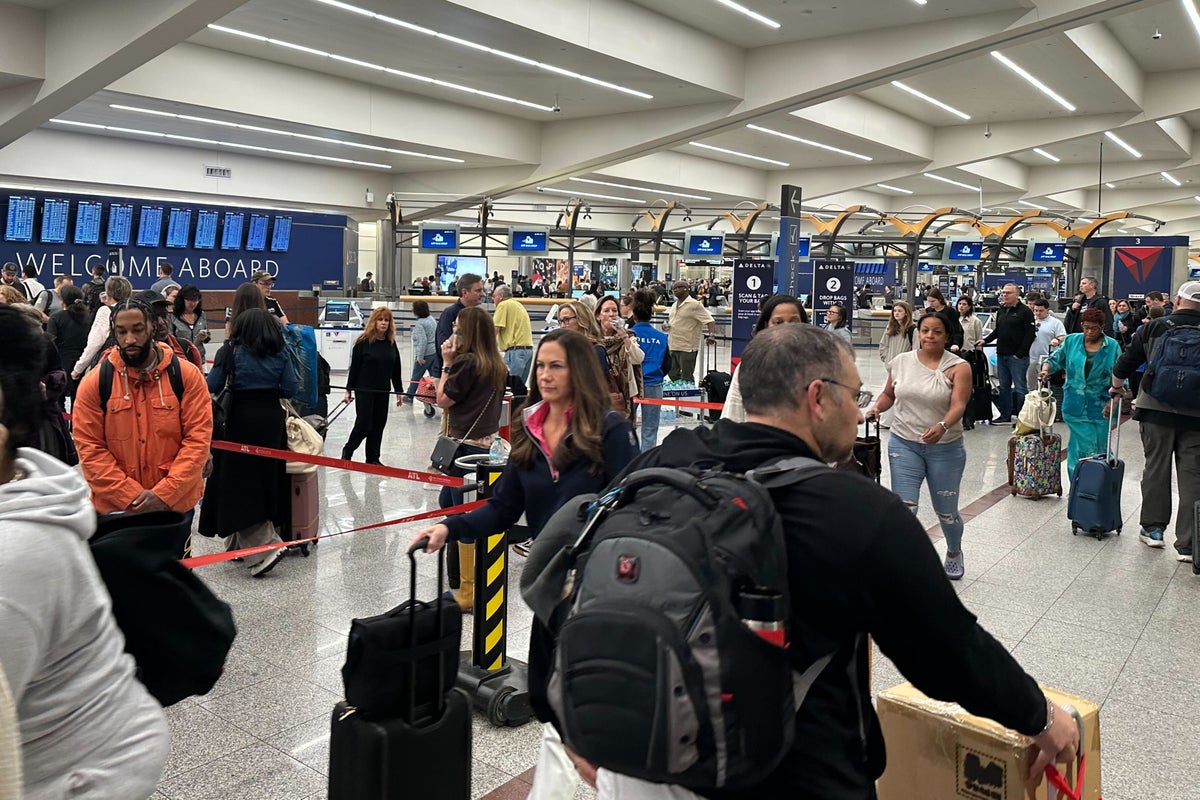
Passenger behavior in U.S. aviation has shifted from a predictable bell curve to a skewed distribution that threatens the structural integrity of terminal operations. While flight delays are typically attributed to mechanical failure or inclement weather, a significant and growing bottleneck stems from "Early Arrival Bloat." This occurs when passengers arrive three to five hours before departure, effectively treating the airport as a pre-flight staging ground rather than a transit node. This behavior creates a localized supply-demand imbalance where the physical throughput of the terminal—designed for transit—is repurposed for long-duration occupancy, overwhelming seating, security checkpoints, and baggage handling systems.
The Tri-Factor Model of Terminal Saturation
To understand why arriving early degrades the system, we must examine the terminal as a finite resource governed by three specific pressure points. When these thresholds are crossed, the efficiency of the entire airport ecosystem collapses.
1. The Security Checkpoint Throughput Lag
TSA checkpoints are engineered for specific hourly flow rates. When passengers arrive significantly ahead of their "wave" (the 60-90 minute window before their flight), they mingle with passengers whose flights are departing sooner. This creates a non-linear increase in wait times.
- Queue Stagnation: Early arrivals increase the density of the "static load" in line.
- Resource Misallocation: TSA cannot dynamically scale staffing for "invisible" surges that occur hours before peak departure blocks.
- The Clearance Friction: Security screening is a serial process; every individual added to the queue hours early adds a fixed unit of time ($t$) to the wait of the passenger arriving exactly on time for a departing flight.
2. The Gate Occupancy Deficit
Gate areas are designed based on the seating capacity of the aircraft currently at the jet bridge. When a passenger for a 4:00 PM flight arrives at 12:00 PM, they occupy a seat intended for a passenger on a 1:00 PM or 2:00 PM flight.
- Spatial Displacement: This forced displacement pushes on-time passengers into walkways, creating "gate lice" or corridor congestion that slows down the boarding process for current flights.
- Operational Drag: Increased floor density hinders the movement of flight crews and maintenance personnel, leading to "micro-delays" in turnaround times.
3. Baggage System Induction Stress
Checked luggage systems operate on a "Just-In-Time" (JIT) logic. Bags are sorted into cart arrays based on immediate flight needs.
- Storage Limitations: Most airports have limited "early bag storage" (EBS). When a bag is checked four hours early, it must be diverted to a holding area.
- Recirculation Costs: If EBS reaches capacity, the system must recirculate bags on belts or hold them in manual staging, increasing the probability of mechanical jams and missed connections.
The Psychological Feedback Loop of Inefficiency
The trend toward early arrival is a rational response to an irrational system, creating a self-reinforcing feedback loop. Passengers hear reports of long security lines, so they arrive earlier. This influx of early passengers creates the long lines they were trying to avoid. This is a classic "Tragedy of the Commons" in a transit context.
- Risk Aversion Inflation: The perceived cost of missing a flight (expensive rebooking, lost time) outweighs the perceived cost of waiting in a terminal.
- The Amenities Trap: Modern airports have transitioned into "Aerotropolises" with high-end dining and lounges. By marketing the terminal as a destination, airports have inadvertently incentivized the very behavior that clogs their transit arteries.
- Digital Uncertainty: While apps provide flight status, they rarely provide real-time, predictive "total time to gate" metrics. Without precise data, passengers default to the most conservative arrival window.
The Economic Cost Function of Early Occupancy
We can define the system-wide cost ($C$) of early arrivals using a simplified function of terminal density ($D$) and time ($T$).
$$C = \int (D_{extra} \cdot T_{occupancy}) dt$$
As $D_{extra}$ increases, the marginal utility of the terminal for the on-time passenger decreases. The airport's primary function is a transfer of kinetic energy—moving people from point A to point B. When the terminal becomes a stationary warehouse for people, the velocity of the entire system drops.
This creates a hidden tax on the aviation industry:
- Increased Labor Costs: Janitorial and security staff must manage higher volumes of people over longer periods.
- Energy Consumption: HVAC systems must work harder to regulate temperatures in over-crowded spaces.
- Retail Cannibalization: While some believe more time in the airport equals more spending, data suggests that after the 90-minute mark, "dwell time" productivity drops. Passengers become "campers," taking up table space in restaurants without ordering additional items.
Structural Bottlenecks in the "Early" Paradigm
The infrastructure of most U.S. airports—built or renovated in the late 20th century—cannot handle the modern "early arrival" volume.
The Check-In Counter Barrier
Many airlines now refuse to accept checked bags more than four hours before a flight. While this protects the baggage system, it creates a "landside" congestion crisis. Passengers who cannot check their bags congregate in the ticket hall, blocking entrances and making it difficult for departing passengers to reach kiosks. This creates a secondary bottleneck before the security process even begins.
The Digital Divide in Queue Management
The lack of a unified, airport-wide appointment system for security is a primary driver of the early arrival surge. While programs like CLEAR or TSA PreCheck offer some predictability, they do not manage the volume of arrivals. They merely re-order the queue. Without a "Time-Slot" model for airport entry, the terminal remains a first-come, first-served system that rewards the most inefficient behavior (arriving excessively early).
Re-Engineering the Arrival Window
To mitigate the systemic decay caused by early arrivals, the industry must move toward a controlled-flow model. This involves shifting the passenger mindset from "as early as possible" to "precision arrival."
Implementation of Slot-Based Security
Airports must adopt a reservations-based model for security checkpoints. By allowing passengers to book a 15-minute window for screening, the airport can flatten the arrival curve. This eliminates the "fear of the unknown" that drives passengers to arrive five hours early.
Tiered Terminal Access
A more radical approach involves restricting airside access based on departure time. If a passenger's flight is more than three hours away, their boarding pass would not grant entry through the security gate unless they have a documented connection. This would immediately clear the "static load" from the gate areas and lounges.
Data-Driven Arrival Incentives
Airlines could leverage their apps to provide dynamic "Suggested Arrival Times" based on live TSA wait data and gate congestion. This would be coupled with a "System Integrity Score" for passengers. Those who arrive within their designated window could receive priority boarding or small loyalty point increments, aligning individual behavior with system efficiency.
The Limitation of the "Early is Better" Strategy
It is a fallacy to assume that arriving early is a foolproof safety net. In many U.S. hubs, arriving too early can actually increase the risk of a missed flight.
- Gate Changes: Passengers who settle in four hours early often miss audio announcements or digital notifications regarding gate changes that happen in the hour before departure.
- Fatigue-Induced Error: Long dwell times lead to "terminal fatigue," reducing passenger alertness during the critical boarding window.
- System Overload: If a massive surge of early arrivals causes a baggage system jam, even the passenger who arrived five hours early may find their bag didn't make the flight because it was buried in the EBS.
The aviation industry is approaching a point where physical expansion cannot keep pace with behavioral inefficiency. The solution lies not in building more gates, but in reclaiming the terminal as a high-velocity transit zone. Passengers must be re-educated to understand that the "safest" arrival time is the one that aligns with the system's design capacity.
Airports should prioritize the deployment of Virtual Queueing (VQ) technology across all major hubs. By converting the physical line into a digital waitlist, the terminal can manage the flow of bodies into the secure area with surgical precision. This removes the incentive for the four-hour arrival, as the passenger is guaranteed a screening slot regardless of when they physically step onto airport grounds. The focus must shift from "handling the crowd" to "dissolving the crowd" through predictive scheduling.