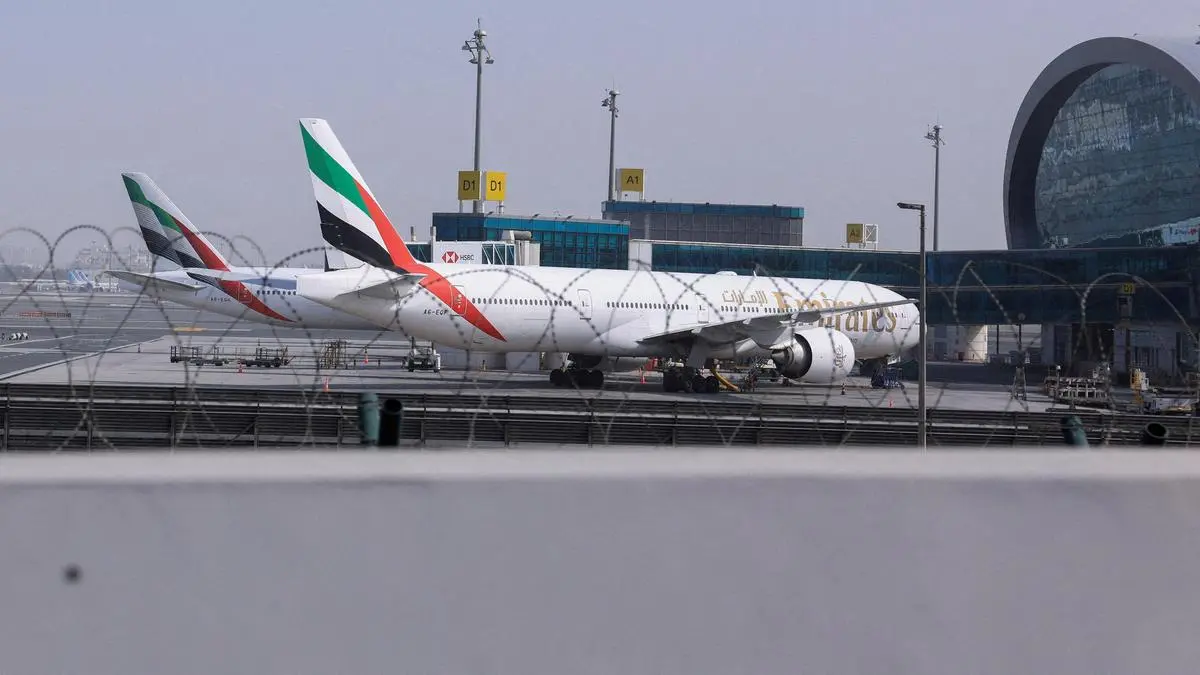
Dubai International (DXB) didn’t just pause because of a fire or a few rogue rotors. It choked because we are still treating 21st-century asymmetrical threats with 20th-century optics. The headlines are screaming about a "drone attack" and "contained fires" as if we’re reading a localized incident report. They are wrong. This wasn't a tactical success for airport security; it was a demonstration of how easily the world’s most vital logistics hubs can be paralyzed by a device that costs less than a business-class seat to London.
The mainstream narrative focuses on the "heroic" containment of the fire and the swift suspension of flights. That is the lazy consensus. If you are patting the authorities on the back for shutting down one of the busiest airspaces on the planet, you’ve already lost the plot. The suspension of flights isn't a safety protocol; it’s a white flag. It’s an admission that despite billions spent on radar, surface-to-air defenses, and "smart" borders, a plastic toy with a rudimentary payload can still dictate the global supply chain.
The Myth of the Hardened Perimeter
Security consultants love to sell the idea of a "hardened" airport. They talk about geofencing and signal jamming as if these are impenetrable digital walls. I’ve sat in the rooms where these systems are pitched. The reality is far messier. Dubai, for all its glitz and technological prowess, is a sprawling target in a region where the cost of disruption is far lower than the cost of defense.
Most "drone-defense" suites are reactive. They wait for a signature, then try to jam a frequency. But what happens when the drone is autonomous? When it doesn't need a pilot’s signal to find its way? When it uses simple optical flow or inertial navigation? You can’t jam a ghost. The fire in the vicinity of the airport isn't the story. The story is the 48-hour ripple effect across every major hub from Heathrow to Changi.
Stop Asking if the Fire is Out
People are asking, "Is the airport safe now?" This is the wrong question. You should be asking, "Why is the global aviation industry still allergic to risk-calculated operations?"
When a drone is spotted, the standard operating procedure is a total shutdown. This is a binary response to a complex problem. By grounding everything, the authorities handed the perpetrator a total victory without them needing to drop a single gram of explosive. They achieved the "denial of service" goal.
Imagine a scenario where a $500 drone causes $50 million in lost revenue, fuel burn for diverted heavies, and logistical nightmares for 100,000 passengers. The ROI for the attacker is astronomical. Until airports develop the backbone to operate through low-level interference using shielded navigation and localized kinetic interception that doesn't involve "wait and see," we are just sitting ducks with fancy duty-free shops.
The Data Gap in "Drone Attacks"
The competitor reports are heavy on "official statements" and light on technical reality. They mention "vicinity," a word used to mask the fact that security perimeters are often arbitrarily drawn. If a fire starts 500 meters outside the fence, but the smoke plume disrupts the Glide Path (GP) of the Instrument Landing System (ILS), the airport is effectively closed.
- The ILS vulnerability: High-precision landings rely on sensitive radio beams. A plume of metallic-particulate smoke or localized interference can distort these signals.
- The "Swarm" Fallacy: Everyone fears a swarm of 1,000 drones. You don't need 1,000. You need two. One to cause a distraction and one to sit in the approach path.
- The Battery Problem: We are told these threats are "contained" quickly. Yet, lithium-polymer fires—the kind found in high-end drones—are notorious for reigniting. If the "contained fire" mentioned in the news involved a battery cache, the terminal isn't safe; it’s just on a temporary ceasefire with chemistry.
Why Air Traffic Control is the Weakest Link
The bottleneck isn't the runway. It’s the human in the tower. Air Traffic Control (ATC) operates on a zero-tolerance safety margin that is increasingly incompatible with modern urban warfare. In Dubai, the integration of military and civilian airspace creates a friction point. When a "security incident" occurs, the civilian controllers are often left in the dark while the military assesses the threat. This lag is where the chaos grows.
I’ve seen this play out in smaller hubs, but at DXB, the scale makes it catastrophic. The "vicinity" of the airport is a dense urban jungle. Identifying a drone operator in that mess is like finding a specific grain of sand on Jumeirah Beach. The industry keeps promising "Remote ID" technology will solve this. It won't. Criminals don't register their drones with the FAA or the GCAA.
The Industry’s Dirty Secret
Here is the truth nobody in the aviation boardrooms wants to admit: We are currently defenseless against a sustained, low-tech drone campaign.
If an actor decides to launch one drone every three hours from a different balcony in Deira, they could keep Dubai International closed for a week. The current strategy of "suspend and sweep" is unsustainable. It relies on the attacker getting bored or running out of hardware.
We need to move toward Active Resilience. This means:
- Hardened ILS: Ground-based augmentation systems that are resistant to localized interference.
- Kinetic Interception: Stop trying to jam signals. Use directed energy or interceptor drones to physically remove the threat within seconds, not hours.
- Tiered Response: Stop grounding the whole fleet because of a sighting five miles away. Modern radar can track a bird’s heartbeat; we can certainly differentiate between a hobbyist and a kinetic threat.
The Economic Warfare Component
This wasn't just a "security incident." It was an economic stress test. Dubai thrives on its reputation as a frictionless gateway. Every minute of a flight suspension chips away at that brand. The competitors are reporting on the "smoke." You should be looking at the bond yields and the insurance premiums for regional carriers.
Insurance companies are already eyeing the "war and terror" clauses for drone-related delays. If these incidents become a monthly occurrence, the "Dubai Miracle" of logistics becomes an expensive liability. The "contained fire" is a footnote; the skyrocketing cost of insuring a flight into the UAE is the real headline.
The Misleading Nature of "Containment"
The term "contained" is a PR masterstroke. It implies control. But in the world of security, you haven't contained a threat until you’ve neutralized the source. If the operator walked away, if the launch site wasn't identified immediately, then nothing is contained. The threat has simply dissipated to be reformed elsewhere.
We are seeing a shift from traditional terrorism—which seeks high-casualty counts—to "disruption-as-a-service." It’s cleaner, cheaper, and harder to prosecute. If you kill 100 people, the world hunts you down. If you delay 100,000 people and cost an emirate $100 million, you’ve just performed a successful economic hit with almost zero risk of a drone pilot being caught.
Stop Thinking About Safety, Start Thinking About Sovereignty
This incident proves that airspace sovereignty is an illusion. If a $2,000 DJI Mavic can force a billion-dollar infrastructure project to go dark, the state does not have full control over its territory. This is the nuance the news missed. It’s not about a fire; it’s about the vulnerability of the "smart city" model. The more we rely on centralized, automated hubs, the more we empower the person with the remote control.
Fixing this requires a brutal reassessment of how we value "safety" versus "continuity." If we continue to prioritize a 0% risk profile, we give every teenager with a drone the power to shut down the global economy.
Don't look at the burnt-out wreckage near the runway. Look at the empty skies and realize that the "attack" was a success the moment the first flight was diverted. The fire was just the signal flare.
Go back and look at the flight tracking data from the hour of the "attack." You’ll see the circles. The holding patterns. That is the visual representation of a system that is failing to adapt. We are trying to fight a swarm with a shield, when we should be fighting it with a scalpel.
Stop reading the updates about when the next flight takes off. Start asking why it ever landed somewhere else in the first place. If we can’t protect a five-mile radius around the world’s most important airport, we aren't living in the future. We’re just waiting for the next battery to charge.