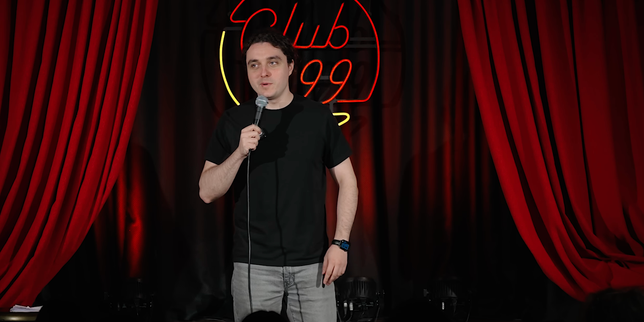
Dragos doesn't care about your borders. While most stand-up comedians spend their careers trying to "break" the American market or dominate their local scene, this Romanian-born comic is doing something much more difficult. He’s stitching together a fragmented continent through the most volatile medium possible: crowd work. If you've spent any time scrolling through comedy clips lately, you've likely seen his face. He's the guy with the sharp eyes and the quick tongue who can identify an audience member’s nationality just by the way they sit or the specific shade of their resentment toward a neighboring country.
It works because it's honest. Europe is a mess of history, ego, and linguistic barriers. Dragos, whose full name is Dragos Cristian, understands that the only way to get a room full of Germans, French, Poles, and Romanians to agree on anything is to point out how ridiculous they all look to each other. He isn't just telling jokes. He’s performing a weird kind of social diplomacy that the European Parliament could only dream of.
The Romanian perspective that conquered Berlin
Berlin is the heart of English-language comedy in Europe right now. It’s a transient city, full of expats and travelers who don't quite fit in. That’s where Dragos found his rhythm. He arrived with a background that wasn't polished for the BBC or Netflix, and that was his greatest strength. Growing up in Romania gives you a specific kind of cynicism. It's a "pull no punches" attitude that resonates with people tired of sanitized, corporate humor.
When he talks about the East-West divide, he isn't reading from a textbook. He lived it. He knows the weight of the Romanian passport. He knows the stereotypes that Western Europeans hold, and instead of being offended, he uses them as a weapon. He leans into the "scary Eastern European" trope just enough to make people comfortable before flipping the script and making the audience the butt of the joke. It's a high-wire act. One wrong word and the room turns. But he rarely misses.
You see this in his "Hungry for Love" tour and his various specials. He doesn't rely on long, scripted stories that might lose someone whose second or third language is English. He relies on the immediate. The "Who are you and why are you here?" style of comedy. By focusing on the person sitting in the front row, he makes the comedy local and universal at the same time.
Why crowd work is the ultimate European equalizer
Crowd work gets a bad rap. Some call it lazy. They think the comedian is just stalling because they don't have enough material. For Dragos, it’s the entire point. In a room with twenty different nationalities, a pre-written joke about a specific TV show in the UK will fail. But a joke about how a Swiss guy looks at his watch while a Spaniard is trying to relax? That hits every single time.
It’s about cultural archetypes. We all have them. We all know the stereotypes about the "stiff" Northern Europeans and the "chaotic" Southerners. Dragos plays these like a piano. He’s essentially a cultural translator. He takes the unspoken tensions between nations—the stuff people usually only whisper about—and puts it center stage.
- The Power of Recognition: When he identifies someone’s hometown and knows the specific, niche rivalry that town has with the next one over, he wins the room.
- The Shared Struggle: He highlights that whether you’re from Bucharest or Brussels, you’re likely annoyed by the same bureaucratic nonsense or dating app horrors.
- The Breaking of Taboos: He talks about the things that make Europe uncomfortable—migration, economic disparity, history—but he does it with a grin that suggests we’re all in on the joke.
This isn't just about laughs. It’s about building a collective identity. When a thousand people from different backgrounds laugh at the same observation about European life, the borders feel a little less permanent.
The logistics of a pan-European comedy career
Running a comedy career across Europe is a nightmare. I’m talking about taxes, travel, and the sheer exhaustion of performing in a different country every two days. Dragos has built his following almost entirely through social media and word of mouth. He didn't wait for a TV executive to give him a break. He started posting clips of his interactions with audiences, and the algorithm did the rest.
People saw themselves in his videos. A Bulgarian living in London sees a clip of Dragos roasting a Bulgarian in Berlin and thinks, "Finally, someone gets us." That digital footprint turned into ticket sales in cities that most English-speaking comics don't even consider, like Ljubljana or Tallinn.
He’s proving that there is a massive, underserved market for English-language comedy that isn't American or British-centric. There are millions of Europeans who speak English as their lingua franca. They don't want to hear jokes about the US elections or British grocery stores. They want to hear about their own weird, beautiful, complicated continent.
Breaking the mold of the typical expat comic
Most expat comics stay in their bubble. They perform for their own people. You’ll find Irish comics performing for Irish expats, or Americans performing for Americans. Dragos refused that. He could have just stayed in the Romanian circuit and done very well. Instead, he chose the harder path of performing in English to a room that looks like a UN assembly.
His style is unapologetically direct. There’s no fluff. He doesn't spend ten minutes setting up a premise. He gets straight to the point, often asking questions that would be considered rude in polite society. "What do you do? How much do you make? Why do you look so sad?" It’s this bluntness that makes him feel authentic. In a world of over-rehearsed specials, his shows feel like a conversation that could go off the rails at any second.
He also avoids the trap of being "too political" while being deeply political in essence. He doesn't preach. He doesn't tell you how to vote. He just shows you the absurdity of how we live. He points out that the things we think divide us are actually the things that make us the most similar.
What you can learn from the Dragos approach
If you’re a creator or someone trying to reach a broad audience, there’s a lesson here. Don't try to be everything to everyone. Dragos is very specific. He is a Romanian man living in Berlin talking to Europeans. Because he is so specific, he becomes universal.
Stop trying to polish your "brand" until it’s unrecognizable. People crave the rough edges. They want the guy who isn't afraid to say the "wrong" thing because it’s actually the true thing. Dragos has succeeded because he leaned into his identity rather than trying to hide it to fit a specific market.
To see this in action, you don't need a plane ticket. Just watch his crowd work sessions on YouTube or Instagram. Notice how he handles tension. When someone gets offended or a joke doesn't land, he doesn't panic. He leans into the awkwardness. He makes the failure part of the show. That’s the mark of a pro.
If you want to catch him live, look for his tour dates across the continent. He’s usually moving through the major hubs—Prague, Vienna, Amsterdam—but he pops up in smaller cities too. Go with an open mind and maybe don't sit in the front row unless you’re prepared to explain your entire life story and your country's GDP to a room full of strangers.
Check his official website for the latest "Hungry for Love" dates. Follow his socials to see the daily clips that are basically a masterclass in reading a room. Most importantly, pay attention to the comments. You’ll see people from every corner of Europe laughing together. In 2026, that’s a rare and necessary thing. Dragos is doing the work that politicians can't, one heckler at a time. Go buy a ticket and see what the fuss is about.