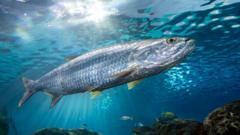
The world’s rivers are getting quieter, and not in a good way. If you look at the latest data from the Living Planet Index, the numbers are staggering. Migratory freshwater fish populations have plummeted by an average of 81% since 1970. That isn't just a "decline." It's a collapse. While we argue about carbon credits and plastic straws, the literal veins of our planet are being emptied of the life that keeps them healthy.
You might think this is just a problem for enthusiasts or people who like to spend their weekends with a fishing rod. You’re wrong. These fish—salmon, sturgeon, eel, and giant catfish—are the connective tissue of global ecosystems. They move nutrients from the deep ocean into the heart of forests. They feed millions of people. When they disappear, the whole system breaks. Discover more on a related issue: this related article.
Why the fight for migratory fish protection is failing
Most people think the biggest threat to fish is overfishing. It’s a factor, sure, but it’s far from the main culprit. The real killer is habitat fragmentation. We’ve spent the last century obsessed with damming every moving body of water we can find. There are now over 1.2 million barriers in European rivers alone. Some are massive hydroelectric dams, while others are just old, useless culverts or weirs that serve zero purpose today.
These barriers act like brick walls in the middle of a highway. Imagine trying to get home but every street you turn down is a dead end. That’s the reality for a salmon trying to reach its spawning grounds. They burn through their energy reserves hitting concrete walls and eventually die without reproducing. Further analysis by Associated Press explores comparable views on this issue.
Pollution and climate change add more pressure. As water temperatures rise, oxygen levels drop. For a species like the Atlantic salmon, which needs cold, fast-flowing water, these changes are lethal. We’re essentially cooking them out of their own homes. Honestly, it’s a miracle any of them are still around.
The myth of the fish ladder
Engineers love to talk about fish ladders as a solution. They point to these concrete steps and say, "See? The fish can just jump over the dam."
It rarely works as advertised.
Studies show that while some fish make it up, many don't. And even fewer make it back down. Young smolts heading to the sea often get chewed up in turbines or become sitting ducks for predators in the stagnant reservoirs behind dams. A fish ladder is often a PR move to make a project look "green" when it's actually devastating the local biodiversity. We need to stop pretending that we can "engineer" our way out of a biological crisis. The only thing that truly works is removing the barrier entirely.
What real protection looks like
If we want to save these species, we have to get aggressive about dam removal. The United States has actually led the way on this recently. The removal of four massive dams on the Klamath River in California and Oregon is the largest project of its kind in history. It’s a massive undertaking. It’s also the only way to give the salmon a fighting chance.
But dam removal is expensive and politically messy. You have to deal with property rights, historical sediment buildup, and people who like the look of their artificial lakes. It’s a grind. Yet, the results are almost immediate. Once a dam comes down, the river heals faster than you’d expect. Nature is resilient if you just get out of the way.
Beyond the dams
Protection also means rethinking how we manage international waters. Fish don't care about borders. An eel might start its life in the Sargasso Sea and travel thousands of miles to a tiny creek in England. If one country protects it but the next one dams its path or poisons the water, the whole effort is wasted.
We need global treaties that treat river basins as single units. Currently, management is a mess of local, state, and national agencies that rarely talk to each other. It’s a bureaucratic nightmare that the fish are paying for with their lives.
The economic cost of doing nothing
Let’s talk money, because that’s usually what it takes to get people to pay attention. The collapse of migratory fish isn't just an environmental tragedy; it’s an economic disaster. The recreational and commercial fishing industries worth billions are tied directly to these migrations.
In places like the Mekong River basin, hundreds of thousands of people rely on migratory fish for their primary source of protein. If those fish disappear, you aren't just losing a species. You're looking at a massive food security crisis and potential mass migration of people. We’re trading long-term survival for short-term energy gains from hydropower. It’s a bad trade.
High stakes for the sturgeon
The sturgeon is perhaps the best example of our failure. These fish have been around since the time of the dinosaurs. They can live for a century and grow to the size of a small car. Today, they are among the most endangered animals on the planet.
They’re slow to mature, which makes them incredibly vulnerable. If you kill a 20-year-old sturgeon before it has spawned for the first time, you’ve wiped out two decades of growth and thousands of potential future fish. Poaching for caviar still exists, but again, the lack of habitat is the real killer. They need specific gravel beds to lay eggs. If those beds are buried under silt from a dam or blocked off entirely, the population just stops. It doesn't matter how many laws you pass if the fish have nowhere to go.
Steps you can take right now
Waiting for a global treaty isn't a strategy. If you actually care about this, you need to look at what’s happening in your own backyard.
- Audit your local watershed. Find out how many "dead" dams are in your local rivers. Many of these structures don't generate power or provide flood control anymore. They’re just there.
- Pressure local reps on infrastructure. When "bridge and road" bills come up, demand that fish passage and culvert replacement are part of the budget. It’s a simple fix that has a huge impact.
- Support organizations that buy water rights. In some areas, the only way to keep a river flowing is to literally buy the water so it doesn't get diverted for industrial agriculture.
- Check your seafood sources. If you eat migratory fish like salmon, make sure you know exactly where it came from. Avoid anything that contributes to the destruction of wild runs.
The fight for migratory fish protection isn't a lost cause, but we’re running out of time. Every year we wait is another year of recruitment lost. Stop falling for the "green" branding of big hydro and start looking at the actual health of the water. If the fish can't move, the river is dying. It’s as simple as that.
Find a local river restoration group today. Donate, volunteer, or just show up to a town hall. The fish can't speak for themselves, so you have to do it.