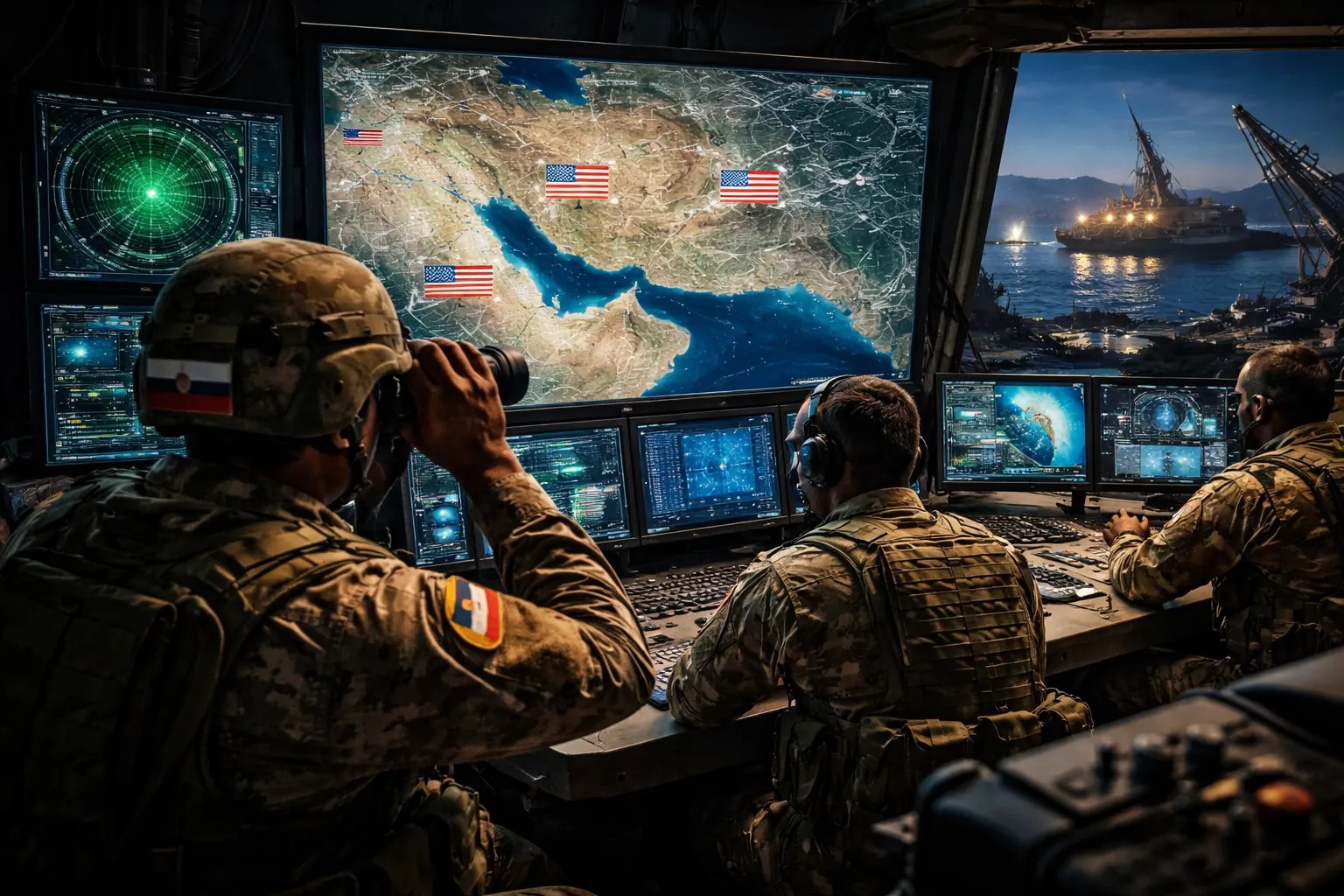
The screen glows with a sickly, electric blue in a small apartment in a city you’ve never visited. A young man named Elias—let’s call him that, though his real name is hidden behind a dozen encrypted proxies—is not a soldier. He has never held a rifle. He has never seen the desert sun bake the earth of the Middle East. Yet, with a rhythmic click of a mechanical keyboard, he is currently deploying a fleet of fighter jets over the Persian Gulf.
He watches a progress bar. 84%. 92%. Done.
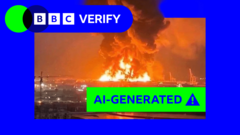
The resulting video is breathtaking. It shows a swarm of drones descending upon an aircraft carrier, the explosions blooming like dark, digital flowers against a twilight sky. It looks real enough to make your throat go dry. It is entirely fake. Elias isn't an insurgent or a state actor; he is a freelancer in the attention economy. He is chasing the "payout" button on a social media dashboard.
This is the new frontline of the information age. It isn't built on ideology. It is built on an algorithm that rewards outrage with cold, hard cash.
The Monetization of Chaos
For decades, propaganda was the heavy, expensive machinery of governments. You needed film crews, editing bays, and a distribution network. Today, you need a subscription to a high-end generative AI tool and a passing knowledge of what makes people angry.
The surge in AI-generated "war" videos—specifically focusing on a hypothetical or escalating conflict involving Iran—is a symptom of a systemic glitch in how we consume news. Creators are leveraging the hyper-realistic capabilities of video synthesis to produce clips that look like leaked body-cam footage or grainy satellite intercepts.
Why Iran? Because the geopolitical tension is a high-yield crop. The keywords "Iran," "Israel," "USA," and "WWIII" are digital gold. When a creator uploads a video of a simulated strike, the AI-driven recommendation engines see the immediate spike in engagement—the panicked comments, the frantic shares, the "Is this real?" queries—and they push it to millions more.
For the platforms, it’s more data and more ad views. For Elias, it’s a few hundred dollars in ad-revenue sharing. For the person scrolling in their kitchen at 6:00 AM, it’s a heart-stopping moment of terror that feels like the end of the world.
The Texture of a Lie
To understand why this works, we have to talk about the "uncanny valley," but in reverse. We used to be suspicious of things that looked too perfect. Now, the creators of these videos have learned to add "human" imperfections. They add digital camera shake. They simulate the muffled, distorted audio of a wind-whipped microphone. They add the timestamp overlays that look like they belong to a Pentagon briefing.
These are the sensory anchors of truth. When we see a shaky, low-resolution video, our brains are hardwired to think eyewitness. We don't think server farm.
Consider the "Deepfake Strike" of last month. A video circulated showing a massive explosion at a known Iranian nuclear facility. Within two hours, it had four million views. It didn't matter that no official news agency reported it. It didn't matter that the shadows in the video didn't align with the position of the sun at that time of day. The feeling it evoked—the dread—was real. And in the digital age, feeling is often mistaken for fact.
The cost of producing this "content" is plummeting toward zero. The profit, however, remains significant. We are witnessing the industrialization of the rumor mill.
The Invisible Stakeholders
We often talk about "misinformation" as if it’s an abstract cloud floating over the internet. It isn't. It has a physical weight.
When these videos go viral, they don't just stay on your phone. They reach the desks of intelligence analysts who have to spend precious hours debunking them. They reach the families of service members who see a ship that looks like their daughter's vessel engulfed in digital flames. They reach the markets, where automated trading bots might scrape social media sentiment and trigger a sell-off based on a war that hasn't happened.
There is a profound psychological toll, too. Constant exposure to hyper-realistic "war porn" numbs us. It creates a state of perpetual high alert—a sympathetic nervous system stuck in "fight or flight" mode. When a real crisis eventually occurs, will we even believe it? Or will we dismiss the smoke over a real city as just another high-bitrate render from a creator looking for a payout?
The creators aren't necessarily villains in the traditional sense. Many of them are just participants in a broken system. They are the "click-farmers" of the 2020s. If the algorithm paid more for videos of kittens playing pianos, they would be prompting the AI for calicos and grand pianos. But the algorithm pays for the adrenaline of war.
The Architecture of Deception
It is a common mistake to think that better technology will solve this. We hope for "detection tools" or "watermarking" that will save us from the lie. But this is a cat-and-mouse game where the mouse has an infinite supply of cheese.
The real problem is our own cognitive vulnerability. We are built to pay attention to threats. In the ancestral environment, if you ignored the sound of a rustle in the grass, you were eaten. In the modern environment, the "rustle in the grass" is a notification ping.
We are currently living through a massive, unconsented experiment in human psychology. We are testing how much fake trauma a society can ingest before its reality-testing mechanisms break down entirely.
Elias, back in his apartment, clicks "Upload" on another one. This one shows a blockade in the Strait of Hormuz. He’s added a filter to make it look like it was filmed on an old iPhone 6—more authentic, more "boots on the ground." He checks his analytics. The curve is already pointing straight up. He thinks about the rent he needs to pay. He doesn't think about the frantic phone calls being made halfway across the world by people who think the world just changed forever.
The Fog of Digital War
The term "Fog of War" used to refer to the uncertainty faced by commanders on the battlefield. Now, that fog has drifted into our living rooms. It is a synthetic mist, generated by GPUs and distributed by fiber-optic cables.
We are moving into an era where the visual record—the "seeing is believing" mantra that has guided human civilization for millennia—is dead. A video is no longer a transcript of reality; it is merely a suggestion.
The surge in these Iran war videos isn't just about geopolitics. It’s about the fact that we have built a world where the truth is a commodity that is often less valuable than a well-constructed hallucination. We are paying for our entertainment with our collective sanity, and the creators are more than happy to keep the change.
Elias closes his laptop. The room goes dark. Outside, the real world continues, quiet and unsuspecting, while inside his machine, a thousand digital fires are still burning, waiting for the next person to scroll by and catch a spark.
Would you like me to help you draft a guide on how to spot the subtle visual artifacts and "tells" common in AI-generated military footage?