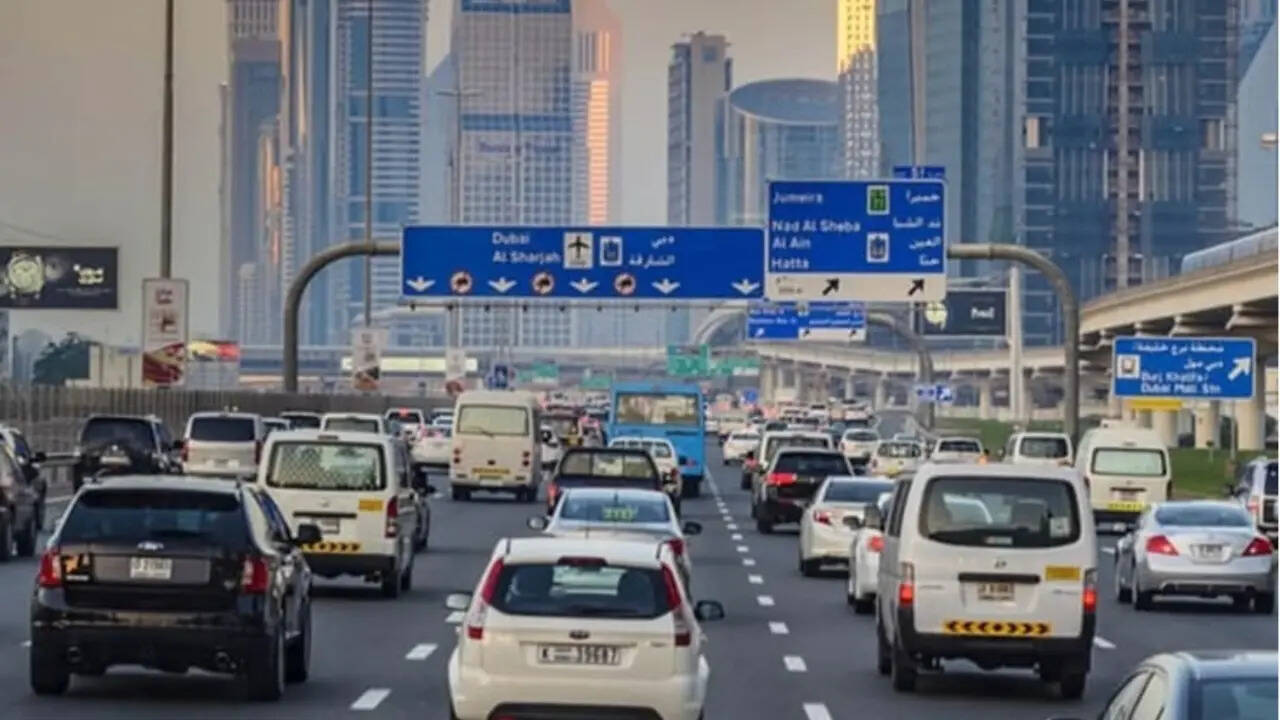
The headlines are screaming about Dh1,000 fines, black points, and the impending doom of vehicle seizure. Most news outlets are happy to serve you the "official" narrative: these rules exist to keep you safe. They want you to believe that a heavier hammer creates a better driver.
They are wrong. Meanwhile, you can find other developments here: The Calculated Silence Behind the June Strikes on Iran.
This isn't about safety. It’s about the systemic failure of road design masquerading as "discipline." When a government has to resort to seizing your property and docking your license points for minor infractions, it’s an admission that the environment they built is mismatched with human psychology.
We need to stop thanking the authorities for "keeping us in line" and start asking why the line is so easy to cross in the first place. To see the full picture, check out the detailed article by Reuters.
The Fine as a Hidden Tax on Poor Design
The logic behind the Dh1,000 fine for blocking traffic or "rubbernecking" at an accident is flawed. The assumption is that the driver is a malicious actor choosing to be a nuisance. In reality, humans are wired for visual curiosity. If you build a twelve-lane highway and expect people not to slow down when a multi-car pileup is smoldering in the median, you aren't fighting bad drivers—you're fighting biology.
In the industry, we call this Forced Compliance through Fear.
If a road requires a Dh1,000 threat to make it function, the road is broken. Modern urban planning in cities like Amsterdam or Copenhagen doesn't rely on the threat of bankruptcy to manage flow. They use "Self-Explaining Roads." This concept suggests that the geometry of the street should dictate the behavior of the driver. If a lane is narrow, you slow down. If the sightlines are clear, you move.
In the UAE, we have high-speed environments that suddenly turn into high-stakes regulatory traps. The "tough new rules" are a band-aid on a gaping wound of car-centric infrastructure that hasn't figured out how to handle volume without coercion.
The Black Point Myth: Safety vs. Revenue
Let’s talk about black points. The system is designed to "rehabilitate" drivers, yet the data on its efficacy is murky at best. Does a driver who loses four points suddenly become a master of the asphalt? No. They become a more paranoid driver.
Paranoia is not safety.
A paranoid driver is hesitant. They brake suddenly at yellow lights, causing rear-end collisions. They obsess over their speedometer instead of the pedestrian darting across the street. By ratcheting up the stakes, the authorities are injecting anxiety into an already high-stress environment.
I have consulted on logistics frameworks where we looked at "incident-to-penalty" ratios. The results are always the same: after a certain threshold, increasing the fine does nothing to decrease the accident rate. It only increases the collection rate.
- The Dh1,000 Fine: A flat fee that hurts the working class while being a minor "subscription fee" for the wealthy in their supercars.
- Vehicle Seizure: A logistical nightmare that removes the primary tool for economic participation (the car) without addressing the root cause of the infraction.
If we actually cared about safety, we wouldn't be talking about fines. We would be talking about automated lane-centring requirements or mandatory gap-control technology in all registered vehicles. But technology costs the government money, while fines generate it.
Why Rubbernecking Fines are a Distraction
One of the "tough new rules" targets those who slow down to look at accidents. The fine is steep because "rubbernecking" causes secondary accidents and delays emergency services.
True. But why can we see the accident?
In high-efficiency jurisdictions, emergency responders use portable "privacy screens." Within minutes of an incident, the visual stimuli are removed. If there’s nothing to see, nobody slows down. Instead of investing in a fleet of Dh500 screens, the strategy here is to charge every passing driver Dh1,000 for having eyes.
It’s a classic shift of responsibility. The system fails to manage the scene, so the citizen is penalized for the system's lack of equipment.
The Hidden Cost of Vehicle Seizure
Seizing a vehicle for 30 or 60 days is the ultimate "tough guy" move in traffic legislation. It sounds decisive. It looks good in a press release.
In practice, it’s an economic wrecking ball.
Imagine a scenario where a small business owner, perhaps a florist or a freelance technician, gets caught in a technicality regarding "unauthorized modifications" or a lane-splitting error. By seizing that vehicle, you aren't just punishing a driver; you are potentially bankrupting a micro-business.
The "nuance" the mainstream media misses is the Disproportionality of Impact.
A CEO with five cars doesn't care if one is in the impound lot for a month. A delivery driver or a school teacher is devastated. This isn't justice; it’s an arbitrary lottery of suffering based on your net worth.
Stop Asking "How Can I Avoid Fines?"
The "People Also Ask" sections of the internet are filled with desperate queries:
- "How many days do I have to pay?"
- "Can I get a discount on my black points?"
These are the wrong questions. You are asking how to navigate a maze that is designed to catch you.
The real question should be: "Why is our transit system so fragile that it requires a police state to function?"
If you want to survive the "New Rule Era," you need to stop driving like the road was designed for you. It wasn't. It was designed for throughput, and you are just a variable in an equation that values "Flow" over "Human Error."
The Industry Secret to Not Getting Fined
If you want to beat the system, you have to become a ghost.
- Ditch the Ego: Most Dh1,000 fines come from aggressive maneuvers. The road isn't a theater for your personality.
- Dashcam Everything: The authorities love their sensors, but they aren't infallible. I've seen countless "blocking traffic" fines overturned because a dashcam proved the driver was stuck behind a stalled truck that the AI camera missed.
- Assume the Design is Flawed: Every time you see a sharp exit or a sudden speed drop, recognize it as a "Revenue Zone." Treat the road geometry as an adversary, not a guide.
The Illusion of Progress
We are told these rules represent a move toward "Global Best Practices." They don't. Global best practices involve Vision Zero—the Swedish philosophy that starts with the assumption that humans will make mistakes, so the system must be designed to absorb those mistakes without death or financial ruin.
What we have is the opposite: A system that assumes humans must be perfect, and when they aren't, the system extracts a pound of flesh.
Don't be fooled by the "safety" branding. This is about control, revenue, and the refusal to admit that our multi-billion-dirham highways are psychologically exhausting and poorly zoned.
The next time you see that "Dh1,000" notification on your phone, don't just feel guilty. Feel cheated. You are paying for the privilege of navigating a design flaw.
Sell your high-performance car. Buy a boring, autonomous-leaning commuter. Stop giving them a reason to seize your property. If the game is rigged, the only way to win is to stop playing the way they want you to.
Drive like a robot, because the system has no room for humans.