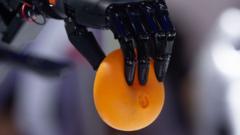
The scaling laws of artificial intelligence have solved the problem of "seeing" and "reasoning," yet the physical world remains an impenetrable barrier because we cannot reliably touch it. While large language models (LLMs) and vision-based transformers can now plan complex sequences of actions, the hardware responsible for executing those actions—the robotic hand—suffers from a profound lack of mechanical sophistication and sensory feedback. This gap between digital intelligence and physical execution, often referred to as Moravec’s Paradox, has narrowed in the digital sense but widened in the mechanical sense. To understand why robotics firms struggle to develop functional hands, one must deconstruct the problem into three fundamental engineering constraints: kinematic complexity, sensor density, and the durability-compliance trade-off.
The Kinematic Constraint: Degrees of Freedom vs. Control Latency
Human hands possess 27 degrees of freedom (DoF), allowing for a massive range of configuration spaces. Most industrial grippers, by contrast, operate on a 1-DoF binary (open/close) or a 3-finger underactuated system. The difficulty in replicating human-level dexterity is not merely a matter of fitting more motors into a palm-sized chassis; it is a problem of actuation density.
The space-torque requirement for a robotic hand is extreme. To move a finger with the nuance required to pick up a needle or turn a screwdriver, the actuator must be small enough to fit within the "bone" structure or the "forearm" of the robot while providing enough torque to maintain a grip under load.
Current engineering approaches generally fall into two categories:
- Fully Actuated Systems: Each joint has a dedicated motor. These are highly precise but heavy, expensive, and prone to mechanical failure.
- Underactuated Systems: A single motor drives multiple joints through a series of tendons or linkages. While these are better at "conforming" to the shape of an object, they lack the independent joint control necessary for complex manipulation, such as in-hand rotation.
This creates a control bottleneck. As DoF increases, the computational overhead for inverse kinematics grows exponentially. If a robot is using reinforcement learning to determine how to grasp a slippery object, the latency between "sensing a slip" and "adjusting motor torque" must be near-instantaneous. Mechanical lag in tendon-driven systems often exceeds the processing speed of the neural network, leading to dropped objects.
The Sensory Gap: Why Vision Cannot Replace Touch
A significant portion of the robotics industry has attempted to solve the "hand problem" using computer vision alone. The logic is that if a camera can see where the hand is relative to the object, the robot can adjust. This is a fundamental misunderstanding of biological dexterity.
Human manipulation relies on haptic feedback loops—the ability to sense shear force, vibration, temperature, and pressure at the point of contact. Without these, a robot is essentially "numb."
- Shear Force Detection: To prevent an object from slipping, a hand must detect the lateral force before the object actually moves. Most current robotic skins can only detect normal force (pressure directly into the sensor).
- Spatial Resolution: The human fingertip has a sensory density of roughly 2,500 receptors per square centimeter. Silicon-based tactile sensors (like MEMS or optical-based tactile skins) struggle to match this density while remaining flexible enough to wrap around a curved finger.
- Proprioception: Robots often lack accurate internal knowledge of their own finger positions when under load. If a finger hits an unexpected obstruction, the lack of high-frequency tactile feedback means the motor will continue to draw power, either damaging the motor or crushing the object.
Developing a "skin" that is both high-resolution and durable enough to survive 100,000 cycles of abrasive contact is the single greatest material science challenge in the field.
The Durability-Compliance Trade-off
Industrial robots are traditionally rigid. Rigidity equals precision. However, human-centric environments (kitchens, hospitals, warehouses) require compliance—the ability for a material to deform and absorb energy.
Robotics firms face a binary choice that currently has no middle ground:
- The Rigid Precision Path: Utilizing hard plastics and metals. These hands are excellent for repeatable tasks in controlled environments but fail when faced with the unpredictability of soft or irregularly shaped objects. They are brittle; one collision with a metal table can snap a finger.
- The Soft Robotics Path: Utilizing elastomers and fluidic actuators. These hands are inherently safe and "grippy," but they lack the force production needed for heavy lifting and the precision needed for fine motor tasks like threading a needle.
This leads to the Maintenance Multiplier. In a warehouse setting, a robot that breaks a finger every 500 hours of operation is a net-negative asset. The cost of downtime and specialized repair exceeds the efficiency gains of the automation. Most "dexterous" hands currently seen in viral videos are lab-grade prototypes that require a team of engineers to maintain. They are not yet "field-ready" hardware.
The Economic Architecture of Hand Development
The struggle is not just an engineering one; it is an economic misalignment. The "Hand Market" is currently fragmented into high-cost research tools and low-capability industrial grippers.
- The Cost Function: A high-end dexterous hand (e.g., Shadow Robot Hand) can cost upwards of $100,000. For a company deploying a fleet of 1,000 robots, the end-effector alone represents a $100 million capital expenditure.
- The Generalization Paradox: To make a hand cheap, you must mass-produce it. To mass-produce it, it must be useful for many tasks. But because a "general-purpose" hand is so difficult to build, firms settle for "bespoke" grippers designed for one specific item (a box, a soda can, a car door).
This specialization prevents the data flywheel from turning. If every robot has a different hand, the data collected by one robot cannot easily be used to train another. We are seeing a "fragmentation of touch" that prevents the creation of a Foundation Model for physical manipulation.
Mapping the Failure Modes of Current Startups
When analyzing why specific firms are stalling, three distinct failure modes emerge:
- Over-Engineering for Bio-Mimicry: Attempting to make a hand look and move exactly like a human hand. This often introduces unnecessary points of failure. Evolution optimized the hand for biological constraints (self-healing, low-energy consumption), not for industrial throughput.
- Under-Estimating Wear and Tear: Using 3D-printed resins or thin tendons that fray. The "MTBF" (Mean Time Between Failure) for a robotic hand needs to be in the thousands of hours to be commercially viable.
- The Software-Hardware Disconnect: Building a magnificent physical hand but failing to provide the API or simulation environment (like NVIDIA Isaac Gym) necessary for developers to actually program it. A hand without a high-fidelity "digital twin" is a paperweight in the age of AI.
The Path Toward Physical Competence
The solution to the "grip" problem will likely not come from a breakthrough in AI, but from a breakthrough in integrated manufacturing.
The next generation of successful end-effectors will likely abandon the 5-finger human aesthetic in favor of a 3- or 4-digit "spherical" or "radial" design that maximizes contact surface area while minimizing the number of actuators. This hardware must be paired with Optical Tactile Sensing—using internal cameras to watch the deformation of a rubber skin from the inside—which offers a cheaper, more high-resolution alternative to traditional electronic pressure sensors.
Strategic priority must shift toward:
- Modular Finger Units: Designing fingers that can be "hot-swapped" in seconds when they break, treating the end-effector as a consumable rather than a permanent asset.
- Hybrid Actuation: Combining high-torque motors for the "grip" with small, high-speed piezo-actuators for "micro-adjustments."
- Sim-to-Real Transferability: Focusing on hardware that can be perfectly modeled in physics engines, allowing for millions of hours of "synthetic practice" before the hand ever touches a real-world object.
The firm that successfully commercializes a $5,000 dexterous hand with a 2,000-hour MTBF will effectively unlock the multi-trillion-dollar general-purpose robotics market. Until then, the world’s most advanced AI will remain trapped behind the "Tactile Barrier," capable of thinking about the world but incapable of moving it.
Invest heavily in firms focusing on the material science of synthetic skins and actuator miniaturization rather than those focusing solely on "end-to-end" AI models. The intelligence exists; the interface does not.