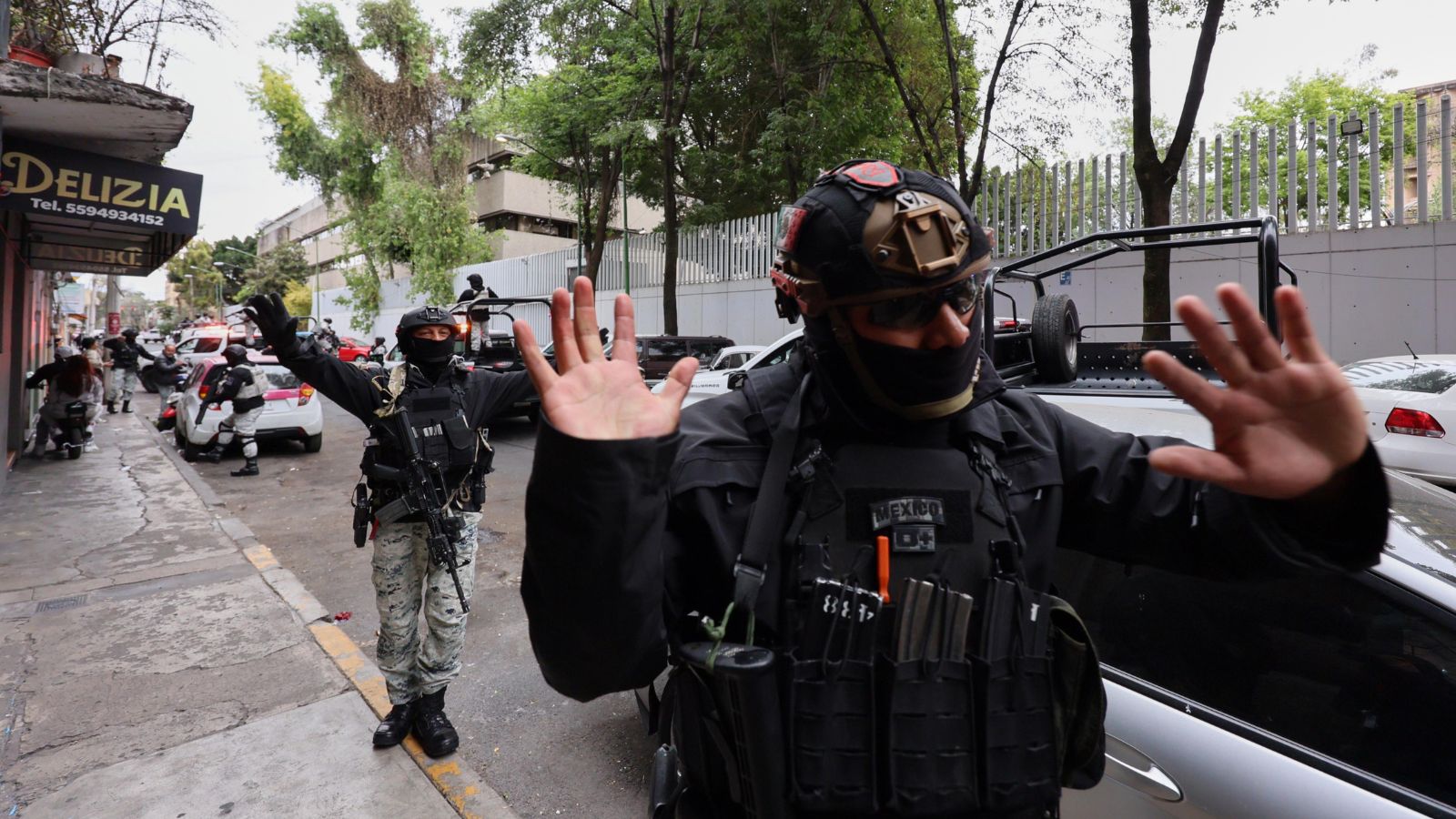
The death of Nemesio Oseguera Cervantes, known as "El Mencho," during a targeted military operation does not signal the cessation of the Cártel de Jalisco Nueva Generación (CJNG). Instead, it triggers a predictable sequence of structural disintegration and violent market correction. In the economics of illicit narcotics, the removal of a "CEO" figure within a vertically integrated organization initiates a transition from a monopoly-aspirant model to a fractured, high-competition environment. This shift is characterized by an immediate spike in localized violence as sub-commanders move to secure individual revenue streams and territorial autonomy.
The efficacy of "Kingpin Strategy" operations must be measured not by the status of the target eliminated, but by the resulting entropy in the criminal ecosystem. Historically, the neutralizations of figures like Arturo Beltrán Leyva or Nazario Moreno González resulted in years of hyper-fragmentation. The CJNG is built on a "franchise" model—a decentralized command structure that utilizes the brand name while maintaining semi-autonomous cells. The death of the central arbiter removes the internal conflict-resolution mechanism, forcing these cells to resolve disputes through kinetic attrition rather than hierarchical decree.
The Structural Mechanics of CJNG Succession
The internal stability of the CJNG relied on a balance of charismatic authority and brutal enforcement. With the central pillar removed, the organization faces a tri-fold crisis of legitimacy, logistics, and liquidity.
- The Leadership Vacuum and Internal Attrition: Successor candidates often lack the historical leverage to command the same level of discipline across diverse geographical plazas. This leads to "horizontal fracturing," where mid-level lieutenants in states like Colima, Guanajuato, and Michoacán stop remitting percentages to the central treasury, declaring themselves independent entities.
- Logistical Bottlenecks: The CJNG controls critical precursor chemical entry points (Manzanillo and Lázaro Cárdenas). A decapitated leadership loses the diplomatic weight required to manage international supply chains with Chinese chemical exporters and South American cocaine producers. Smaller factions lack the volume to negotiate the same "wholesale" rates, increasing the cost of goods sold and driving them toward high-margin, high-violence crimes like extortion and kidnapping to maintain cash flow.
- The Signal of Weakness: External rivals, primarily the Sinaloa Cartel (CDS), interpret the death of a leader as a period of institutional vulnerability. This initiates a "land grab" phase where rivals attempt to flip corrupt local officials who previously held allegiances to the fallen leader.
The Geography of Kinetic Contagion
The violence spreading across several Mexican states is not random; it follows a specific logic of strategic assets. Violence is a tool for market entry and defense.
In Guanajuato, the conflict centers on the "huachicol" (fuel theft) pipelines and the domestic synthetic drug market. The CJNG’s presence there was an expansionist project. Without El Mencho’s centralized backing, the CJNG cells in Celaya and León are isolated, facing renewed pressure from the Cártel de Santa Rosa de Lima (CSRL) and CDS-backed remnants.
In Michoacán, the situation is more complex due to the presence of "autodefensas" and the United Cartels (Cárteles Unidos). The CJNG’s campaign in the Tierra Caliente region was driven by Oseguera’s personal desire to control his home state. His death removes the emotional driver of the conflict, potentially leading to a stalemate or a messy retreat that creates a power vacuum for local warlords.
The border states—specifically Baja California and Tamaulipas—represent the highest-stakes theaters. These are the "exit ramps" for the product. Any instability at the top of the CJNG hierarchy creates a "rush to the gate," where multiple factions attempt to seize control of the same smuggling tunnels and ports of entry simultaneously.
The Cost Function of Decapitation Operations
Security analysts often fail to quantify the externalities of high-value target (HVT) strikes. The state’s tactical success in killing El Mencho creates a strategic deficit in three ways:
- Information Decay: As the CJNG splits into a dozen "mini-cartels," the intelligence gathered over a decade on the parent organization becomes obsolete. Instead of tracking one monolithic entity, the military must now track twelve smaller, more agile, and more desperate groups.
- The Urbanization of Conflict: Large cartels prefer a level of "pax mafiosa" to facilitate business. Smaller splinter groups lack the resources for long-term territorial governance and instead resort to high-visibility tactics—blockades (narcobloqueos), arson, and public displays of violence—to project power they do not actually possess.
- Corruption Dispersion: A centralized cartel can be monitored by tracking a few high-level political figures. Fragmentation forces the state to deal with "retail-level" corruption, where dozens of small-town mayors and police chiefs are suborned by different, competing factions, making national security policy impossible to implement uniformly.
The Kinetic Response and State Capacity
The military operation that killed Oseguera indicates a high level of tactical proficiency and signals a shift in the "hugs not bullets" (abrazos no balazos) policy previously touted by the federal government. However, tactical success in a vacuum does not equate to a victory in the "War on Drugs."
The immediate response from the CJNG—setting fire to convenience stores and vehicles—is a standard psychological operation designed to force the government into a defensive posture. By creating chaos in civilian centers, the cartel aims to divert military resources away from the operational theater where the leader was killed, allowing other high-ranking members to escape the dragnet.
This "asymmetric leverage" allows a weakened criminal group to dictate the tempo of national discourse. The government’s inability to prevent these reprisal attacks highlights a fundamental gap in state capacity: the military can win the "high-end" kinetic engagements, but the civilian police forces are unable to manage the "low-end" public order disruptions that follow.
Anticipating the Reconfiguration of the Narcotic Market
We must look past the headlines of the military raid to understand the future of the Mexican security environment. The death of El Mencho accelerates the "commoditization" of the drug trade.
- Transition to Fentanyl Dominance: Unlike cocaine, which requires vast tracts of land and hundreds of workers, fentanyl can be produced in small, mobile labs. Fragmentation favors fentanyl production. Small CJNG splinters will likely double down on synthetics because they require less "territorial integrity" to produce and ship.
- The Rise of the "Invisible" Narco: The era of the flamboyant, larger-than-life kingpin may be ending. The successors to El Mencho are likely to be more technocratic, focusing on money laundering and cyber-enabled crime rather than the paramilitary displays of their predecessor. They have learned that being "the most wanted" is a terminal career path.
- Regional Balkanization: Mexico is moving toward a state of "permanent low-level insurgency." Without a dominant hegemon like the CJNG or a unified CDS, the country will likely settle into a patchwork of local fiefdoms. This makes any comprehensive peace treaty or security strategy nearly impossible to execute at a federal level.
The removal of Nemesio Oseguera Cervantes is a significant blow to the CJNG’s brand, but the infrastructure of the organization remains largely intact. The "Hydra effect" is not just a metaphor; it is a mathematical certainty in markets with high demand and low barriers to entry for violence. The coming months will reveal whether the CJNG can sustain its "New Generation" moniker through institutionalization, or if it will follow the path of the Zetas into historical irrelevance, leaving a trail of hyper-violent splinters in its wake.
The strategic imperative for the Mexican state now shifts from decapitation to "containment and professionalization." If the government cannot fill the vacuum left by the CJNG with functional judicial and police presence, the territory will simply be re-occupied by the next iteration of the same predatory model. Decapitation is an event; stability is a process. Without the latter, the former is merely a catalyst for more efficient chaos.