Stop calling it a miracle.
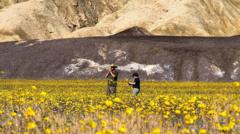
Every few years, when the atmospheric rivers align and the rain gauges in Death Valley hit that sweet spot of roughly two inches, the internet loses its collective mind. The headlines are always the same: "Life Returns to the Wasteland," or "A Rare Miracle in the Driest Place on Earth."
This narrative is more than just lazy; it’s a fundamental misunderstanding of how the desert works. By framing the "Superbloom" as a fleeting moment of life in a land of death, we are ignoring the most sophisticated biological machinery on the planet. The desert isn't waiting for the rain to "save" it. The desert is perfectly fine. It’s the tourists who are the problem.
The Myth of the Barren Wasteland
The standard travel piece treats Death Valley like a graveyard that occasionally gets resurrected by a rainstorm. This is a linear, anthropocentric view of biology. We see green and think "alive." We see brown and think "dead."
In reality, the desert is a high-performance engine idling at 1,000 RPM. The organisms here haven't "conquered" the heat; they have integrated it into their lifecycle. Take the Desert Gold (Geraea canescens). You see a yellow flower that’s going to wither in two weeks. I see a seed that has spent the last seven years performing complex chemical calculations in the soil.
These seeds are equipped with water-soluble growth inhibitors. They don't just "wake up" when it gets wet. They measure the rainfall. If the rain is too light, the inhibitors don't wash away, and the seed stays dormant. It knows a light sprinkle is a death sentence. It waits for the deluge. That isn't a miracle. It’s an algorithm.
Stop Treating Wildflowers Like Instagram Backdrops
The obsession with the "Superbloom" has turned one of the most hostile, pristine environments on earth into a Coachella for people who own hiking boots they’ve never dirtied.
When a "rare" bloom is announced, thousands of people descend on the valley floor. They pull their SUVs onto the shoulders, crushing the very crust that protects the soil from erosion. They walk into the fields to get the "perfect shot," oblivious to the fact that they are compacting the earth and destroying the delicate seed bank for the next decade.
The "lazy consensus" says that more people seeing the desert leads to more conservation. I’ve spent twenty years tracking land usage in the Mojave, and I can tell you the opposite is true. Mass tourism doesn't breed respect; it breeds consumption. We are consuming the bloom, not appreciating it. We treat the desert like a temporary exhibit at a museum rather than a permanent, breathing entity that doesn't need our validation or our filters.
The Data of Desiccation
If you want to understand the desert, stop looking at the flowers. Look at the heat.
The media loves to talk about the "record-breaking" 134°F (56.7°C) recorded at Furnace Creek in 1913. Modern skeptics love to argue about the validity of that reading. They’re missing the point. Whether it was 134 or 129 is irrelevant. The real story is the thermal mass.
Death Valley is a narrow basin situated below sea level, walled in by steep, high mountain ranges. The sun heats the valley floor, and that heat radiates upward. But the heat gets trapped. It rises, cools slightly, and then sinks back down into the basin, getting compressed and further heated by the sheer weight of the atmosphere.
This is the "convection oven" effect. Most "outsider" articles describe this as a hellscape. But for the resident species—the Pupfish, the Bighorn sheep, the Chuckwalla—this is the stable state. The "bloom" is actually the period of highest stress for the ecosystem because it brings the one thing the desert can't handle: us.
The Darwinian Superiority of the Dry
We have a pathological need to "fix" dry places. We want to irrigate the desert, plant grass in Las Vegas, and celebrate when the "brown" turns "green."
This is a deep-seated bias. We view the lush, temperate forests of the Pacific Northwest as the biological gold standard. But a forest is easy. Life in a forest is a participation trophy. In a forest, everything has what it needs.
The desert is the elite tier of evolution.
Take the Creosote bush (Larrea tridentata). Some of these organisms are estimated to be nearly 12,000 years old. They have survived since the last Ice Age by being the most territorial, efficient water-managers on the planet. They secrete chemicals into the soil to prevent other plants from growing nearby and stealing their resources.
When you celebrate the "fleeting" wildflowers, you are ignoring the titans that have been standing there since the dawn of human civilization. The flowers are the desert's makeup; the Creosote is its bone structure.
The Logistics of the Lie
Travel influencers tell you to "catch it before it's gone." This creates a false sense of urgency that leads to bad decision-making.
People drive into the backcountry with half a liter of water and a smartphone, thinking the desert is "soft" because it’s covered in yellow petals. I have seen visitors try to hike the salt flats of Badwater Basin in midday July because they "wanted to see where the flowers were."
The desert is not your friend. It is not "blooming for you." It is an indifferent, hyper-efficient system that will kill you without noticing.
The real contrarian truth? The best time to see Death Valley isn't during a Superbloom. It’s in the dead of August, when the heat is a physical weight and the silence is absolute. That is when the desert is its most authentic self. That is when you can see the specialized adaptations that make this place a marvel of engineering, not a lucky fluke of the weather.
Stop Asking When the Flowers Are Coming
People always ask: "When is the next Superbloom?"
The question itself is flawed. It assumes the bloom is the goal of the desert. The bloom is just a reproductive gamble—a massive "all-in" bet on the future.
If we actually cared about the "driest place in North America," we would stop rooting for it to look like a Dutch tulip field. We would appreciate the salt pans, the cracked mud, and the heat-shimmer on the horizon.
We need to stop looking for life that looks like our life. The desert is teeming with activity, but it’s happening at a frequency most humans are too distracted to hear. It’s in the nocturnal movement of the Kangaroo Rat, which never has to drink a drop of water in its entire life because it metabolizes it from dry seeds. It’s in the Cyanobacteria in the soil crust that holds the world together.
The "miracle" isn't that the desert blooms. The miracle is that it doesn't need to bloom to be the most vital place on the continent.
Next time you see a headline about the desert "coming to life," ignore it. The desert has been awake the whole time. You’re the one who’s been sleeping.
Leave your camera at home. Stay on the pavement. Let the seeds sleep.