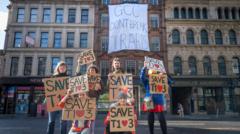
Glasgow is currently witnessing the systematic dismantling of its reputation as a global cultural powerhouse through a series of brutal rent hikes and property liquidations. For decades, the city’s international "cool" was subsidized by cheap, drafty industrial spaces where artists could fail, iterate, and eventually win Turner Prizes. That era is over. Property developers and charitable trusts, squeezed by rising interest rates and maintenance backlogs, have shifted their strategy from stewardship to survivalism. The result is a mass exodus of the creative class that once defined the city’s post-industrial identity.
What is happening in districts like Trongate and the East End isn't just a local real estate dispute. It is a fundamental breakdown of the "creative city" model. When organizations like the Glasgow School of Art or Various Artists’ Studios face 30% to 100% rent increases, the math stops working. This isn't a natural market correction; it is a structural failure where the very people who increased the property value of these neighborhoods are being priced out by the equity they helped create.
The Myth of the Benevolent Landlord
The narrative often focuses on "greedy landlords," but the reality is more clinical and perhaps more dangerous. Many of the buildings housing Glasgow’s creative heart are owned by charitable trusts or arm's-length organizations. These entities are mandated to achieve "market value" for their assets. As the surrounding areas undergo gentrification—often spurred by the presence of the artists themselves—the market value skyrockets. The landlord, bound by fiduciary duty or a desperate need to repair crumbling Victorian masonry, raises the rent.
This creates a predatory loop.
An artist moves into a derelict warehouse in a "risky" neighborhood. They start a gallery. A coffee shop opens next door. A boutique hotel follows. Suddenly, the neighborhood is "vibrant." The landlord looks at the new hotel and decides the artist's studio is undervalued. They demand a rent that reflects the new vibe. The artist, who operates on a profit margin thinner than a coat of primer, cannot pay. They leave. The "vibrant" neighborhood loses its soul, leaving behind a hollowed-out shell of luxury flats and chain restaurants.
The Hidden Cost of Maintenance Backlogs
For years, many of Glasgow's studio providers operated on a "patch and mend" philosophy. It was sustainable as long as energy was cheap and interest rates remained at historic lows. However, the combination of the UK's aging building stock and the recent spike in utility costs has created a perfect storm.
Consider the typical red sandstone or brick industrial unit. These buildings are notoriously difficult to heat and maintain. When a trust realizes it needs £500,000 for a new roof, that money doesn't come from a government grant—it comes from the tenants. If the tenants are low-income earners, the building becomes a liability rather than an asset. In this light, the rent row isn't just about profit; it's about the total inability of the current ownership model to sustain historic buildings without a massive infusion of public cash.
The Fallacy of the Creative Economy
Politicians love to talk about the "creative economy." They cite statistics about how many billions the arts contribute to the GDP. Yet, when it comes to the granular level of keeping a sculptor in a room with four walls and a roof, the support evaporates.
The Scottish Government’s cultural funding has been characterized by "standstill" budgets for years, which, in an inflationary environment, are actually deep cuts. Creative Scotland, the national body for arts funding, is itself caught in a pincer movement of reduced government settlement and increased demand. When an arts organization gets its funding frozen but its rent doubled, the math is simple and brutal: they close.
Why Relocation Isn't a Solution
The standard response from city planners is often, "Move further out." They suggest that artists can simply find cheaper space in the outskirts or neighboring towns like Paisley or Clydebank. This ignores the vital importance of creative density.
Artistic communities don't thrive in isolation. They require a network of suppliers, fabricators, peers, and venues. When you fragment a community by scattering it across the Central Belt, you destroy the informal knowledge exchange that leads to innovation. A painter needs to be near a framer; a filmmaker needs to be near an editor. By treating studios as interchangeable commodities rather than nodes in a complex ecosystem, the city is killing the very thing it claims to value.
The Commercialization of the Commons
We are seeing a shift where public or semi-public spaces are being repurposed for high-yield commercial use. In Glasgow, this often takes the form of "purpose-built student accommodation" (PBSA). For a developer, the choice between a risky arts collective and a guaranteed stream of international student rent is no choice at all.
- PBSA yield: High, predictable, and subsidized by education loans.
- Artist studio yield: Low, volatile, and requires constant management.
The planning system is currently weighted in favor of the former. There are no mandatory "cultural quotas" for new developments that carry real weight. While a developer might promise a "community space" in their ground floor plans to grease the wheels of a planning application, these spaces are often sterile, overpriced, and entirely unsuitable for actual creative work.
The Ghost of the 1990s
In the 1990s, Glasgow’s "City of Culture" status was built on the back of a genuine partnership between the city and its creators. There was a recognition that culture was the primary engine of post-industrial recovery. Somewhere in the last decade, that recognition shifted. Culture is now viewed as a "nice-to-have" or a marketing tool for the real business of real estate.
This is a strategic error. Without the artists, Glasgow is just another rainy city with expensive parking. The "betrayal" felt by the tenants at Trongate 103 or the Briggait is not just about the money; it's about the realization that they were the bait used to attract investment, and now that the investment has arrived, they are being discarded.
How to Break the Cycle of Displacement
If the city actually wants to save its cultural sector, it needs to stop using the language of "support" and start using the language of ownership.
The only way to insulate artists from the volatility of the property market is through the permanent acquisition of assets. This means community land trusts and artist-led cooperatives owning their buildings outright. It requires the Scottish Government and Glasgow City Council to move beyond one-year project grants and toward large-scale capital investment.
Implementation of Cultural Rent Control
There is a growing argument for a "Cultural Rent Control" or a protected status for artistic spaces, similar to how we protect listed buildings. If a space has been a hub of creative production for twenty years, it should not be possible to double the rent overnight just because a new luxury flat opened across the street.
We need to implement:
- Long-term leases: Minimum ten-year terms to provide stability.
- Rent caps: Linked to inflation or a specific cultural index, not "market value."
- Right to Buy: Giving existing tenants first refusal if a building is put up for sale.
Without these protections, the creative scene will continue to shrink until only the independently wealthy can afford to be artists in Glasgow.
The High Cost of Doing Nothing
The displacement of the Glasgow art scene will have long-term economic consequences that far outweigh the short-term gains of increased rent. When the "cool" factor leaves, the high-spending tourists and international students follow. You cannot manufacture authenticity. Once the studios are converted into micro-apartments and the galleries become chain pharmacies, you cannot simply "fund" them back into existence.
The current rent row is the final warning. The city is at a tipping point. It can choose to be a living, breathing center of production, or it can become a museum of its own past, curated for the benefit of developers who don't even live here.
The artists aren't asking for a handout; they are asking for the right to remain in the rooms they made famous. If Glasgow continues to prioritize the balance sheets of property trusts over the livelihoods of its creators, it will find itself with plenty of "market value" and absolutely no value at all.
Look at the empty units in the city center. Those are the future of the art scene if the current trajectory continues: dark windows, "To Let" signs, and a lingering sense of what used to be. The betrayal is real, and the clock is ticking.
Demand a public audit of all council-owned and arm's-length property to identify which spaces can be permanently transferred to artist-led trusts.