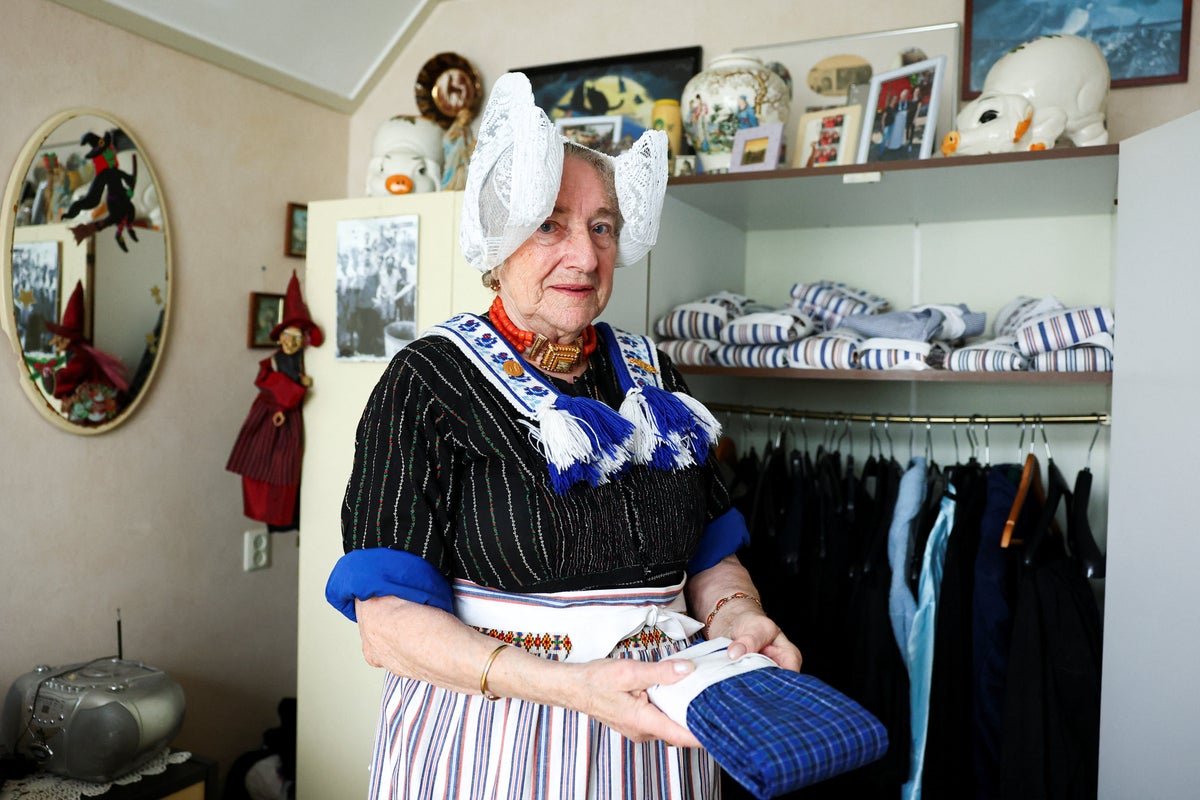
In the small fishing village of Volendam, the visual history of the Netherlands is down to its final biological clock. For centuries, the starched lace caps and heavy wool striped skirts defined the identity of the Zuiderzee. Now, the entire weight of this heritage rests on the shoulders of one woman. This is not a quaint human-interest story about a hobbyist in a costume. It is a slow-motion cultural extinction event. When the last wearer of the klederdracht passes away, a specific way of existing in the world—one where your social status, marital standing, and village of origin were readable at a glance—will vanish into the archives.
The narrative often framed as a "choice" to remain traditional is actually a story of stubborn endurance against a globalized mono-culture. We are witnessing the final seconds of a thousand-year-old sartorial language. Meanwhile, you can find related events here: The 17 Puppy Record is a Biological Crisis Not a Viral Celebration.
The Architecture of Identity
Traditional Dutch dress was never about fashion. It was a rigorous social code. In communities like Staphorst, Bunschoten, and Spakenburg, the clothing functioned as a biological and social GPS. Every pin, every fold of the kraplap (the starched chest piece), and every specific shade of embroidery signaled something precise to the community.
To wear the costume in the 21st century is to engage in a grueling daily ritual. It takes nearly an hour of pinning and tucking to achieve the correct silhouette. There are no zippers here. There are no elastic waistbands. The garment requires a physical discipline that the modern body has largely forgotten. The lace must be starched with a precision that borders on the chemical. The wool must be brushed. The silver jewelry must be polished to a mirror finish. To understand the bigger picture, we recommend the excellent analysis by Vogue.
When the last practitioner of this daily art is gone, the knowledge of how these clothes feel against the skin and how they dictate movement will be lost. Museums can preserve the fabric, but they cannot preserve the muscle memory. The "last wearer" is not just a person; she is a living library of a discarded lifestyle.
The Economic Engine of Erasure
The decline of the Dutch costume did not happen by accident. It was the direct result of the industrialization of the Netherlands and the post-war drive toward European integration. After 1945, the pressure to conform to "civilian" dress—modern, mass-produced clothing—became an economic necessity.
Young women entering the workforce in Amsterdam or Utrecht found that their traditional caps and skirts were barriers to employment. The costume marked them as "provincial" or "backward" in an era that worshiped the future. To get ahead, you had to blend in. The costume became a cage.
The Tourism Paradox
Ironically, the very thing that is dying is what brings millions of Euros into the Dutch economy. Towns like Volendam and Marken have become living museums, but they are hollowed out. While tourists pay to have their photos taken in rented costumes, the actual residents have long since swapped their clogs for sneakers.
The industry treats the heritage as a theme park attraction while ignoring the lived reality of those who still wear it. The last traditional wearers often find themselves treated as public property, photographed by strangers without permission as if they were statues rather than citizens. This commodification of heritage creates a strange friction: the world wants the image of the traditional Dutch woman, but it has no interest in supporting the difficult, isolated life that produces her.
The Psychological Burden of the Last One
Being the "last" of anything carries a crushing weight. For the individual at the center of this story, the morning ritual of dressing is a solitary act of defiance. Every time she puts on the lace cap, she is asserting that her ancestors' way of life still has a place in a world of polyester and fast fashion.
But there is a loneliness to it that the glossy travel brochures never mention. She is a woman out of time. When she goes to the grocery store, she is a spectacle. When she attends church, she is a reminder of a congregation that no longer exists. Her peers have all passed away or succumbed to the ease of modern clothing.
She remains because, for her, the alternative is a loss of self. To take off the costume for the last time would be to admit that the world she knew is truly dead. It is an act of mourning performed in public, day after day.
The Technical Loss of Craft
We must also talk about the tactile loss. The production of the klederdracht involved specialized artisans who are also disappearing.
- Lace makers who understood the specific patterns of a single village.
- Silversmiths who forged the distinct throat buttons and "blood coral" necklaces.
- Starchers who knew the exact consistency required to make a cap stand like a sail against the North Sea wind.
When the demand for these items drops to a single customer, the supply chain collapses. The knowledge of how to make these items is not being passed down because there is no market for them. We are losing the "how" along with the "who."
The Myth of Preservation
Museums like the Zuiderzee Museum in Enkhuizen do an admirable job of cataloging these garments. They keep them in climate-controlled drawers, protected from the sun and the oil of human skin. But a costume in a drawer is a corpse.
The true value of the Dutch traditional dress was its movement. The way the heavy skirts swung during a walk through the dunes. The way the lace caught the light during a Sunday service. Once the last wearer is gone, the clothes will never move that way again. They will become artifacts—curiosities from a pre-digital age that seem as distant to the modern Dutch teenager as the armor of a medieval knight.
A Culture of Convenience
The real reason the costume is failing is that we have prioritized convenience over continuity. Modern life is designed for the friction-less. We want clothes we can throw in a washing machine and shoes we can slip on in a second. The traditional Dutch silhouette is the opposite of friction-less. It is heavy, hot, restrictive, and demanding.
It represents a time when people were willing to endure physical discomfort to signal their belonging to a specific place and a specific people. Our current global "uniform"—jeans, t-shirts, hoodies—signals that we belong everywhere and nowhere. We have traded the depth of local identity for the breadth of global convenience.
The Final Thread
There is no "saving" this tradition in its original form. You cannot force a generation raised on the internet to spend an hour pinning on a wool bodice. Any attempt to "revive" it usually results in a kitschy, watered-down version that lacks the soul of the original.
What we are losing is the concept of the "unapologetic local." The person who does not care what the rest of the world is wearing because they know exactly who they are and where they stand. The 85-year-old woman in her lace cap is the final sentinel of that philosophy. She is not a relic; she is a witness.
When the last pin is finally put away, a silence will fall over the villages of the North Sea that no amount of tourism revenue can fill. We will be left with the photographs and the replicas, but the heartbeat of the tradition will have stopped.
Stop looking at her as a charming curiosity. Look at her as a warning of what happens when a culture stops valuing the difficult beauty of its own unique history in favor of the easy, the cheap, and the universal. The silhouette is fading, and once it disappears into the gray mist of the Dutch coast, it is never coming back.
Identify the nearest local historical archive or textile museum in your region and document one disappearing craft before the last practitioner retires.