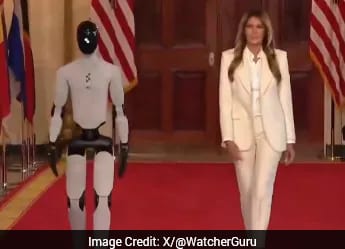
When the First Lady of the United States meets a 4-foot-tall robot that can sense human emotions, it’s more than just a photo op. It’s a collision of high-stakes diplomacy and the rapidly evolving world of social robotics. Back when Melania Trump hosted a White House event focused on technology and the "Be Best" initiative, one particular interaction stole the spotlight. She wasn't just shaking hands with world leaders or visiting local schools. She was interacting with Pepper, the humanoid robot developed by SoftBank Robotics.
The moment wasn't just cute. It was a litmus test for how we're going to live alongside machines that look, act, and talk like us. If you think this was just a gimmick, you’re missing the bigger picture of where automation is actually heading in 2026.
The White House Event That Put Robots in the Spotlight
This specific encounter happened during a White House event where the First Lady was showcasing innovations designed to help children. Melania Trump has always focused her "Be Best" campaign on the well-being of the next generation, and technology plays a massive role in that.
During the demonstration, Pepper did more than just sit there. The robot greeted the First Lady, performed some basic gestures, and even engaged in a bit of programmed banter. Pepper is designed to read human emotions by analyzing facial expressions and voice tones. It’s not just a machine that follows a script; it’s a machine that responds to the person in front of it.
What Pepper Actually Does
To understand why this mattered, you have to look at what Pepper represents. It isn't a factory arm designed to weld car parts. It’s a "social robot."
- Emotion Recognition: It uses high-definition cameras and microphones to detect if a person is happy, sad, or surprised.
- Human-Centric Design: With its big eyes and smooth, white exterior, it’s intentionally built to look approachable, not intimidating.
- Language Skills: It can speak over 20 languages, making it a favorite for international events.
When Melania Trump interacted with it, the robot's ability to maintain eye contact and gesture naturally was on full display. This isn't just about cool tech. It’s about building trust between humans and silicon.
Why Social Robots Like Pepper Are More Than Just Toys
Many critics at the time dismissed the interaction as a PR stunt. They’re wrong. The real value of Pepper—and the reason it was at the White House—is its application in healthcare and education.
We’ve seen these robots used in Japanese nursing homes to combat loneliness among the elderly. We’ve seen them in pediatric wards, helping kids feel less scared before a big surgery. When the First Lady highlights this tech, she’s signaling that the U.S. government is paying attention to how AI can assist in social spheres, not just industrial ones.
The "Be Best" initiative often touches on the dangers of the internet, but this event showed the positive side. It showed that technology, when designed with empathy in mind, can actually serve a greater good. It’s a tool for connection, not just a screen for scrolling.
The Design Philosophy Behind the Humanoid Form
Why does Pepper look like a person? SoftBank could have made it a box on wheels.
They didn't because humans are hard-wired to respond to faces. By giving the robot a head, arms, and expressive eyes, the designers ensure that people treat it with a level of respect and attention that a laptop simply doesn't get. During the White House event, you could see this in action. The First Lady didn't just look at a screen; she looked at the robot.
This form factor is vital for the future of service industries. If we want robots to help us in hotels, airports, or hospitals, they need to fit into our world. They can't be clunky industrial machines. They have to be Pepper-like.
The Controversy of AI in the East Wing
Not everyone was thrilled. Every time a high-profile figure interacts with AI, the "uncanny valley" debate resurfaces. That’s the feeling of unease people get when a robot looks too much like a human but not quite enough to be real.
Pepper hits a sweet spot. It’s humanoid but clearly a robot. It doesn't try to trick you into thinking it's a person. That’s a deliberate choice. When Melania Trump greeted the robot, she was validating a specific type of AI—one that is helpful and subservient rather than one that mimics humanity perfectly.
Lessons for the Future of Robotics in 2026
What can we take away from this now? First, the integration of AI into public life is inevitable. If the First Lady is hosting robots at the White House, it means the technology has reached a level of maturity that can't be ignored.
Second, the focus on "social" AI is where the real growth is happening. While everyone is obsessed with LLMs and chat interfaces, the physical manifestation of AI—robots that can move and interact—is the next frontier.
If you're a business owner or a tech enthusiast, don't ignore the "social" aspect of automation. The world doesn't just need faster processors. It needs machines that can navigate human spaces without making us feel uncomfortable.
How to Evaluate Social Robotics for Your Own Use
If you're looking to bring this kind of tech into a school, office, or clinic, keep these factors in mind.
- User Comfort: Does the robot look friendly? If it scares the people it’s supposed to help, it’s a failure.
- Reliability: A robot that freezes mid-sentence during a greeting is worse than no robot at all.
- Data Privacy: Especially in a setting like the White House, knowing what the robot is "hearing" and where that data goes is a top priority.
The meeting between Melania Trump and Pepper wasn't just a moment in history. It was a preview of a world where the line between "machine" and "companion" starts to blur. We're moving toward a future where seeing a robot in a government building or a local school won't even be news. It’ll just be Tuesday.
To stay ahead of these shifts, start looking at how your own field could benefit from "empathetic" automation. Don't wait for the next big White House event to realize the landscape has changed. Look at what’s happening in the social robotics space right now. The tech is already here. It’s just waiting for us to figure out where it fits best.