The coffee in Onslow usually tastes like salt and ambition, but that morning in 2013, it tasted like copper. It started with a stillness that felt heavy, the kind of silence that makes you check the horizon because your skin knows something your eyes haven’t seen yet. Off the coast of Western Australia, Cyclone Narelle was churning, a Category 4 beast spinning through the Indian Ocean. But the water wasn’t the story. The story was the dirt.
Imagine the Pilbara. It is a land of ancient, rusted earth, where the soil is so saturated with iron oxide that it looks like the surface of Mars. For millions of years, that dust has stayed pinned to the ground by scrub and gravity. Then Narelle arrived. The cyclone didn’t just bring wind; it brought a vacuum. As the storm skirted the coastline, its low-pressure heart began to drag the very skin off the desert.
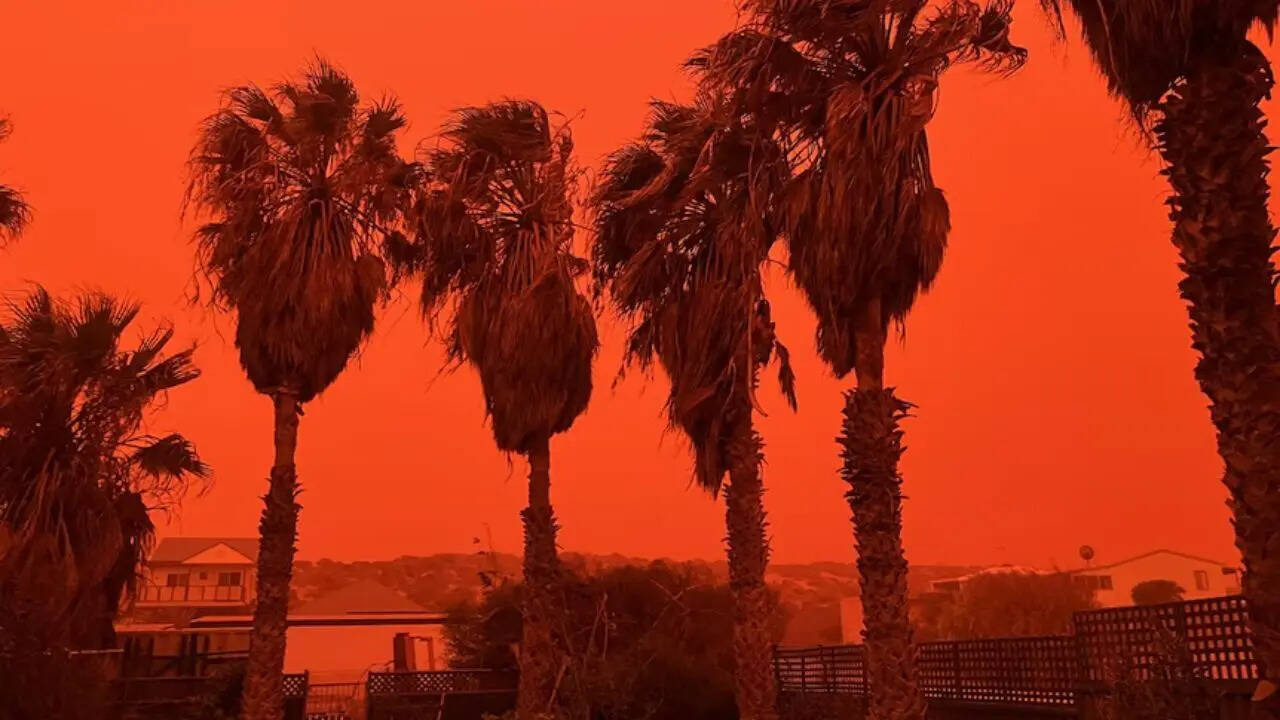
The sky didn’t turn gray. It didn't turn black. It turned a visceral, bruised crimson.
The Anatomy of a Blood Sky
If you were standing on a boat in the Exmouth Gulf that afternoon, you weren't looking at a sunset. You were looking at a physics experiment on a planetary scale. To understand why the world turned the color of an open wound, you have to look at Rayleigh scattering. Usually, the atmosphere scatters shorter blue wavelengths of light, which is why we have a blue sky. But when the air is suddenly choked with particles—massive, dense grains of iron-rich sand—the blue is suffocated. Only the longest wavelengths, the deep reds and oranges, can fight their way through the haze.
Narelle was the engine. The Pilbara was the fuel.
The cyclone’s internal winds, screaming at over 200 kilometers per hour, acted like a giant centrifuge. It sucked up thousands of tons of topsoil, lofting it kilometers into the troposphere. This wasn't a localized "dust devil." This was a wall of earth five kilometers high and hundreds of kilometers wide, marching toward the ocean. When that wall met the moisture of the storm’s outer bands, the light began to die.
The Human Toll of an Alien Horizon
For the miners and deckhands in the path of the plume, the shift in reality was instantaneous. One minute, the Indian Ocean was a brilliant turquoise. The next, the horizon vanished. It wasn't just dark; it was dense. The air felt thick enough to chew. Men on offshore oil rigs described it like being inside a jar of paprika.
Imagine the confusion of a pilot caught in that. For a brief, terrifying window, every instrument and every eyeball on the coast was blinded. The dust wasn't just a visual nuisance. It was an abrasive. It was a fine-grit sandpaper for every engine, every lung, every delicate sensor in its path. Those on the ground didn't just see the storm; they heard it. It wasn't the roar of wind. It was the hiss of a trillion particles of rock sandblasting the world.
The Physics of the Red Light District
The eerie crimson glow that day was a result of a rare atmospheric double-act. To the west, the sun was low. To the east, the cyclone’s dust was a physical barrier. As the sun’s rays hit the dust wall, they were filtered. But it wasn't just the iron in the dust. The moisture in Narelle’s storm clouds acted as a lens.
Water droplets and dust particles together created a specific kind of light scattering called Mie scattering. While Rayleigh scattering handles the blue of a clear day, Mie scattering happens when particles are roughly the same size as the wavelength of light. It’s what makes clouds white and, in this case, what made the dust wall look like a solid, glowing brick of neon blood.
The Aftermath of the Red Dust
When the wind finally subsided and Narelle continued its path south, the world was different. The red didn't just wash away. It stained everything it touched. In coastal towns like Onslow and Exmouth, the white of the buildings had been replaced by a pale, rusty pink. The decks of ships were caked in a fine, metallic silt.
The event remains a legend among the people of the Pilbara, not because of the cyclone's wind, but because of the day the air became earth. It was a reminder of how fragile our atmosphere really is—a thin, blue veil that can be stripped away in an afternoon by the right combination of low pressure and ancient, iron-rich sand.
The blood-red sky of Cyclone Narelle wasn't an omen. It was a physics lesson. It was a testament to the power of a continent that is still, after all these eons, essentially a giant, rusted rock. The silence that followed was even heavier than the coffee that morning. The world felt newer, cleaner, and yet somehow more dangerous, as if the desert had reminded everyone that it could take the sky whenever it felt like it.
On a clear day in Western Australia now, you look up and see the blue and you think it’s permanent. But the people who were there in January 2013 know better. They know the red is always just a few hundred knots of wind away.