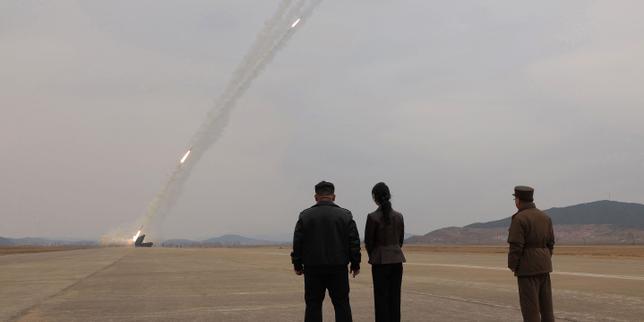
Kim Jong-un is no longer just playing with fire for domestic applause. The recent supervision of a 240mm multiple rocket launcher system (MLRS) test in North Korea signals a pivot from mere saber-rattling to a calculated entry into the global arms trade. While international headlines focused on the "deadly" nature of the hardware, the real story lies in the industrial refinement of these systems. Pyongyang is currently fine-tuning these weapons not just to level Seoul, but to provide a high-volume, low-cost alternative to Russian and Iranian systems currently saturating modern conflict zones.
This isn't about a single test. It is about the mass production of a specific caliber of violence. The 240mm rocket system is a workhorse. It lacks the prestige of an Intercontinental Ballistic Missile (ICBM), yet it possesses a terrifying utility in prolonged ground wars. By integrating "maneuverability" and "concentrated firing" capabilities, as state media recently boasted, the North is addressing the specific demands of 21st-century trench and urban warfare. They are building a product for a buyer's market.
The Engineering of Mass Destruction
To understand why this specific test matters, one must look at the technical shift from "dumb" rockets to guided precision. Historically, North Korean artillery was a numbers game. You fired a thousand shells and hoped a hundred hit something important. That is changing.
The recent tests highlighted a new "substitution" of components and a focus on "controllable" shells. In plain English, Pyongyang is trying to retrofit its massive stockpiles with basic guidance systems. They are not using high-end GPS—which can be jammed—but rather simpler, grittier inertial navigation and perhaps localized satellite correction.
Why 240mm is the Sweet Spot
- Logistical Ease: Smaller than the massive 600mm "super-large" launchers, the 240mm units are easier to hide in the North’s vast network of underground tunnels.
- Production Speed: The factories mentioned in recent reports are not artisanal workshops. They are high-output industrial centers.
- Compatibility: This caliber is a standard that many Soviet-era client states still use, making it an easy "plug and play" export.
The move toward "maneuverability" indicates a shift in tactics. Static artillery is dead artillery in an age of counter-battery radar and suicide drones. By putting these launchers on highly mobile, locally produced chassis, the North is ensuring their survival long enough to fire a second volley. This is a practical evolution, born of watching how Russian batteries have struggled or succeeded in Eastern Europe.
The Kremlin Connection and the Ukraine Laboratory
We cannot ignore the timing. Since the summit between Kim Jong-un and Vladimir Putin, the frequency of these tests has aligned perfectly with Russia's dwindling artillery reserves. North Korea has become the back-office warehouse for the Kremlin’s war effort.
However, the relationship is reciprocal. Russia provides the raw telemetry and "combat feedback" that North Korean engineers could never get on a practice range. Every time a North Korean rocket is fired in a real-world conflict, the data flows back to Pyongyang. They are learning how their guidance systems handle Western electronic warfare. They are seeing how their fuzes perform in cold weather versus mud.
Ukraine is the testing ground for the North Korean arms catalog.
When Kim Jong-un calls these weapons "attractive," he is using the language of a salesman. He is telling the world—and specifically Moscow—that his hardware is reliable, available, and ready for shipment. This isn't just a threat to the South; it's a business pitch to any regime currently under Western sanctions.
The Fragmented Sanctions Shield
For decades, the global community relied on a unified front to keep North Korean tech in a box. That box is now shattered. With Russia holding a veto at the UN Security Council and openly flaunting its imports of North Korean munitions, the "maximum pressure" campaign has effectively collapsed.
The "why" behind the recent rocket tests is partially a celebration of this impunity. Kim Jong-un is showing that he can modernize his entire conventional force while the world watches, and there is very little anyone can do about it without risking a wider conflagration. The 240mm system is a "grey zone" weapon. It’s too small to trigger a nuclear-level response, but too large to ignore.
The Shell Game of Components
How does a country under total blockade suddenly find the chips and precision tools to upgrade its rockets? The answer is a sophisticated network of front companies and a "no-questions-asked" supply chain through shared borders.
- Dual-use technology: Smuggling civilian-grade sensors that are "good enough" for short-range rocket guidance.
- Reverse engineering: Taking captured Western tech provided by partners and stripping it for parts or design inspiration.
- Industrial Espionage: Digital theft of manufacturing processes that bypasses years of R&D.
The result is a hybrid weapon. It’s part Soviet legacy, part stolen Western tech, and entirely North Korean in its brutal simplicity.
Rethinking the Seoul Hostage Situation
For 70 years, the security of Seoul has been predicated on the idea that North Korean artillery was a "stationary" threat. If war broke out, the South and the U.S. would use air superiority to "pick off" the North’s guns.
The 240mm MLRS update throws a wrench in that plan. These new launchers are designed for "shoot and scoot" operations. By the time an F-35 is over the launch site, the truck is already deep inside a mountain. This increases the "lethality" Kim spoke of by ensuring the North can maintain a sustained barrage over days, rather than hours.
The psychological impact of "controllable" shells cannot be overstated. If Pyongyang can prove it can hit specific buildings in Seoul—rather than just the general metropolitan area—the deterrent math changes. It moves the needle from "mass casualty event" to "surgical decapitation capability."
The Manufacturing Renaissance
The most overlooked aspect of the recent state media coverage was the focus on the factories themselves. Kim wasn't just looking at the rockets; he was looking at the machines that make the rockets.
North Korea is undergoing a quiet industrial reorganization. They are moving away from centralized, massive complexes that are easy targets for "bunker buster" bombs. Instead, they are distributing production across smaller, specialized units. This makes the supply chain more resilient and harder to track via satellite.
This industrial push also serves a domestic purpose. It creates a narrative of "self-reliance" (Juche) that resonates with a population facing chronic shortages. In Kim’s world, a new rocket launcher is as much a symbol of economic success as a new housing project. It is the only industry where North Korea can genuinely claim to be a world leader: the production of cheap, reliable death.
The Intelligence Failure of Dismissal
There is a dangerous tendency among Western analysts to mock North Korean technology. We see a grainy video of a tractor pulling a rocket pod and we laugh. This is a mistake.
The 240mm system doesn't need to be better than the American HIMARS. It just needs to be "good enough" and available in quantities that overwhelm defenses. Quantity has a quality all its own. If North Korea can produce 10,000 guided 240mm rockets while the West struggles to ramp up production of its own high-end interceptors, the advantage shifts to the aggressor.
We are witnessing the birth of a "Second Tier" arms superpower. A nation that doesn't care about environmental standards, labor laws, or international treaties, focusing 100% of its national energy on the perfection of the artillery strike.
The Logistics of a New Cold War
As the West focuses on high-tech AI drones and cyber warfare, North Korea is doubling down on the "God of War": Artillery. The 240mm tests are a reminder that in a real-world clash, the side with the most steel in the air usually wins.
Pyongyang is now positioning itself as the primary armory for the anti-Western bloc. This isn't just about Kim Jong-un’s ego. It’s about creating an economic lifeline that is immune to banking sanctions. You can’t freeze a shipment of rocket motors when it’s traveling via rail through the Siberian wilderness.
The "attractiveness" of the weapon is its simplicity. It is easy to train on, easy to maintain, and devastatingly effective at clearing a path for an advancing army. By supervising these tests personally, Kim is signing his name to the quality control certificate. He is the CEO of a defense firm that is currently seeing record "interest" from abroad.
The world needs to stop looking at North Korean missile tests as cries for attention. They are product demonstrations. Every explosion in the Sea of Japan is a "Coming Soon" advertisement for a world that is becoming increasingly comfortable with the prospect of large-scale conventional war.
Identify the source of the thermal imaging sensors found in the 240mm guidance kits. That is where the next front of the sanctions war must begin.