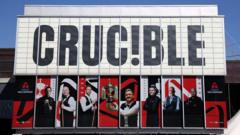
The ink is dry, the champagne is flat, and the "heritage" crowd is cheering. World Snooker Tour and Sheffield City Council have shaken hands on a deal to keep the World Championship at the Crucible Theatre until 2045. They are calling it a victory for tradition. I’m calling it a suicide note for the sport.
We are told that a revamped, shiny new theater will bridge the gap between 1977 and the mid-21st century. It won't. You can put a fresh coat of paint on a bunker, but you’re still living underground while the rest of the world is flying. By tethering the pinnacle of the game to a 980-seat room in South Yorkshire for the next two decades, the powers that be have effectively capped the sport’s growth at the ceiling of a mid-sized provincial playhouse.
The 980 Seat Ceiling
Let’s talk about the math that the "Save the Crucible" cult ignores. The Crucible’s capacity is its greatest liability. Even with a "revamp," the physical footprint of the site limits how many bodies you can get into those seats.
In a world where the Saudi Masters is offering million-pound prize pots and playing in venues that look like they belong in the year 3000, snooker is choosing to stay in a venue where the legroom is a human rights violation and the media facilities are cramped.
If you are a global sport, your flagship event should be a massive, soaring spectacle. It should be a Glastonbury on baize. Instead, snooker has opted for the intimacy of a library. Intimacy is a polite word for "unscalable." When you limit your live audience to under a thousand people, you aren't creating "prestige." You are creating an artificial bottleneck that keeps the sport’s revenue in the basement.
The Myth of the Sheffield Soul
The argument for staying is always emotional. "It’s the home of snooker." "The walls have ghosts." "The atmosphere is unique."
I have spent twenty years in and around professional sports management. I’ve seen this movie before. It’s the same logic that nearly killed top-flight English football before the Premier League era. It’s the belief that the dirt on the floor is part of the magic. It isn't. The magic is the $12k$ square millimeters of the cue ball hitting the object ball at exactly the right velocity. That magic works just as well in a 5,000-seat arena in Shanghai or a custom-built glass cube in Riyadh.
By prioritizing "soul" over "growth," the WST is telling every potential Gen-Z fan that this sport is a museum piece. It’s a heritage act. It’s something your grandad watched in 1985 while the country stopped to watch Dennis Taylor’s glasses. But here is the brutal truth: 1985 isn't coming back. The 18.5 million viewers who watched that final are now a statistical anomaly in a fragmented streaming market. To survive, snooker needs to be a product, not a memory.
The Opportunity Cost of Nostalgia
Think about what we are giving up for the sake of 2045.
- Global Expansion: We are turning our backs on the Far East and the Middle East for the most important month of the calendar.
- Production Value: A theater designed for plays cannot handle the riggings, 360-degree cameras, and light shows required for modern sports broadcasting.
- Player Earnings: Small venues mean small gate receipts. Small gate receipts mean the prize money is perpetually subsidized by sponsors or TV deals rather than a thriving, massive live event economy.
Imagine a scenario where the World Championship moved every three years. A "World Cup" model. One year in Sheffield (sure, give the traditionalists their fix), one year in Beijing, one year in London, one year in Doha. You create a global bidding war. You force cities to compete for the right to host. You inject billion-dollar infrastructure into the game.
Instead, we have a 20-year lease. A 20-year lease is a white flag. It is the sound of a sport settling for "fine" when it should be chasing "massive."
The "Revamp" Fallacy
The proposed "New Crucible" or the major renovation is a classic sunk-cost fallacy. We are going to spend tens of millions of pounds to try and make an old building act like a new one. In architecture, this is almost always a disaster. You end up with a compromise that pleases nobody—too modern for the purists, too small for the commercialists.
The "one-table setup" is the only thing the Crucible has going for it. It is, admittedly, the tensest environment in sports. But you can replicate that tension elsewhere. You don't need a specific set of bricks in South Yorkshire to create pressure. You need the stakes. The stakes are the $£500,000$ winner’s check. That check doesn't care about the postcode it’s signed in.
The Demographic Time Bomb
Look at the crowd in the Crucible. If you aren't seeing a lot of gray hair, you aren't looking. Snooker has a demographic problem. The average age of the viewer is climbing. By locking the tournament into a "prestige" theater for the next 21 years, you are doubling down on an aging audience.
Young fans want fan zones. They want interactive displays. They want loud, aggressive, high-production environments. They want the "PDC Darts" energy—which, by the way, snooker purists despise, even as the PDC eats snooker’s lunch in terms of cultural relevance in the UK.
You can’t have a fan zone in the middle of Sheffield’s Tudor Square that rivals the scale of a purpose-built sports complex. You just can’t. Space is a finite resource.
Realism over Romance
I understand why the players are divided. To Ronnie O’Sullivan, the Crucible is a place of torture and triumph. To the lower-ranked players, it’s the only place they feel like stars. But the players shouldn't be running the business strategy. They are athletes; their job is to play on the table, not to balance the books for the next three decades.
The WST should have walked away. They should have used the threat of leaving to secure a deal that allowed for a roving championship. They should have demanded a 10,000-seat arena. Instead, they took the safe bet. They took the "steady" option.
In the 21st-century sports economy, "steady" is just a slow-motion car crash. While other sports are reinventing their formats, chasing new markets, and building cathedrals of consumption, snooker is retreating into its shell.
We’ve traded the global potential of the sport for a comfortable seat in a familiar room. We haven't secured the future of the World Championship; we’ve just ensured its stagnation.
If you want to see the World Championship in 2045, you’ll know where to find it. It’ll be exactly where it was in 1977. And that is the biggest tragedy of all.
Stop pretending this is a win. It’s a surrender.