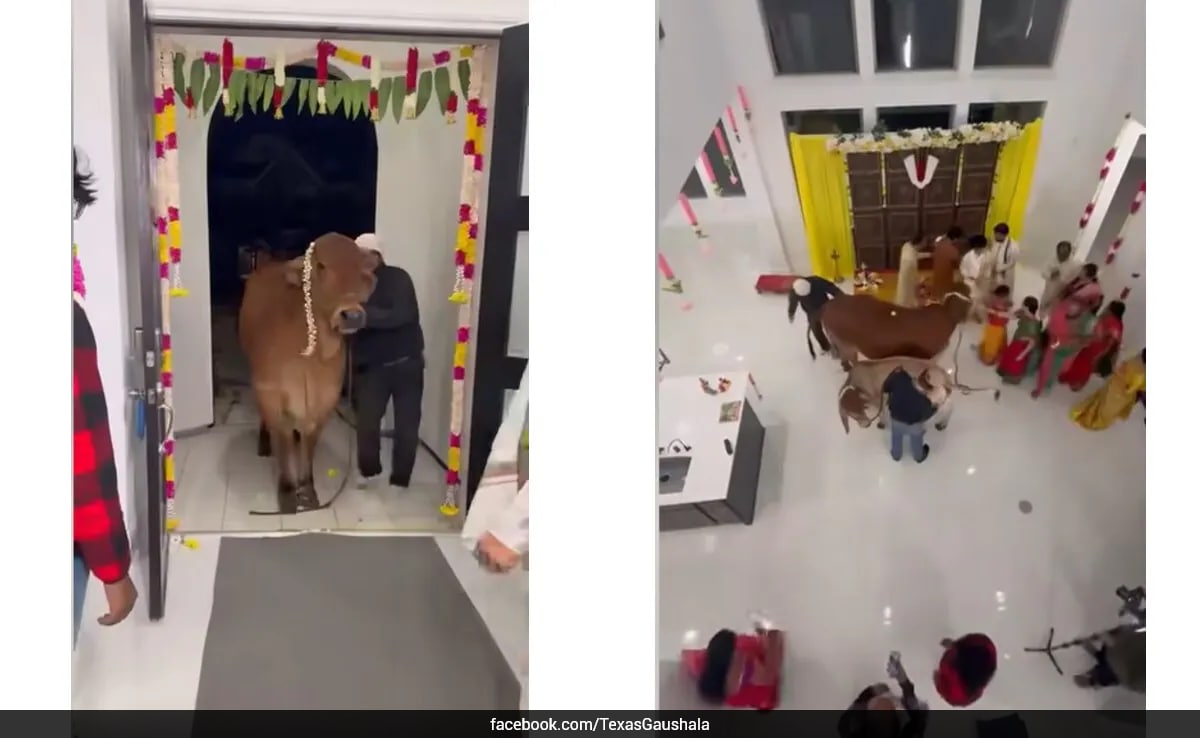
The floorboards of a modern Texas suburban home are usually designed to withstand nothing more strenuous than a spilled glass of Cabernet or the frantic scurrying of a Golden Retriever. They are not built for eighteen hundred pounds of muscle, bone, and ancient sanctity.
When a video surfaced recently of a black-and-white cow being led through the front door of a pristine, beige-walled home in a quiet Texas neighborhood, the internet did what it does best. It fractured. To some, it was a moment of profound spiritual beauty—a Griha Pravesh ceremony, an ancient Hindu housewarming ritual intended to invite prosperity and divine energy into a new space. To others, watching from behind glowing screens in the same zip code, it was a bizarre violation of HOA norms, a sanitation nightmare, or a puzzling display of "otherness" that didn't fit the local aesthetic.
But the cow doesn't care about property values. She walked across the hardwood with a slow, rhythmic thud, her tail swishing against the fresh paint, oblivious to the fact that she had just stepped into the center of a brewing cultural war.
The Weight of a Thousand Miles
Consider a family—let’s call them the Sharmas. They have spent a decade climbing the corporate ladder in Austin’s tech corridor. They have navigated visa renewals, the biting anxiety of green card backlogs, and the slow, often painful process of shedding parts of their past to fit into the sleek, glass-and-steel future of the American Dream.
When they finally sign the closing papers on a four-bedroom house with a two-car garage, they aren't just buying real estate. They are claiming a stake in the earth. To ground that stake, they reach back. Way back.
In the Vedic tradition, the cow is the Gaumata, the mother of all. Bringing her into a new home isn't a stunt. It is a purification. The logic is simple yet deep: if the most sacred, gentle creature in the universe blesses the threshold, the home is no longer just a box made of wood and drywall. It becomes a sanctuary.
But when that sanctuary is located in a cul-de-sac where the most radical thing anyone does is plant non-native hydrangeas, the friction is immediate. The "cow in the living room" ceases to be a metaphor for an ignored problem. It becomes a literal, breathing challenge to the unspoken rules of Texas suburbia.
The Great Suburban Filter
Texas prides itself on being a "big tent" state, a place where rugged individualism meets wide-open spaces. Yet, our suburbs often tell a different story. They are designed for a specific kind of harmony. Uniformity. The HOA manual is the modern book of Leviticus, dictating the height of the grass and the permissible shades of brown for a front door.
The backlash to the video wasn't just about the animal. It was about the disruption of a visual brand.
"Is that even legal?"
"The smell must be awful."
"Why can't they just use a statue?"
These questions, bubbling up in the comments sections of local news pages, aren't really seeking answers. They are expressions of discomfort. They represent the moment where the "melting pot" hits a temperature that feels a little too hot for comfort. We love the food. We love the tech jobs. We love the tax revenue. But are we ready for the 2,000-year-old ritual to take place next door?
The Logistics of the Divine
The reality of a bovine housewarming is far less chaotic than the imagination suggests. It is a highly choreographed dance. Professional cow handlers—yes, they exist in Texas, specializing in exactly this—ensure the animal is calm. They use specialized flooring protectors. They monitor the cow’s stress levels.
In many ways, the cow is treated with more dignity and care than the movers who hauled the sectional sofa in an hour earlier.
The ritual usually lasts about thirty minutes. The cow is offered grass and water. Prayers are chanted. Then, she is led back out to a waiting trailer, leaving behind nothing but a few stray hairs and a sense of cosmic alignment.
The invisible stakes here aren't about sanitation. Texas is a state defined by cattle. We wear their hides on our feet and put their heads on our walls. We celebrate the "cowboy" as the ultimate archetype of freedom. There is a profound irony in a Texan feeling "threatened" by a cow inside a house when that same Texan likely has a steer’s skull mounted over their fireplace.
The difference, it seems, is the state of the animal. A dead cow is decoration. A living cow is a statement of faith.
The Cost of Fitting In
There is a quiet, heavy price to pay for the "American Dream." It is the price of sanitization. We are taught that to belong, we must make our private lives look like everyone else’s public lives. We trim the edges of our heritages until they fit neatly into the suburban mold.
For the family in that video, bringing the cow inside was an act of bravery. It was a refusal to be sanitized. They knew the neighbors might look through the blinds. They knew someone might record it and post it with a snarky caption. They did it anyway.
Imagine the tension in the air. The smell of incense mingling with the scent of a farm animal. The high-pitched ring of a prayer bell echoing off the vaulted ceilings. Outside, the world is all Teslas and manicured lawns. Inside, time has collapsed.
This is the friction of the modern South. It is no longer just a black-and-white conversation; it is a global one. The suburbs are becoming the frontline of a new kind of integration—one that isn't just about who lives next door, but how they live, and what they carry with them from across the oceans.
The Invisible Border
We often talk about borders as physical lines in the sand, guarded by fences and paperwork. But the most difficult borders to cross are the ones that exist between a driveway and a front door.
When we see a ritual like this and react with mockery or anger, we are essentially saying that the "Texas" we love has no room for the very things that make it vibrant. We are choosing a sterile, beige existence over a textured, lived-in reality.
A house is just a structure. It’s the things we do inside that turn it into a home. For some, that’s a housewarming party with craft beer and a charcuterie board. For others, it’s a sacred animal walking through the foyer to ensure the ancestors are happy.
Neither is "wrong." But only one of them requires the courage to be seen as different.
The video eventually faded from the news cycle, replaced by the next viral outrage. The cow went back to her pasture. The family unpacked their boxes. The neighbors likely went back to their routines, perhaps glancing at the house next door with a lingering sense of mystery.
Next time you drive through a suburban neighborhood, look at the identical houses. The identical lawns. The identical cars. It feels safe. It feels predictable. But somewhere behind one of those doors, there might just be the faint, lingering scent of hay and the memory of a heavy hoof hitting a wooden floor, a reminder that the world is much older, much stranger, and much more beautiful than an HOA agreement allows.
The cow has left the building, but the question she left behind remains: are we building communities, or are we just building fences?