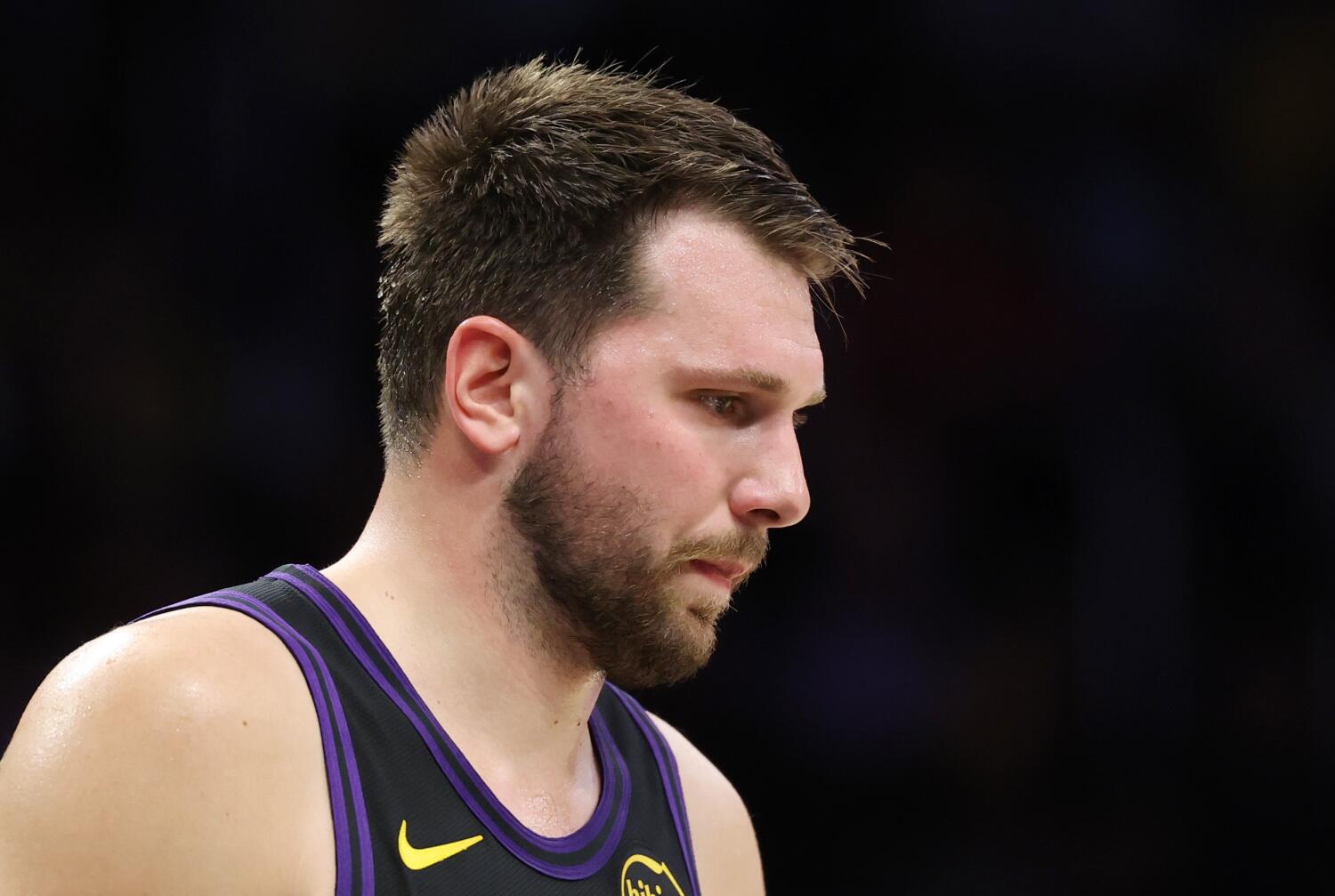
The bright lights of the American Airlines Center are designed to erase the outside world. When the buzzer sounds and the hardwood vibrates under the weight of ten elite athletes, the roar of thirty thousand fans creates a vacuum. Inside that vacuum, Luka Doncic is a god of geometry. He sees passing lanes before they exist. He manipulates defenders like a puppeteer. Every step-back three-point shot is a calculated defiance of physics. But when the lights go down and the jersey comes off, the geometry of his life becomes far more jagged, far less predictable, and infinitely more painful.
The scoreboard doesn't track the stats that matter now. There are no triple-doubles in a Slovenian family court. There is only the cold, bureaucratic reality of a custody battle that has stretched across an ocean, pitting the most famous face in Dallas against the mother of his children in the quiet streets of Ljubljana.
The Geography of a Fracture
Slovenia is a country of emerald rivers and silent mountains. It is a place where privacy is a cultural currency. For years, it served as the sanctuary for Luka and his former fiancée. It was the "home" that existed away from the glitz of the NBA—a place where he wasn't a superstar, but a father. That sanctuary has dissolved.
The transition from a shared life to a legal dispute is rarely a sudden explosion. It is a slow erosion. One day you are choosing nursery colors; the next, you are reading affidavits translated from a language that used to sound like love but now feels like a weapon. The dispute centers on their two young daughters. In the eyes of the law, these children are "subjects" of a filing. To a father who spends half his year living out of suitcases in hotels from Boston to Los Angeles, they are the only tethers to a reality that isn't made of highlights and endorsement deals.
Consider the physical distance. Dallas to Ljubljana is over 5,000 miles. That is not just a flight; it is a chasm. When a relationship ends at this level of fame, the logistical hurdles are staggering. Every visitation becomes a diplomatic negotiation. Every holiday is a chess match. For a professional athlete, time is the one resource that cannot be bought, yet it is the very thing being litigated in a courtroom half a world away.
The Invisible Weight of the Jersey
We often forget that the people we watch on television are carrying ghosts. We see a missed free throw and blame "fatigue" or "lack of focus." We rarely consider that the man at the line might have spent the previous four hours on a grainy FaceTime call, trying to explain to a toddler why he isn't there to tuck them in.
The psychological toll of a custody battle is a specialized kind of exhaustion. It is a background radiation that colors every interaction. For Doncic, the stakes are uniquely high. He is the centerpiece of a multi-billion dollar franchise. The hopes of a city rest on his shoulders. But the weight of the Mavericks' postseason chances is nothing compared to the weight of a legal document that dictates how many days a year he gets to hear his daughters laugh in person.
In these rooms—the ones with wood-paneled walls and judges who don't care about PER or True Shooting percentages—fame is often a liability. The court looks at a globetrotting lifestyle and sees instability. They look at the wealth and see a tool, not a solution. The very things that make Luka a hero in Texas make him a complicated case study in Slovenia.
The Human Cost of High Stakes
Imagine, for a moment, a hypothetical father in a similar position. We’ll call him Marko. Marko works a high-pressure job that requires him to be in another country for eight months of the year. He provides everything. He builds a life of luxury for his children. But when the relationship with their mother breaks, his primary virtue—his career—becomes his primary flaw. The more he succeeds, the further he has to be from the people he is succeeding for.
This is the paradox of the elite athlete. They sacrifice their youth and their bodies to secure their family's future, only to find that the sacrifice has cost them their place within that family.
The former fiancée, living in the quiet reality of their home country, holds the home-field advantage. In international custody disputes, the "habitual residence" of the children is the ultimate prize. If the children are settled, enrolled in school, and surrounded by extended family in Slovenia, the law is notoriously hesitant to uproot them. Even for a man who can move a basketball through a crowd with surgical precision, moving the needle of international family law is a gargantuan task.
The Silence Behind the Scenes
Unlike the public spats of Hollywood, this battle has been characterized by a heavy, almost suffocating silence. There are no leaked videos. There are no social media tirades. This isn't just about PR; it’s about protection. In the Balkan culture, family matters are handled behind closed doors, even when those doors are being kicked in by legal teams.
But the silence shouldn't be mistaken for peace.
Behind the legal jargon of "joint legal custody" and "visitation schedules" lies a series of agonizing compromises. Who gets the girls for Christmas? Does the Slovenian school system allow for extended trips to the United States during the NBA playoffs? What happens if an injury occurs? These aren't just questions for a lawyer; they are the cracks in a man's foundation.
The fans in Dallas see the scowl on the court. they see the way he barks at referees when a call goes against him. They see a "competitor." But perhaps they are seeing a man who is tired of losing things he cannot control. On the court, he can fight back. He can hunt a mismatch. He can force his will onto the game. In the custody battle, he is just another petitioner, waiting for a clerk to call his name.
The Unseen Mirror
This story resonates because it is a magnified version of a struggle millions of people face. The heartbreak of a failed union is universal, but the added layer of geographical separation adds a cruelty that is hard to articulate. We live in a world that tells us we can have it all—the career, the global impact, the perfect family. But the reality is that everything has a price.
Luka Doncic is paying that price in real-time.
He is navigating the most productive years of his professional life while simultaneously navigating the most destructive years of his personal life. It is a tightrope walk over a jagged landscape. To remain the "Wonder Boy" of basketball while your heart is being dissected in a European courtroom requires a level of compartmentalization that is almost superhuman.
There is no "winning" a custody battle. There is only a series of managed losses. You lose time. You lose the spontaneity of fatherhood. You lose the version of the future you spent years building in your head. Even if the court grants him everything he asks for, the scars of the process remain.
The next time you see Luka drive to the hoop, or look up at the rafters with a frustrated sigh, remember that the game on the floor is the easy part. The real game is being played in the quiet moments between the whistles, in the long flights over the Atlantic, and in the silence of a house that is too big for one person.
The stadium lights will eventually go out. The fans will go home. The jerseys will be retired. But the father remains, still searching for a way to bridge the 5,000 miles between who he is to the world and who he needs to be for his daughters.
He stands at the free-throw line. The ball bounces three times. He breathes. He shoots. The ball sails through the air, a perfect arc toward a familiar goal. But his eyes are already somewhere else, looking past the rim, past the crowd, toward a small house in Slovenia where the only two people who don't care about his stats are waiting for the phone to ring.


