The tea in the samovar was still bubbling when the air changed.
In Tehran, the air is often a heavy, tactile thing—a mix of high-altitude thinness and the persistent ghost of exhaust from millions of Paykans and Peugeots. But this was different. It wasn't the slow crawl of smog. It was a sudden, violent displacement. A sound that didn't just hit the ears but vibrated the marrow of the teeth.
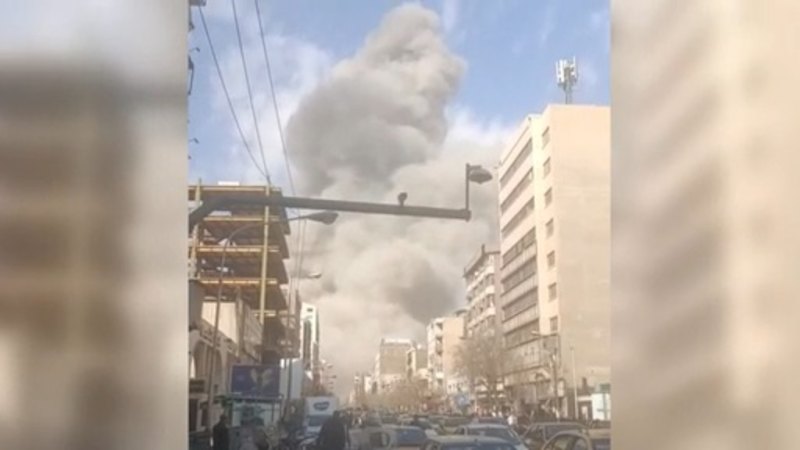
Fatemeh, a grandmother whose life has been measured in the shifting borders of her neighborhood near Vali-e-Asr Avenue, didn’t look at the news first. She looked at the glass. The thin panes of her balcony buzzed like trapped hornets. Then came the plume. It rose over the city’s jagged skyline, a bruised purple and charcoal column that seemed to mock the Alborz mountains standing silent in the distance.
This is how history arrives in the 21st century: not as a declared war on a parchment scroll, but as a notification on a cracked smartphone screen while the smell of burning rubber drifts through a kitchen window.
The Architecture of Anxiety
Living in a city under the shadow of strikes is an exercise in cognitive dissonance. On one side of the street, a young man in a North Face knock-off jacket is trying to download a VPN update so he can post a video of the smoke. On the other, a shopkeeper is stubbornly sweeping the dust from his stoop, as if the rhythmic motion of the broom could push back the geopolitical tides.
The facts are stark, cold, and stripped of the heat that actually radiates from the blast site. The reports will tell you that projectiles impacted specific coordinates. They will mention "strategic assets" and "minimal civilian interference." They will use terms like kinetic energy and intercepted trajectories.
But these terms are a linguistic veil.
They do not account for the way a city holds its breath. When a strike hits a major metropolitan artery like a Tehran avenue, the "asset" being targeted isn't just a building or a warehouse. The target is the psychic floor of the population. Every boom is a question mark placed at the end of a family’s plans for the weekend.
Do we buy the groceries for the month? Do we fix the leaking pipe? Do we keep the children home from school?
The Invisible Stakes of a Visible Fire
We often talk about "precision" in modern conflict. We are told that the math is perfect.
$$F = ma$$
The physics of a strike are indeed precise. The velocity of the incoming craft, the chemical yield of the payload, the structural integrity of the reinforced concrete—these are variables that can be solved on a chalkboard. However, there is no formula for the ripple effect of a smoke plume over a city of nearly nine million people.
Consider the "invisible stakes." When the smoke rises, the currency falters. Not just the Rial, but the currency of trust. People look at the sky and then they look at each other, wondering who knew this was coming and who is lying about what happens next. The "plume" isn't just carbon and debris; it is a signal fire that alerts every citizen that the boundaries of their private lives have been breached by the whims of men in distant rooms.
The competitor’s headline says there is "smoke on the avenue." That is a geographical fact. But the reality is that the smoke is in the lungs of the collective. It’s the bitter taste of uncertainty that lingers long after the fire trucks have gone silent.
A City of Layers
Tehran is not a flat map. It is a vertical stack of histories. There are the ancient foundations, the revolutionary echoes, and the modern, glass-fronted aspirations of a tech-savvy youth. When a strike occurs, it tears through all these layers at once.
Imagine a student sitting in a cafe, working on a coding project. He is listening to lo-fi beats, trying to forget the sanctions, trying to forget the tension. Then, the windows rattle. The music doesn't stop, but it becomes irrelevant. He goes to the door. He sees the black smear against the blue sky.
In that moment, he isn't a coder. He isn't a "demographic" or a "civilian." He is a human being witnessing the fragility of the grid. He realizes that the digital world he inhabits is powered by cables that run under streets that can be opened up by a single command from a thousand miles away.
The vulnerability is total.
The Persistence of the Mundane
The most jarring thing about a city under fire isn't the destruction. It is the survival of the ordinary.
Two blocks away from the rising smoke, a woman is still haggling over the price of saffron. A taxi driver is still honking at a delivery bike. Life in Tehran has a terrifyingly high boiling point. People have learned to internalize the crisis, to tuck it away in a pocket next to their keys.
But don't mistake this for indifference. It is a defense mechanism. If they stop to acknowledge the full weight of that smoke plume, the machinery of the city would grind to a halt. They keep moving because the alternative is a paralysis that no one can afford.
The strikes are described by analysts as "surgical." It’s a medical metaphor designed to make us feel that the violence is curative. But a surgeon operates with the consent of the patient and the goal of healing. Here, the "patient" is a city that never asked to be on the table. The "scars" are left on the skyline and in the sleep cycles of the children who now jump at the sound of a heavy door slamming.
The Geometry of the Plume
If you look at the photos of the smoke, you see a specific shape. It’s a mushrooming, chaotic expansion. It follows the laws of fluid dynamics, rising because it is hotter than the surrounding air.
Eventually, the smoke thins. It disperses. It becomes a haze that covers the entire city, making the sun look like a pale, sickly coin. This is the stage where the news cameras usually turn off. Once the fire is out and the plume is gone, the "story" is over for the outside world.
For the people on the avenue, this is when the real story begins.
The cleanup is the easy part. You can haul away the charred metal. You can repave the asphalt. What you cannot do is un-ring the bell. You cannot remove the memory of the vibration from the grandmother's balcony glass.
The strikes create a new "normal" that is anything but. It is a state of constant, low-grade vibration. It’s the feeling of waiting for the second shoe to drop, even when you aren't sure there is a second shoe.
We are told that these events are about "deterrence" and "projections of power." But power is a funny thing. True power is the ability to provide a night of sleep where the only thing that wakes a person is the sun. By that metric, every plume of smoke is an admission of failure. It is a sign that the dialogue of diplomacy has been replaced by the monologue of the explosion.
Fatemeh eventually turned away from her balcony. She went back to the samovar. She poured a glass of tea, the amber liquid glowing in the dim light of her kitchen. Her hand shook, just a little, but she didn't spill a drop.
Outside, the smoke continued to climb, a dark ladder leaning against nothing.
The city waited. The mountains watched. The tea grew cold.