Li Wei stands on a patch of scrubland in the Northern New Territories, his back to the gleaming skyline of Shenzhen just across the Sham Chun River. He is twenty-two, a doctoral candidate in biotechnology, and he is holding a blueprint that feels increasingly like a work of historical fiction. For three years, he has heard about the "Northern Metropolis," a sprawling urban ambition designed to house 2.5 million people and, more importantly, to act as the beating heart of Hong Kong’s new innovation economy.
Specifically, he is looking for the "University Town."
The plan is elegant on paper. It envisions sixty hectares of high-tech campuses, shared laboratories, and vibrant student housing where the brightest minds from the city’s top-tier universities will rub shoulders with industry titans. It is supposed to be Hong Kong’s answer to Silicon Valley—a place where ideas transform into IPOs before the morning coffee gets cold. But as Li looks at the horizon, he sees only the slow, rhythmic movement of a solitary excavator and a lot of mud.
The silence here is expensive.
The Velocity of Ambition
In the boardrooms of Central, time is measured in milliseconds. In the halls of government, it is measured in decades. This friction is at the core of the growing anxiety surrounding the Northern Metropolis. While the government insists the project is moving according to a "compressed" schedule, those on the ground—the academics, the developers, and the students—worry that Hong Kong is moving at a local train’s pace in a world of high-speed rail.
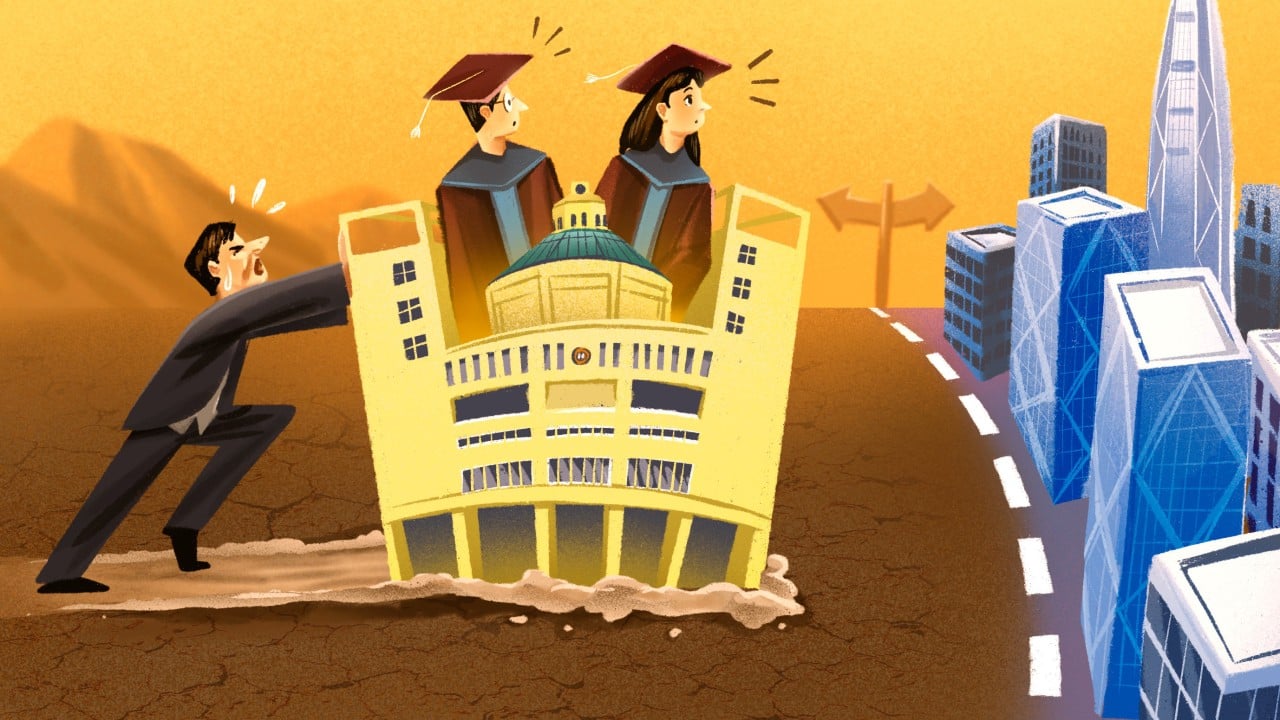
Consider the stakes. Hong Kong is currently caught in a structural pincer movement. Its traditional pillars—finance and logistics—are facing fierce global headwinds. To survive, the city must pivot to technology. The University Town isn't just a collection of classrooms; it is the engine room for this entire economic transition. If the engine isn't built in time, the ship stays adrift.
The government’s most recent updates suggest that the first batch of land for the university hub won't be ready for "disposition" until 2026 or 2027. To a bureaucrat, that sounds like tomorrow. To a tech startup, that is an eternity. By 2027, an entire generation of graduates will have already moved to Singapore, London, or across the border to Shenzhen, where the "Iterate Fast" mantra isn't a slogan, but a requirement for breathing.
The Shared Lab Dilemma
One of the more innovative—and controversial—aspects of the plan is the push for "shared facilities." Instead of each university building its own massive, independent campus, the government wants institutions to share high-end laboratories, libraries, and sports complexes.
It makes sense from a land-premium perspective. Land in Hong Kong is more precious than gold, and the government wants to squeeze every possible square foot of utility out of the Northern Metropolis. But academia is a world of fierce territoriality and specific needs.
Imagine a hypothetical researcher named Dr. Aris. She specializes in cryogenic electron microscopy. Her equipment is sensitive enough to be disrupted by a heavy truck driving a block away. In a traditional campus, she controls her environment. In a "shared" University Town, she has to negotiate floor vibration specs with a neighboring department that might be doing heavy-duty robotics testing.
The fear is that by trying to make the space "efficient," the planners might make it unusable for the very elite researchers they are trying to attract. When you move too slowly on the infrastructure, you lose the chance to ask these experts what they actually need. You end up building a "smart city" that is remarkably dim-witted in its execution.
The Shenzhen Shadow
The most stinging critique of the current pace comes from a simple glance northward. From the muddy fields of the New Territories, you can see the lights of the Hetao Shenzhen-Hong Kong Science and Technology Innovation Cooperation Zone.
On the Shenzhen side, buildings seem to sprout overnight. The legislative frameworks are adjusted with a surgical, if sometimes ruthless, efficiency. They are not waiting for the "perfect" plan; they are building the "good enough" plan and fixing it while the paint dries.
Hong Kong, by contrast, is a city of consultations, environmental impact assessments, and multi-stage funding approvals. These are the hallmarks of a mature, rule-of-law society, and they are vital. But there is a point where due process becomes a suicide pact. If the University Town takes fifteen years to reach critical mass, the industries it was meant to birth will have already matured elsewhere.
We aren't just competing for capital anymore. We are competing for the "presence" of people like Li Wei. If he can get a state-of-the-art lab and a subsidized apartment in Shenzhen by next year, why would he wait five years for a "maybe" in Hong Kong?
The Cost of Caution
Critics within the Legislative Council have begun to use a specific word: "fragmented." They see a plan that doles out land in tiny parcels, hoping that a cohesive ecosystem will somehow emerge from the chaos.
But ecosystems don't work like that. A forest doesn't grow if you plant one tree every three years and hope they eventually talk to each other. You need a canopy. You need a floor. You need everything to happen at once to create the microclimate required for life.
The Northern Metropolis is currently a collection of projects rather than a singular vision. There is the San Tin Technopole, the University Town, the various residential towers—all moving at different speeds, overseen by different departments, funded through different cycles.
The human element gets lost in this fragmentation. A student living in a new housing estate in 2028 might find that their campus won't be finished until 2031. For three years, they are living in a construction zone with no grocery stores, no "third spaces" for intellectual exchange, and a two-hour commute to the old campus in Kowloon. That isn't a "metropolis." It’s a dormitory in a wasteland.
A Ghost of Potential
There is a specific kind of melancholy found in an empty construction site. It represents a "future-past"—a vision of what could be that is already starting to look dated because it took too long to arrive.
The University Town has the potential to be the most exciting chapter in Hong Kong’s post-industrial history. It could be the place where the city finally breaks its addiction to real estate speculation and starts betting on brains. It could be the bridge that finally connects the two sides of the river in a way that benefits everyone.
But "potential" is a word used for things that haven't happened yet.
Li Wei folds his blueprint. He is thinking about an offer he received from a lab in Nanshan. It’s a fifteen-minute subway ride from where he stands, but in terms of momentum, it feels like it’s on another planet. He looks at the excavator again. It has stopped moving. The operator is taking a break, sitting in the shade of the giant yellow arm, staring at his phone.
The sun sets over the marshlands, casting long, distorted shadows of cranes that aren't currently lifting anything. The birds in the nearby nature reserve are loud, reclaiming the space that the humans haven't quite managed to take over yet. In the distance, the lights of Shenzhen flicker on, one by one, a thousand tiny signals of a future that isn't waiting for permission to begin.
Hong Kong’s new heart is waiting for a beat. The longer it waits, the harder it will be to start.
Li Wei turns away from the river and starts the long walk back to the station. He doesn't look back. He can't afford to wait for the concrete to dry. No one who actually matters can.